Gen Z India Rural Urban Digital Divide Class Privilege
Indian Express
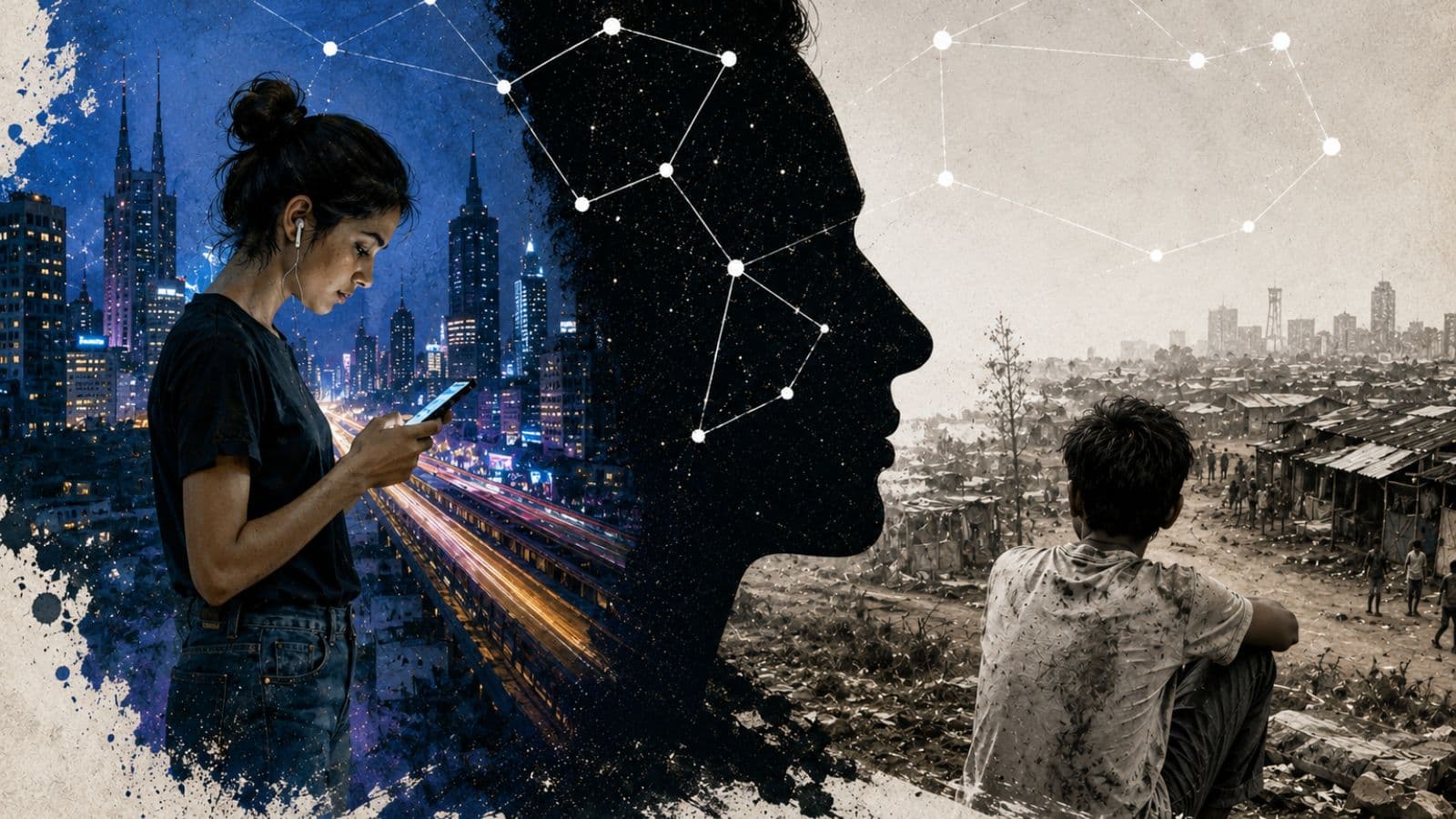
I must have been in Class Three when a teacher first showed us a picture of the constellations. The white dots seemed scattered across the two-page spread of a navy-blue sky until the teacher had...
I must have been in Class Three when a teacher first showed us a picture of the constellations. The white dots seemed scattered across the two-page spread of a navy-blue sky until the teacher had joined a few with neat lines and declared they formed a bear, a hunter, a plough. The class was delighted. Then someone asked, in utter confusion, where the line actually was and why they had never seen it before.
The teacher smiled. The lines, she said, were our imagination.
A few years ago, in a hamlet tucked into the Himalayan foothills, I spent an evening talking to a group of young girls. Their mornings began before sunrise. They fetched water, gathered fodder, prepared meals, and moved through a rhythm of life that had barely changed across generations. At one point, I asked if they knew about some of the internet slang that now appears in every interview segment about “today’s youth.” They looked puzzled. One girl, with some access to a phone, thought for a moment before saying rather meekly, “That is a different type of world. It’s the city people’s world.”
A cursory glance at the internet tabloids, and one would find countless articles every day explaining what Gen Z wants, how Gen Z dates, why Gen Z quits jobs, analysing the minutest crevices of the life of “today’s youth”. Yet the young person being described is almost always the same. She usually has an urban orientation, is chronically online and digitally savvy, is cushioned by disposable income and most likely speaks in a newly devised social media grammar that incites both intrigue and disgust. What about the shepherd beneath a Himalayan glacier, the girl in a remote Odisha village supporting her family, the unemployed young man in a Delhi slum? They were all born after 1997 too. Are they Gen Z too? Or has the label quietly stopped including them?
Rather than being an inevitable sociological category, “Gen Z” emerged from American market research. Advertising firms needed a convenient label for the cohort that followed Millennials, one that could segment audiences and forecast purchasing habits. The label was then adopted far beyond the world of advertising, gradually acquiring the authority of common sense. This echoes philosopher Ian Hacking’s idea of “making up people”: classifications do not merely describe people; they can shape how people come to understand themselves. The point is not that Gen Z is fictional, but that the boundaries of the category are drawn by people, and are therefore never neutral.
Like many imported ideas, “Gen Z” travelled well and arrived in a deeply divided and stratified society like India. The intrigue and brouhaha around their seemingly unique behaviour followed suit. But the assumption beneath most conversations about Gen Z—that a generation shares broadly similar experiences—begins to unravel in India.
Among the most common observations about Gen Z in India is that they are chronically online. But how true is that in a country where rural internet penetration stands at a meagre 41.72%, against an urban rate exceeding 110%? A label built around digital nativeness excludes millions of young rural Indians before it has even framed its first question.
Language sharpens that divide further still. The young Indian at the centre of every trend piece is almost invariably an English-language speaker, a demographic that constitutes barely 10 to 12 percent of the country. Increasingly, this narrow slice comes to stand in for the whole.
Caste further compounds this phenomenon. Historically marginalized communities like the SC, ST, and OBC together make up approximately 75% of India’s population, the overwhelming majority of whom have no presence in the media ecosystems where Gen Z stereotypes are manufactured and circulated.
The “lazy, entitled” Gen Z being complained about by CEOs on LinkedIn represents a thin urban, privileged sliver. For them, the luxury of being perceived as disengaged is itself a class privilege. Everyone else is too busy working to make it into the discourse at all.
The result is a biased feedback loop. When opinion-influencers, policymakers, brands and media go looking for “the youth,” they find precisely the young person their instruments were designed to find. She becomes the face of a generation not because she represents the majority, but because she is the most legible. A shape is drawn, again and again, from the same vantage point. Everyone beyond its edges slowly becomes harder to see.
The stars were always there. The lines were ours.
Perhaps that is the question worth asking each time we invoke Gen Z in India: are we discovering a constellation, or are we drawing one? And as we admire the peculiarities of the shape, which stars have we stopped looking at altogether?
The article is co-authored by Vagmi Joshi (Development practitioner, published writer and author of the book ‘Babaal Talai) and Charu Pawar (Development practitioner, Lady Shri Ram College for Women alumna)