Raul Jimenez Nearly Died 2020 Now Leads Mexico World Cup Dream
Indian Express
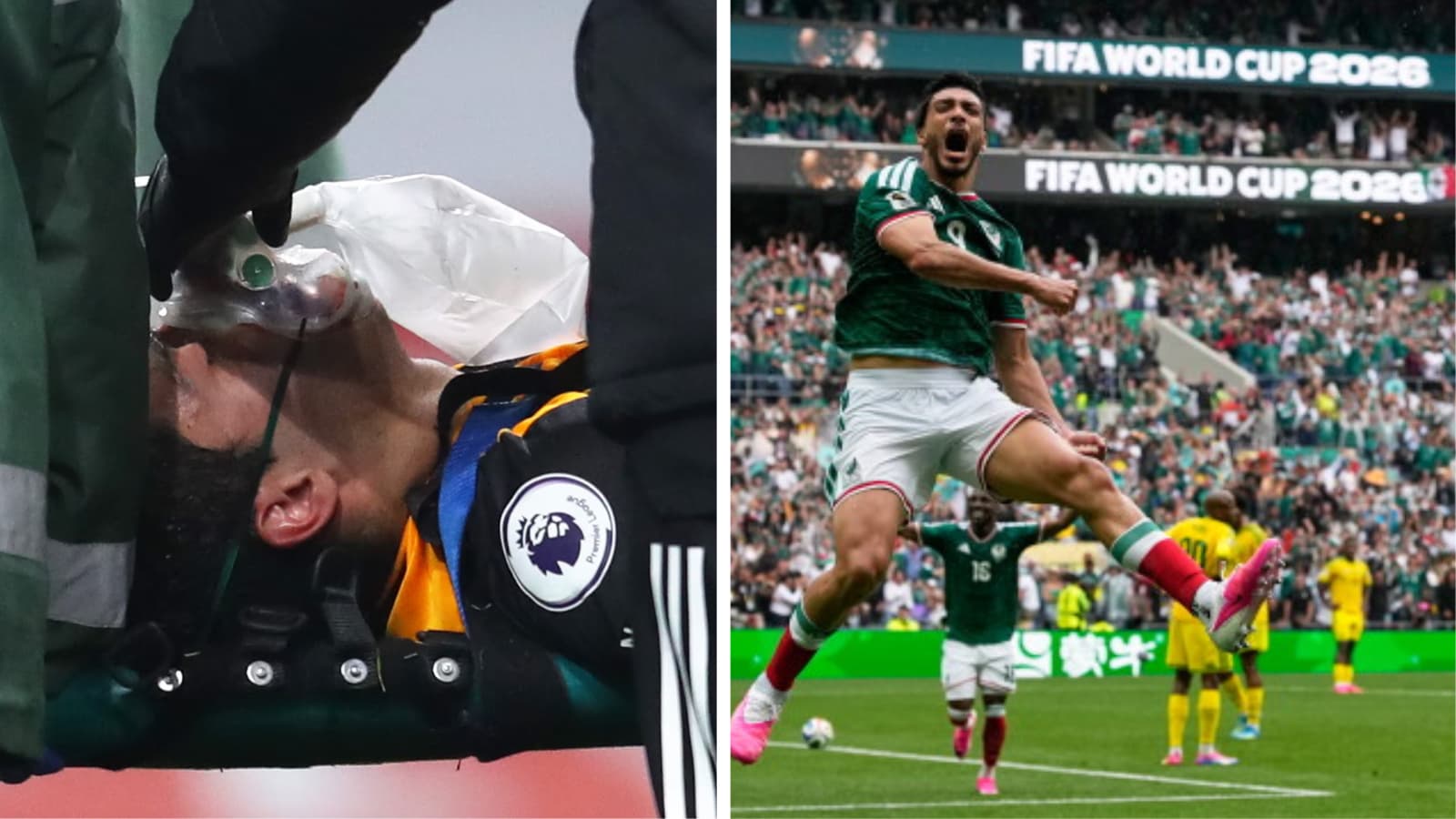
The image has become so familiar that it is easy to forget why it exists. Every time Raul Jimenez walks onto a football pitch, the black protective headband accompanies him
. It is no longer merely equipment. It is a reminder – of a collision that nearly killed him, of a career that almost ended, and of a second chance that has turned him into something bigger than Mexico’s No. 9.
“I was almost losing everything, even my life,” Jimenez told The Times. “So I’m trying to enjoy football as much as I can. Everything, not just football, everything I try to enjoy more.”
It is a remarkable perspective for someone carrying the expectations of a nation that has spent decades trying to escape one recurring World Cup fate.
On November 29, 2020, a routine corner at the Emirates Stadium changed Jimenez’s life. A clash of heads with Arsenal defender David Luiz left him unconscious. He suffered a fractured skull, underwent emergency surgery and spent days in hospital. The injury threatened his life, let alone his career.
“The doctors told me it was like a miracle to be there,” Jiménez recalled months later. “The skull fracture… there was a little bit of bleeding inside the brain. It was pushing my brain to the inside and that is why the surgery had to be quick.”
The injury erased memories of the incident itself. “I remember we arrived at the stadium… then it’s like lights out,” Jiménez told The Guardian. “I remember nothing else.”
Yet the striker never accepted that football was over. “I never thought about ending my career,” he said. “There was a chance, but I was always confident.”
That optimism contrasted sharply with the fear around him. “It’s difficult to see your partner lifeless,” his wife, Daniela Basso, said in the BBC documentary Code Red. “I closed my eyes, and I just said, ‘Please wake up… just move a little bit, just to know you’re alive.’”
Surviving the injury did not mean returning immediately to the player he once was.
Jimenez missed eight months of football. He returned wearing a protective headguard and slowly rebuilt his game and his confidence. At one stage, doctors advised Wolves to keep him away from the near-post role he had occupied so often before the injury because of the risks involved.
He later admitted that heading the ball again required overcoming fear. “I was always so confident about coming back as the same player, or even better, that I didn’t realise how bad the injury was,” Jimenez said.
But football rarely grants sentimental endings.
As his goals dried up, Wolves eventually moved on. For Mexico, younger forwards emerged. Supporters questioned whether Jimenez should still lead the line and labelled him as ‘the most overrated player’ in the national setup.
Today, Jimenez’s value extends well beyond goals. At Fulham, manager Marco Silva has trusted him not simply as a finisher but as a complete centre-forward, capable of linking play, bringing teammates into the game and creating chances as much as finishing them himself.
That evolution has defined Mexico’s World Cup as well. Jimenez has become the team’s reference point in attack, holding up the ball under pressure, knitting moves together and creating space for runners around him. His influence has stretched beyond the scoresheet, with his experience helping guide one of the tournament’s youngest squads through difficult moments. When Mexico have needed composure, they have invariably looked towards the man wearing the black headband.
His performances have also answered the questions that once surrounded his place in the national team. After years of injuries and growing calls for Mexico to move on, Jimenez has re-established himself as Javier Aguirre’s indispensable No. 9. Whether by scoring, creating or simply setting the tone with his relentless pressing and selfless running, he has been central to Mexico’s run into the knockout stages.
That duality defines Jimenez today. He is still judged by goals, as every striker is, but his significance now runs much deeper. He is both Mexico’s attacking fulcrum and the embodiment of resilience. Mexico have spent decades chasing el quinto partido – the elusive fifth match that signifies reaching the World Cup quarterfinals.
This squad believes it can finally change that. For Jimenez, the pursuit carries a different resonance. For most footballers, surviving a skull fracture would have been the defining achievement. For Raul Jimenez, it may yet become the prologue.
Over the course of a 18-year-long career, Mihir Vasavda has covered 2010 FIFA World Cup; the London 2012, Tokyo 2020 and Paris 2024 Olympic Games; Asian Games in 2014 and 2022; Commonwealth Games in 2010 and 2018; Hockey World Cups in 2018 and 2023 and the 2023 ODI Cricket World Cup. ... Read More