Plastic Waste Management Is The Current Epr Framework Enough
Hindustan Times
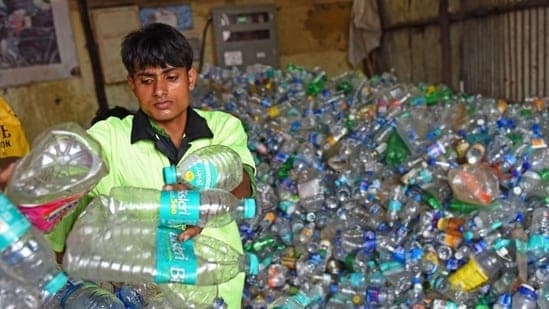
On March 31, 2026, India notified the Plastic Waste Management (Amendment) Rules, 2026 (G.S.R. 237(E))
. Two things changed at once: recycled-content mandates became binding, and chemical recycling gained its first legal definition as a circularity pathway. Both are welcome — and both are now being tested by the same design question.
India's plastic-waste generation is not running away; it is broadly flat — about 4.1 million tonnes in 2020-21, 3.9 Mt in 2021-22, and roughly 4.1 Mt (41.36 lakh tonnes) in 2022-23 — reflecting better reporting rather than a surge (Lok Sabha, December 2024). More than 3,000 processors are now registered on the national portal. Progress is real; the harder question is circularity for the fractions mechanical recycling cannot serve.
The 2016 Rules introduced EPR; the 2022 Guidelines operationalised it with 100% collection obligations and a category recycling ladder — rigid packaging from 50% to 80%, flexible and multi-layer from 30% to 60% by 2027-28. The 2026 Amendment added binding recycled-content mandates, a new seller category for raw-plastic suppliers, Registered Environment Auditors, and decentralised enforcement through urban local bodies and panchayats.
For context, Germany reports a plastic-packaging recycling rate near 68% on its national methodology (~52% on the comparable Eurostat basis) and the Netherlands around 49% — rates built on decades of upstream redesign India is only now beginning. To enable market-based compliance, CPCB appointed MSTC Ltd in September 2025 to run a national EPR-certificate trading platform, with trading expected in 2026; nearly 60,000 producers, importers and brand owners are now registered.
But a second feature of the rules works against the first. India's targets are set by packaging category — rigid, flexible, multi-layer — not by polymer. Flexible and multi-layer packaging is overwhelmingly polyethylene and polypropylene, yet the only recycled polymer FSSAI has approved for food contact is rPET (March 2025); there is still no pathway for food-contact recycled PP or PE. A polymer-agnostic target therefore creates a practical incentive to add rPET into polyolefin packs simply to hit a number.
That shortcut fails twice. It turns a recyclable mono-material pack into a PET-plus-polyolefin laminate that CEFLEX, RecyClass and APR — the three principal design-for-recycling frameworks — each classify as non-recyclable. And it sabotages the chemical-recycling route the same rules just legitimised: peer-reviewed work by Kusenberg et al. (Ghent University, 2022 and 2024) finds that non-polyolefin polymers such as PET raise oxygenates in pyrolysis oil to 1-10 wt% — far above the roughly 100 ppm steam crackers accept — causing coking and catalyst poisoning. PET in a polyolefin stream breaks recyclability at both ends.
The fix is to make recycled-content targets polymer-specific, as the EU's PPWR does — 30% for contact-sensitive PET and 10% for other contact-sensitive plastics from 2030, with South Korea mandating recycled content specifically for PET bottles. A polyolefin pack should meet its target with recycled polyolefin, not with PET filler that no one can recycle.
A 2024 peer-reviewed study (Nature, University of Leeds) estimates India emits about 9.3 million tonnes of plastic into the environment each year — far above the ~4.1 Mt of officially reported generation, because the official figure excludes rural areas, open burning and the informal sector. Collection still leans heavily on informal waste pickers and thins beyond major cities. Flexible and multi-layer packaging carry the lowest targets precisely because they are hardest to collect cleanly — which makes getting their polymer logic right all the more important.
The 2026 rules have done the hard political work. Five actions would turn recognition into operational reality:
* Make recycled-content targets polymer-specific (MoEFCC and CPCB).
* Open a food-contact pathway for recycled PP and PE (FSSAI). The US FDA already clears chemically recycled PET; no regulator has yet approved chemically recycled polyolefins, a standard India could help set.
* Publish measurement and verification protocols for chemical recycling (CPCB).
* Set distinct standards for chemically versus mechanically recycled plastic (CPCB and BIS).
* Require independent physical verification for credit issuance (CPCB).
India has notified ambitious rules and opened the door to chemical recycling. The task now is to ensure the rules' own design does not force the very contamination that breaks recyclability — and to build the standards that turn a legal definition into a working circular economy. The door is open. The question is who walks through it first.
This article is authored by Suhas Dixit, CEO, APChemi & Sunita Mohanty, advisor, Primus Partners.