Amarnath Yatra Spiritual Environmental Economic Aspects Exploredinternational Conference
Indian Express
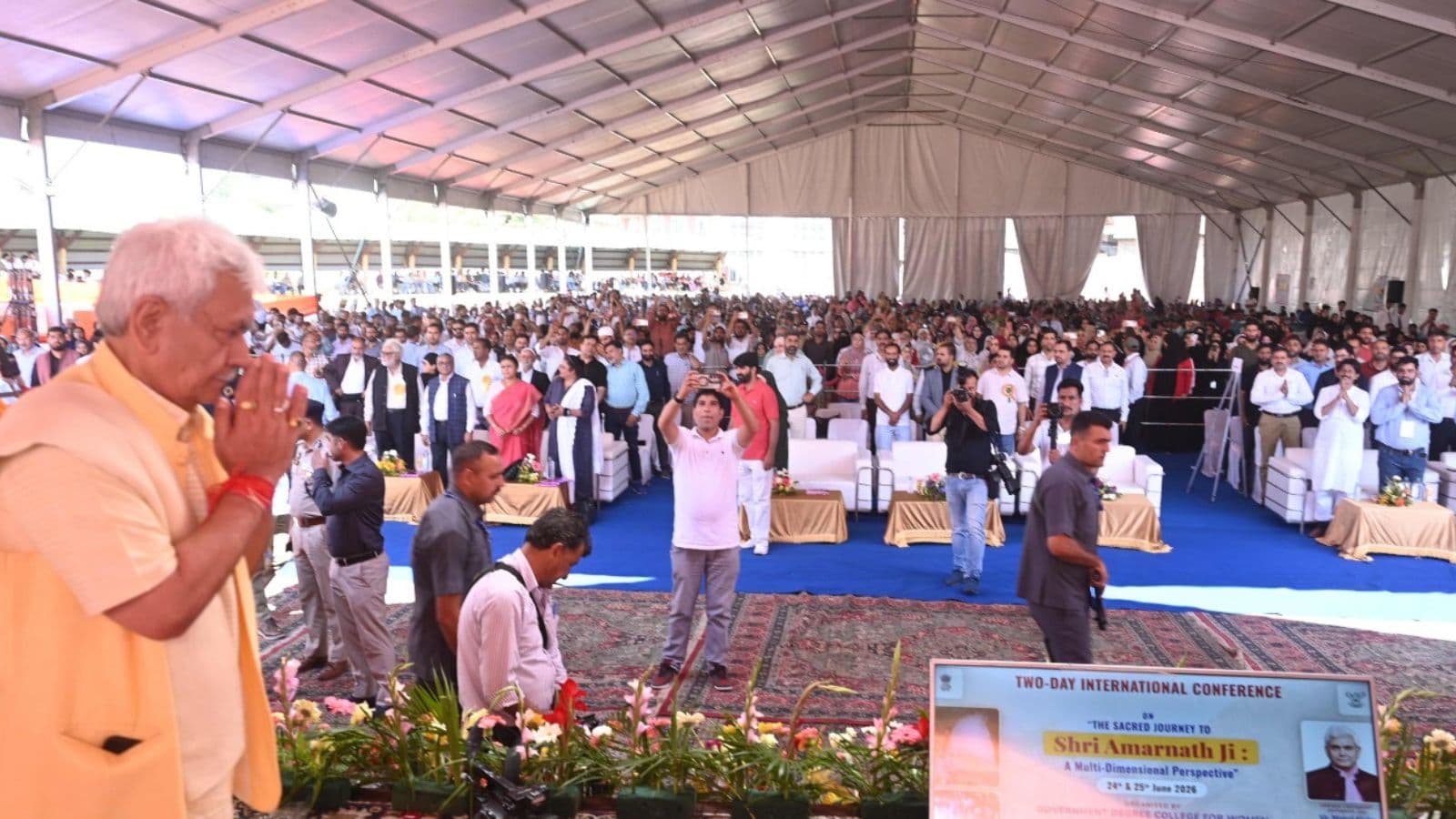
A two-day international academic conference titled The sacred journey to Shri Amarnath Ji: A multi-dimensional perspective has been held in Anantnag.
A two-day international academic conference titled ‘The sacred journey to Shri Amarnath Ji: A multi-dimensional perspective’ has been held in Anantnag. It was organised by the Government College for Women in Anantnag in collaboration with the district administration.
In a first, the conference brought historians, environmental experts and researchers together to deliberate on the spiritual, environmental and economic aspects of the pilgrimage.
Concluding the conference, Lt Govenor Manoj Sinha said the annual pilgrimage “stands for social unity and deep inner reflection”.
“At a time when divisions appear to be rising in many parts of the world, Shri Amarnath ji yatra offers a unique model of co-existence,” Sinha said, adding, “The pilgrimage conveys that the true purpose of faith is to bring people together. It is a spiritual journey of the shared values of humanity and a vibrant celebration of India’s cultural diversity.”
Sinha commended the role of Deputy Commissioner Bilal Mohiuddin Bhat and the organising secretary, Prof Farooq Ahmad Malik, for conceptualising the international conference. “The conference has emerged as a remarkable platform for meaningful academic dialogue and interdisciplinary engagement on the multifaceted dimensions of the Shri Amarnath ji yatra,” Sinha said.
It is for the first time that an international conference on the importance of the pilgrimage, its spirituality, economics and ecological concerns is being organised in the Valley.
“We want to send a message that this sacred pilgrimage portrays Kashmiriyat, a syncretic culture,” Deputy Commissioner Bhat said after the inaugural session of the two-day conference on Wednesday. “Every year, on the eve of the yatra, we call stakeholders and civil society members to discuss the Amarnath yatra. This year, we have tried to institutionalise it in the form of an international conference,” he said.
In the two-day conference, around 100 research papers, encompassing the different aspects of the annual Himalayan pilgrimage, were presented. “We had around 300 delegates here, and they included some prominent personalities — historians, environmentalists and scholars — who have come from different parts of the country,” Bhat said.
Noted environmentalist and professor of Integral University Lucknow, Prof Monowar Alam Khalid, delivered a special address focused on the ecological challenges thrown up by the annual pilgrimage in one of the most ecologically fragile zones of the Valley. He stressed the need to integrate sustainable practices into pilgrimage management.
In his address, Prof Kapil Kumar, former chairperson and professor at the Centre for Freedom Struggle and Diaspora Studies, called the annual Amarnath Yatra an irreplaceable tool for building emotional bridges between communities.
Deputy Commissioner Bhat called it a “unique conference” that blended academic discourse with ground-level experience. “While researchers and scholars shared their academic insights, the stakeholders directly involved in the pilgrimage, like pony operators, hoteliers, transporters and civil society members, contributed perspectives drawn from their practical experience,” he said.
Bashaarat Masood is a Special Correspondent with The Indian Express. He has been covering Jammu and Kashmir, especially the conflict-ridden Kashmir valley, for two decades. Bashaarat joined The Indian Express after completing his Masters in Mass Communication and Journalism from the University in Kashmir. He has been writing on politics, conflict and development. Bashaarat was awarded with the Ramnath Goenka Excellence in Journalism Awards in 2012 for his stories on the Pathribal fake encounter. Expertise and Experience Two Decades of Frontline Reporting: Bashaarat has spent 20 years documenting the evolution of Kashmir, from high-intensity conflict and political shifts to socio-economic development. Award-Winning Investigative Journalism: He is a recipient of the prestigious Ramnath Goenka Excellence in Journalism Award (2012). This honor was bestowed for his reporting on the Pathribal fake encounter, a series of stories that highlighted his ability to handle sensitive human rights and security issues with investigative rigor. Specialized Beats: His authoritative coverage spans: Political Transitions: Tracking the shift from statehood to Union Territory, electoral dynamics, and the pulse of local governance. Security & Conflict: Providing nuanced reporting on counter-insurgency, civil liberties, and the impact of the conflict on the civilian population. Development: Documenting the infrastructure, healthcare, and educational landscape within the Valley. Academic Background: He holds a Masters in Mass Communication and Journalism from the University of Kashmir, providing him with a localized academic and professional foundation that is rare in regional reporting. ... Read More