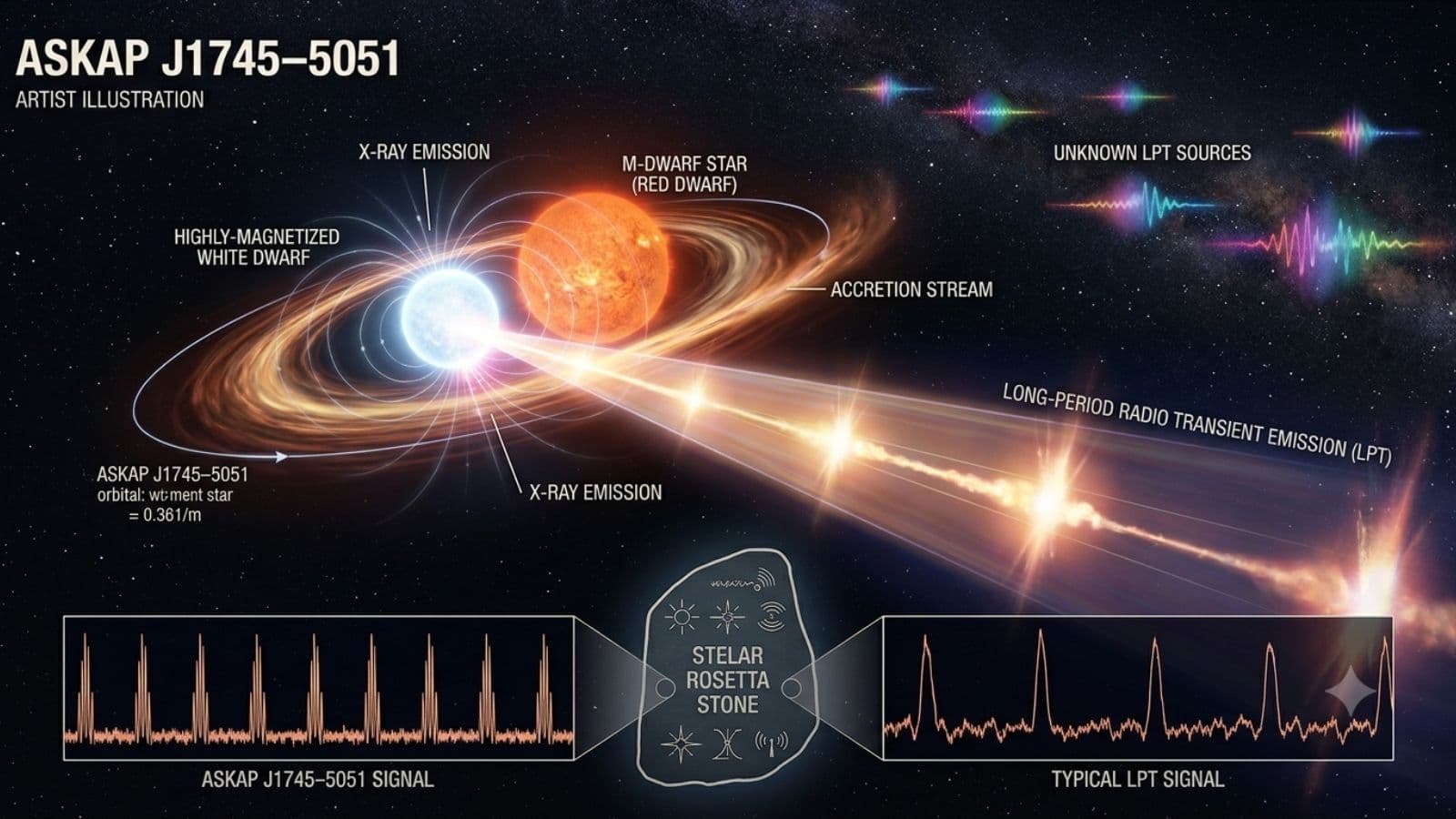
For years, astronomers have been puzzled by a set of mysterious radio signals arriving from different parts of our galaxy. These signals, known as long-period radio transients (LPTs), appear at regular intervals but do not behave like any known cosmic objects
. Now, researchers believe they may finally have found the key to understanding them.
A team led by scientists at the University of Sydney has identified an unusual star system that appears to produce one of these strange signals. Writing in the journal Nature Astronomy, the researchers describe the system as a possible “stellar Rosetta Stone” that could help decode similar signals detected across the Milky Way.
The newly discovered system, called ASKAP J1745−5051, consists of two stars locked in an incredibly tight orbit. One is a white dwarf, the dense remnant of a dead star about the size of Earth but with a mass similar to the Sun. The other is a much smaller red dwarf star with roughly one-tenth of the Sun’s mass.
The two stars orbit each other in just over an hour, bringing them so close together that their magnetic fields interact intensely. According to the researchers, these magnetic interactions generate powerful radio bursts at specific points during the orbit, creating a repeating signal that can be detected from Earth.
Lead researcher Kovi Rose said the system could help scientists understand whether other long-period radio transients are produced by similar star systems or by entirely different objects, such as pulsars.
“This system gives us a way to decode these signals. It could help us determine whether other long-period transients are more like pulsars or white dwarf systems, acting as a stellar Rosetta Stone,” Rose explained in an interview with BBC Science Focus.
The discovery is important because only about a dozen long-period radio transients have been identified so far, and their origin remains one of astronomy’s newest mysteries.
The system is also producing more than just radio waves. Material from the red dwarf is being pulled toward the white dwarf, heating it up and generating X-rays. This provides scientists with a rare opportunity to study extreme magnetic environments and plasma physics under conditions that cannot be recreated in laboratories on Earth.
Researchers say such systems act as natural laboratories for understanding how matter behaves under powerful gravitational and magnetic forces.
Experts not involved in the study have welcomed the findings. Dr Darren Baskill, a specialist in variable star systems at the University of Sussex, said the research provides a convincing explanation for the origin of these unusual radio signals.
However, he noted that although the source of the signals may now be understood, many questions remain about the complex physics that drives interactions between these stars.
The discovery does not solve every mystery surrounding long-period radio transients, but it offers the strongest clue yet about their origin. As astronomers continue to search the galaxy for more examples, this unusual stellar pairing may prove to be the key that finally unlocks one of space science’s most intriguing puzzles.