India West G7 Modi Trump Macaron Carney
Indian Express
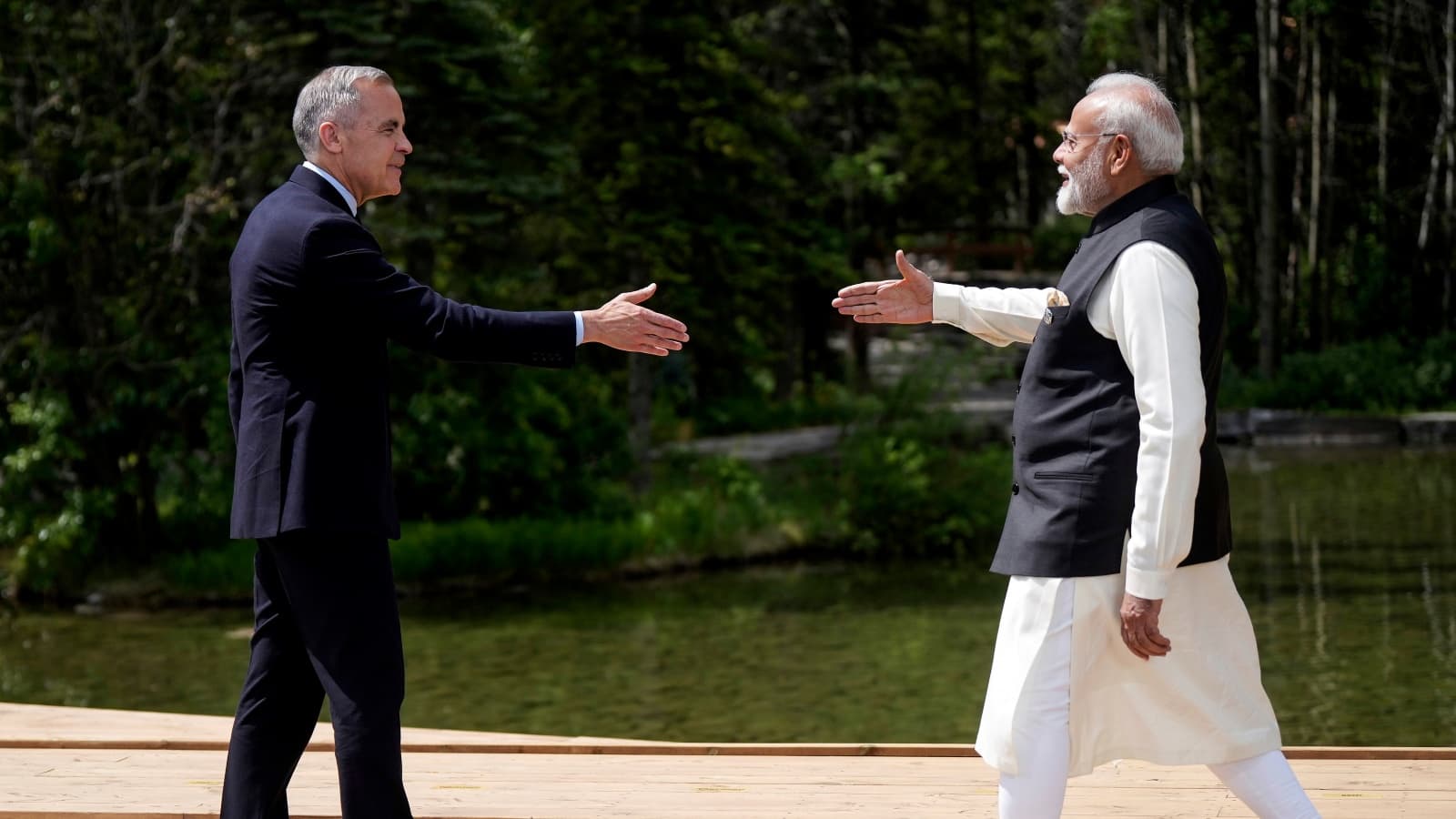
Narendra Modi s participation in the G7 summit at vian this week marks India s 13th appearance at the forum and the Prime Minister s seventh in a row since 2019. Fittingly, India s engagement with the grouping began at vian itself, when Atal Bihari Vajpayee wa
Narendra Modi’s participation in the G7 summit at Évian this week marks India’s 13th appearance at the forum and the Prime Minister’s seventh in a row since 2019. Fittingly, India’s engagement with the grouping began at Évian itself, when Atal Bihari Vajpayee was invited in 2003, and continued with Manmohan Singh between 2005 and 2009.
That India is a regular invitee reflects a deepening mutual engagement, rooted in the country’s economic transformation since the 1990s and its growing salience in the international system. During the Cold War, India placed most of its economic and political eggs in the Russian basket. The Soviet collapse of 1991, coinciding with the breakdown of India’s own economic model, forced a restructuring that profoundly altered Delhi’s relationship with the West.
Today, the G7 is the principal destination of Indian exports, absorbing nearly a third of the country’s merchandise shipments. Most of India’s service exports also go to the G7. It is also the main destination for the outward flow of Indian professionals and students; a more restrictive America since Donald Trump’s re-election as president has merely redirected some of those flows to Europe.
Despite the rhetoric about building a new global economic order with Russia and China, India’s economic diplomacy in recent years has been less about BRICS than about deepening ties with the developed West through trade liberalisation. India’s quest for diversification is now less between the West and BRICS than within the West — it is marked by a new determination to deepen ties with Europe, the UK and Canada in the G7.
India’s real challenge today comes from rapid and unexpected change within the West itself. Three trends stand out. The first is the rise of American unilateralism under Trump. Trump’s instinct is to pursue the narrow national interest of the US in the name of “America First”. As he forces allies to fall in line on key issues, the divisions across the Atlantic have widened.
Contrary to the popular notion of American decline, the US has grown stronger relative to its Western allies over three decades. In the mid-1990s, the European economy was roughly equal in size to America’s, and Japan’s GDP stood at two-thirds to three-quarters of it. Today, the eurozone is little more than half of US output and Japan barely a seventh. With its GDP at around $31 trillion and still growing at 2.5 per cent, the US is set to widen its lead over allies and over China — the one power whose relative weight has risen, though Beijing’s own troubles have dimmed the prospect of overtaking America.
To be sure, Washington has ceded some ground to Beijing in select frontier areas — advanced manufacturing, electric vehicles, increasingly competitive open-weight AI models. Trump’s industrial policy is eager to make amends. But the depth of the American innovation system and its capital markets remains without parallel.
SpaceX’s listing on the Nasdaq last week, on extravagant promises of a new space economy, pushed its paper valuation to $2 trillion despite the absence of past profitability. What it really signals is a new technological revolution — in what China’s communists call the “new quality productive forces”. French President Emmanuel Macron’s decision to seat the tech titans at Évian as near-equals underlines the rise of a new American tech capitalism with far-reaching consequences.
Third, Trump is recasting not only the internal balance of the West but the terms of its engagement with Russia and China. In pursuit of a grand bargain with Tehran, he has strained the alliance with Israel; in South Asia, he is talking up Pakistan. His fluid new approaches, with no attachment to the past, promise to transform the geopolitics of Europe, the Middle East and the Indo-Pacific.
That brings us back to Évian in 2003, where China’s president, Hu Jintao, sat alongside Vajpayee — the first time Beijing was drawn into the Western outreach. China’s GDP then was about $1.6 trillion, India’s barely $600 billion. China has since raced to some $20 trillion in 2025; India still hovers below $4 trillion. The speed and purpose of internal transformation is what distinguishes China from India. It is not just a question of quantity. The quality of the Chinese economy in terms of its technological advances and scientific sophistication is more than impressive.
China’s leaders are no longer invited to the G7, yet they loom large over it: A central question at Évian is how to manage the global imbalances produced by China’s export juggernaut. That transformation underlines the twin dialectic China navigated with such aplomb over the last five decades: To rise through deeper ties with the West but also strengthen China’s national capability. China today is at once a huge economic partner for the West and its principal strategic challenger.
Where many in Delhi’s foreign policy community see an irreconcilable contradiction between the pursuit of strategic autonomy and partnership with the West, China demonstrated the art of transcending it — and against far steeper odds. The Korean War of 1950-53 cost hundreds of thousands of Chinese lives, yet within two decades, Mao Zedong was befriending Washington. It is that cold realism that separates China’s hard-headed strategy from the perpetually prickly and anxious Indian foreign policy discourse.
The writer is a contributing editor on international affairs for The Indian Express. He is also associated with the Motwani Jadeja Institute of American Studies, Jindal Global University and the Council on Strategic and Defence Research, Delhi