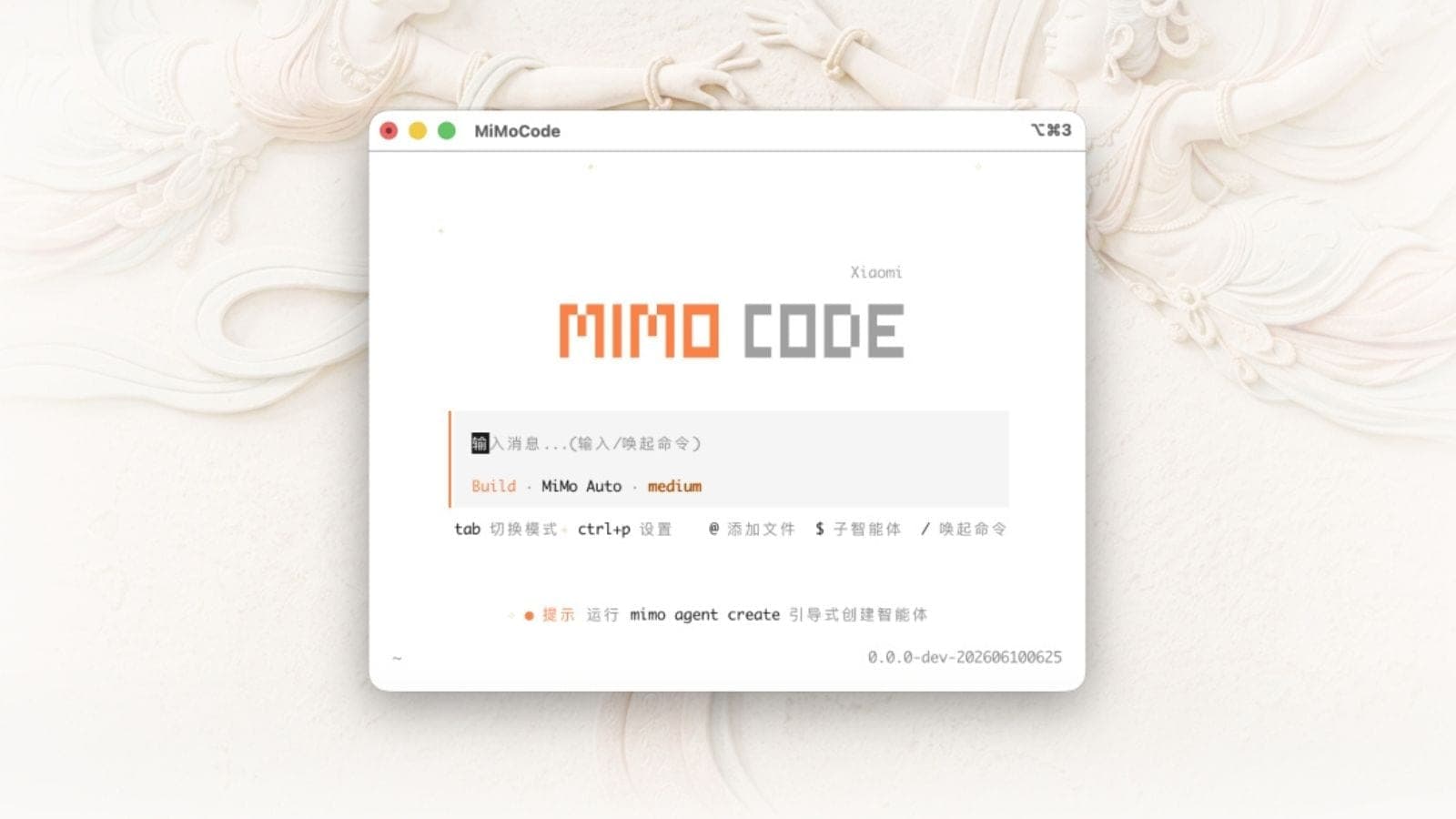
Chinese electronics giant Xiaomi has released Mimo Code v0.1.0, its latest open-source terminal-native AI coding assistant aimed at developers. The model has reportedly surpassed Anthropic s Claude
Chinese electronics giant Xiaomi has released Mimo Code v0.1.0, its latest open-source terminal-native AI coding assistant aimed at developers. The model has reportedly surpassed Anthropic’s Claude Code on some key benchmarks in agentic coding, particularly on long horizon tasks and multi-steps tasks. Long horizon tasks are simply goals assigned to an AI agent that may require numerous sequential steps, decisions, and hundreds of actions to accomplish a task.
The claims are reportedly based on its internal beta release and a survey of 576 developers. According to the company, the model reads and writes code, executes commands, manages Git operations, and maintains persistent project memory across sessions inside the terminal. Xiaomi’s latest release comes along with MiMo V2.5, a multimodal model that is free for a limited time and features a one-million-token context window.
Xiaomi describes MiMo Code V0.1.0 as a tool that is more than an AI coding assistant in your terminal. “It’s the smartest coding partner you’ll ever work with,” the company said on its X handle. The model is currently available on GitHub under an MIT license. It can be installed with a single terminal command on MacOS and Linux, and on Windows via npm. It is based on the open source OpenCode agent with Xiaomi adding its own memory system, workflow modes, and model support.
The AI-powered coding assistant works directly from the terminal, allowing developers to read and write code, run commands, and manage Git repositories. For the uninitiated, a Git repository is a digital folder inside a coding project that tracks all changes made to files in it, building a history over time. MiMo Code is powered by Xiaomi’s MiMo V2.5 multimodal AI which is currently free for a limited time.
Based on the announcement, the tool is designed to manage large software projects with its ‘infinite context’ through automatic knowledge storage and compression, helping it remember important information across coding sessions. The model can also test, review, and validate its own work, based on a structured workflow that moves from planning and specifications to building and reporting results.
MiMo Code comes with features that allow it to learn from past interactions. Besides, it is capable of saving useful project knowledge, converting repeated tasks into reusable skills, and improving over time. The model has a built-in speech recognition support that lets users interact with it using voice commands. The model can work with multiple AI model providers including Anthropic, OpenAI, Kimi, DeepSeek, and GLM. It is also compatible with Claude Code tools and workflows.
MiMo Code also includes a persistent memory system, supports multiple AI agents working together on tasks, tracks complex task hierarchies, and offers experimental features for parallel reasoning and agent switching to improve coding efficiency.
Based on Xiaomi’s own benchmark results, MiMo Code outperforms Anthropic’s Claude Code on several software engineering tests when paired with their respective flagship AI models. On SWE-bench Verified, MiMo Code achieved 82 per cent compared to Claude Code’s 79 per cent. On SWE-bench Pro, it secured 62 per cent versus 55 per cent, while on Terminal Bench 2 it recorded 73 per cent against Claude Code’s 69 per cent.
Reportedly, Xiaomi claims that part of this improvement comes from MiMo Code’s underlying agent system rather than the AI model itself. When the same MiMo-V2.5-Pro model was tested in both frameworks, MiMo Code scored about five percentage points higher than Claude Code on SWE-bench Pro and Terminal Bench 2, suggesting that its memory architecture and workflow design contribute to the performance gains.
According to Xiaomi, it conducted an internal double-blind evaluation involving 576 developers across 474 private repositories. The company claimed that MiMo Code and Claude Code performed similarly on shorter tasks, but on projects that required more than 200 execution steps, MiMo Code’s win rate exceeded 65 per cent. According to Xiaomi, this advantage was possible due to long-term memory and state-management capabilities that are designed for complex, multi-session coding tasks.
It is important to view these figures with caution, as they are self-reported by Xiaomi. With benchmarks, companies building AI models often tend to cherrypick performance scores that fit their narrative. The company also did not publish comparisons with OpenAI’s Codex or Google’s Gemini CLI. Public benchmark data suggests that OpenAI’s Codex CLI running GPT-5.5 scores around 82 per cent on Terminal Bench 2, significantly higher than MiMo Code’s reported 73 per cent. On the other hand, Xiaomi’s reported 62 per cent score on SWE-bench Pro is higher than OpenAI’s published GPT-5.5 result of 58.6 per cent.
Overall, Xiaomi’s claims point to a growing trend in AI coding tools that performance largely depends not just on the underlying language model, but also on the agent framework, memory system, and workflow design.
Xiaomi’s latest offering reflects a wider shift in the AI industry that is increasingly working improving AI-backed coding. It also shows that companies are no longer focussing on strength of their language models, but also on the quality of their agent framework. Essentially, more focus on facets such as how well a model remembers context, plans tasks, manages workflows, and improves over time.
If Xiaomi’s assessment holds up, MiMo Code could likely emerge as a credible alternative to established tools like Claude Code, especially for developers working on extensive, long-running software projects. This also indicates that in the grander scheme of things, memory, orchestration, agent design are increasingly becoming key differentiators in real-world software development.