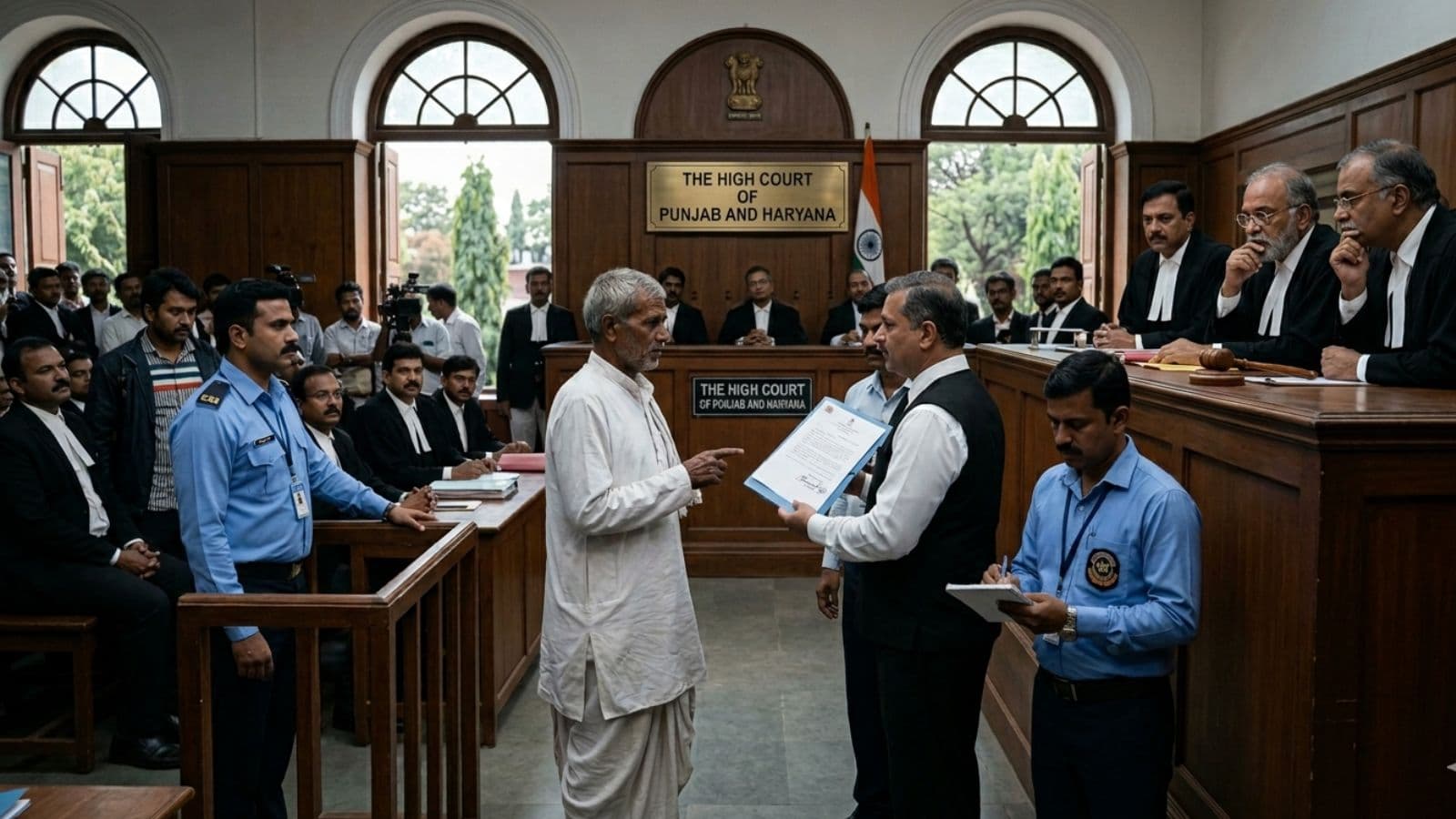
An alleged illegal mining petition before the Punjab and Haryana High Court took a dramatic turn when the petitioner failed to explain the contents of the case filed in his name, leading the court
to question whether he was being used as a front by unknown persons with ulterior motives.
A Division Bench of Justice Ashwani Kumar Mishra and Justice Rohit Kapoor subsequently ordered a Central Bureau of Investigation (CBI) inquiry, observing that several circumstances surrounding the filing and attempted withdrawal of the writ petition raised serious doubts about its authenticity.
Among the factors that caught the bench’s attention was the petitioner’s claim that he was “illiterate”, despite the writ petition bearing his signature in English. The bench also noted that a fresh vakalatnama or an authority letter filed later carried his signature in Hindi.
“The petitioner is absolutely clueless about the cause which he has raised in the writ petition, nor is he aware as to how the petition has been prepared and drafted,” the bench observed after interacting with him in person on April 24.
The case was filed in the name of Ashok, alleging illegal mining activities in Bakhrija village in Haryana’s Mahendergarh district. However, after the court sought responses from authorities regarding the allegations, a counsel appeared and sought permission to withdraw the petition. The development itself raised the bench’s suspicion, leading it to direct the petitioner to personally appear before it.
Following his appearance, the bench concluded that both the filing of the petition and the subsequent attempt to withdraw it were “highly suspect.”
“The manner in which the petition has been filed and subsequently the petitioner has come forward to withdraw it, raises a serious doubt with regard to the genuineness of the filing of the writ petition. It appears that somebody else is acting through the petitioner, and his signatures prima facie have been forged in the writ petition.”
‘Larger concern of misuse of judicial process’
Ordering a CBI investigation into who was actually behind the litigation, the bench directed the Central agency’s deputy director to examine the circumstances surrounding the filing and attempted withdrawal of the petition, as well as the role of persons associated with the petitioner.
The bench made it clear that while “the petition itself appeared suspicious”, the allegations of illegal mining remained serious and warranted independent examination. Referring to its earlier proceedings concerning alleged illegal mining in the Aravalli region, the bench observed that “a serious issue, otherwise, has been raised with regard to illegal mining.”
The judges also underscored the larger concern of misuse of the judicial process, stating: “This direction is being issued because we do not approve of the filing of fictitious writs by unknown persons through strangers for oblique motives and then withdrawing them after the purpose is served.”
In a pointed warning, the bench added: “Proceedings before this court cannot be taken for a ride. We are therefore compelled to issue these directions in order to ascertain correct facts.”
The matter came up again on May 25, when the court was informed that CBI had already begun examining the issue. Recording the submission made on behalf of the investigating agency, the bench noted: “Pursuant to the previous occasion, Mr Akashdeep Singh, Advocate, has entered an appearance on behalf of the Central Bureau of Investigation (CBI) and states that a preliminary inquiry has been instituted in the matter and a report would be submitted within a period of three months.”
Accepting the statement, the court directed, “Let that be done.” The bench also further ordered that “the records of the main petition shall be kept in the safe custody of the Registrar General and shall be made available to the CBI as and when required,” while also directing the Registry to extend all necessary cooperation to the investigating agency.
The case is now scheduled for further hearing on August 11, 2026, by which time CBI is expected to place its preliminary findings before the court.