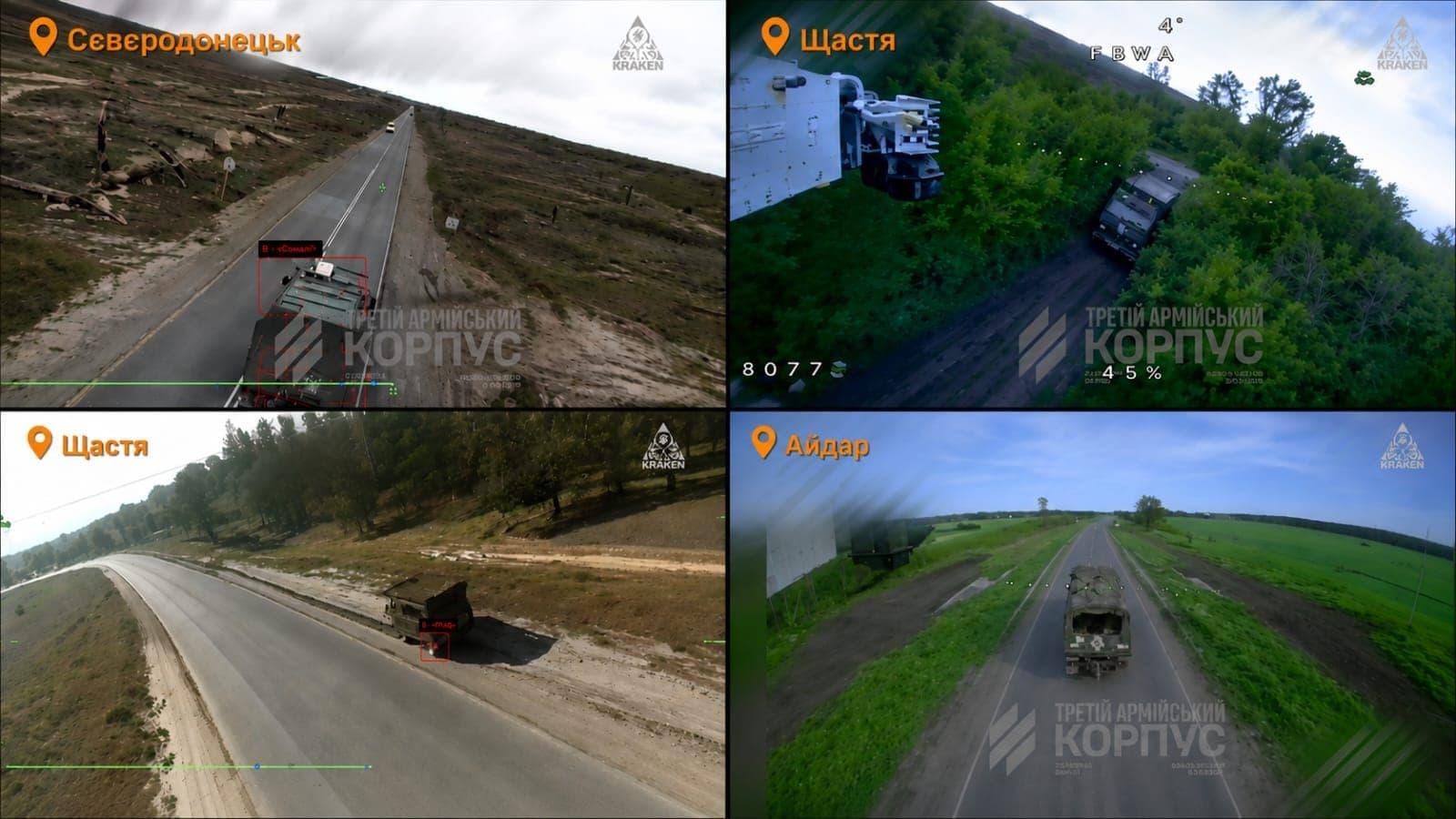
Ukrainian forces have dramatically stepped up drone strikes on a critical Russian supply road in occupied southern Ukraine, cutting military cargo traffic by 71 per cent in two weeks and leaving the
route – once the backbone of Moscow’s southern logistics – littered with destroyed trucks and tankers.
The R-280 highway, which Russian forces call the “Novorossiya” route, runs from Rostov-on-Don in Russia through the occupied territories of Melitopol and Mariupol along the Sea of Azov coastline to Crimea. It is Moscow’s primary land corridor for supplying its forces in the south, and a critical alternative to the Kerch Bridge, which is more exposed and has itself been struck before.
The road has been almost entirely closed to civilian traffic since late May. Video footage recorded by drivers shows burnt-out trucks on the roadside, and in some cases captures drone strikes as they happen.
The strikes are part of a deliberate Ukrainian strategy called the “middle strike campaign” – targeting Russian assets located between 20 km and 200 km behind the frontline, with a specific focus on logistics and supply lines.
Ukrainian President Volodymyr Zelenskyy said on May 5 that such strikes had quadrupled since February.
“There are now twice as many strikes at distances of 20km-plus compared with March, and four times as many compared with February. And there will be even more. This is a priority area,” Zelenskyy said, according to The Guardian.
Ukraine’s Defence Minister Mykhailo Fedorov was more direct about the goal, describing it as a “logistics lockdown.”
“Our task now, as directed by the president, is to maximise the middle strike and, in coordination with the military, create a complete logistics lockdown for the enemy,” Fedorov said. “The enemy will no longer feel safe even at a great distance from the frontline.”
Ukrainian drone units have been tight-lipped about the precise tactics involved, but the campaign appears to centre on deploying swarms of drones against roads, railways, and bridges in numbers that have caught Russian forces off guard.
US-produced Hornet drones – roughly the size of a large surfboard with a range of about 150 km – have featured heavily in the attacks, with operators using artificial intelligence to identify truck traffic and strike convoys almost continuously.
Ukraine has also deployed a new locally produced fixed-wing drone called the Morrigan, a two-metre-long lightweight aircraft that can be launched from a slingshot or rail, removing the need for a runway or airfield. A Russian official quoted by independent outlet Meduza also indicated that airdropped mines are being used.
Yevgeny Balitsky, the Kremlin-installed head of the occupied part of Ukraine’s Zaporizhzhia region, described A “comprehensive remote mining system” that detonates on movement, warning drivers to “limit trips unless absolutely necessary,” as reported by The Guardian.
The results have been significant. On Tuesday, Robert Brovdi, commander of Ukraine’s Unmanned Systems Forces, said military cargo traffic along the highway had fallen by 71 per cent over the past two weeks.
Traffic on the Chonhar Bridge – a key section connecting Russia-occupied Kherson province to Crimea – was suspended this week after a series of Ukrainian drone strikes. Ukraine’s 1st Separate Assault Regiment said on Tuesday: “We see all movements and totally control the enemy’s repair works. We are ready to make our long-range adjustments at any moment.”
One immediate consequence has been fuel shortages in Crimea. Destroyed trucks now line the route, as Russian convoys have attempted to move off main roads to avoid detection.
On May 21, Vladimir Saldo, the Kremlin-appointed governor of the Russian-occupied Kherson region, signed a decree restricting civilian truck movements along the R-280 near the Sea of Azov coastline.
The campaign has drawn attention from independent defence analysts. The US-based Institute for the Study of War said in a recent update: “Ukrainian intermediate-range strikes are already achieving notable operational effects, including degrading Russia’s ability to use the key Russian highway connecting Russia to occupied Crimea and GLOCs [ground lines of communication] around Donetsk City.”
Russia’s reaction has been pointed. Saldo compared the strikes to the Nazi siege of Leningrad during the Second World War, saying: “This is cynical barbarism. In its cruelty, these actions are reminiscent of the fascist blockade of Leningrad, when the enemy tried to intimidate people, sever connections between territories, and break the will of the civilian population.”
The Express Global Desk at indianexpress.com which delivers authoritative, verified, and context-driven coverage of key international developments shaping global politics, policy, and migration trends. The desk focuses on stories with direct relevance for Indian and global audiences, combining breaking news with in-depth explainers and analysis. A major focus area of the desk is US immigration and visa policy, including developments related to student visas, work permits, permanent residency pathways, executive actions, and court rulings. The Global Desk also closely tracks Canada’s immigration, visa, and study policies, covering changes to study permits, post-study work options, permanent residence programmes, and regulatory updates affecting migrants and international students. All reporting from the Global Desk adheres to The Indian Express’ editorial standards, relying on official data, government notifications, court documents, and on-record sources. The desk prioritises clarity, accuracy, and accountability, ensuring readers can navigate complex global systems with confidence. Core Team The Express Global Desk is led by a team of experienced journalists and editors with deep expertise in international affairs and migration policy: Aniruddha Dhar – Senior Assistant Editor with extensive experience in global affairs, international politics, and editorial leadership. Nischai Vats – Deputy Copy Editor specialising in US politics, US visa and immigration policy, and policy-driven international coverage. Mashkoora Khan – Sub-editor focusing on global developments, with a strong emphasis on Canada visa, immigration, and study-related policy coverage. ... Read More