Mumbai Hidden Death Traps Inside City Open Manhole Menace
Indian Express
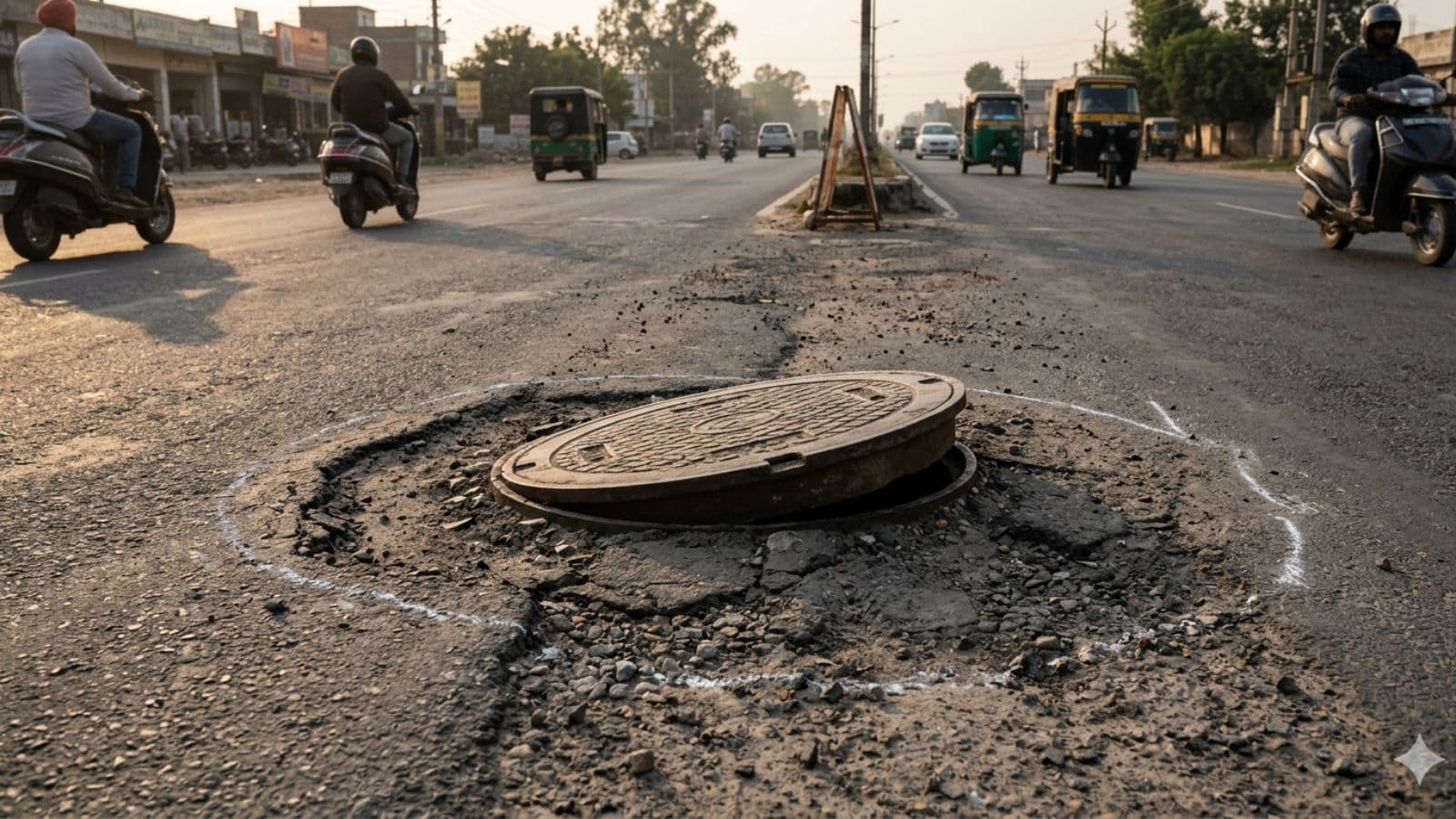
The death of Aslam Shaikh after falling into an open manhole in Sakinaka on Thursday has yet again brought to fore concerns over Mumbai s missing manhole covers.
The death of Aslam Shaikh after falling into an open manhole in Sakinaka on Thursday has yet again brought to fore concerns over Mumbai’s missing manhole covers.
Spurred by over 3,360 manhole cover thefts in the past seven years to opening of covers for maintenance works by agencies – open and unprotected manholes are making the city’s streets increasingly perilous for citizens.
According to records procured from the Brihanmumbai Municipal Corporation (BMC), the city has 73,437 sewer line manhole covers and more than 25,000 covers to shield storm water drains.
Typically, manhole covers are opened by the storm water drainage or sewerage department for carrying out cleaning of the network through an array of machinery. On Thursday, for instance, the manhole in Saki Naka in which 55-year-old Shaikh fell, had been opened to carry out installation of protective grills on a sewer manhole.
Besides this, some storm water drain covers are opened under the presence of civic teams to enable flooded water to run away into the drains.
In situations of unabated heavy downpour, sewer manholes too are opened in chronic flooding points like Hindmata junction and King’s circle to allow accumulated water to discharge.
“During monsoon season, accumulated water from roads is often discharged through grilled roadside entrances. While maintenance work is stalled during monsoon period, the covers are moved under vigilance of teams to allow excess water to run off,” an official explained.
In what makes the manholes perilous, maintenance work is often undertaken without protective barricades as it was observed during the incident in Saki Naka on Thursday.
However, even in cases where manholes are shielded with protective barriers and grills to alarm citizens, the open portal becomes dangerous for commuters and pedestrians plying on the road.
The menace came to light last week during Mayor Ritu Tawde’s inspection at the flooded Gandhi market when a BMC supervisor from F/North ward fell into an open chamber, opened to allow waste and water to drain, despite barricades on all sides.
Civic officials added that during flooding, many citizens ignorantly tend to open manhole covers in a bid to drain the rainwater. “When the covers are opened the locals, these open manholes become deadly for pedestrians as it is invisible specially during water logging.” another official explained.
For the civic body, another challenge lies in tackling the theft of open manhole covers.
Data procured by The Indian Express shows that in the past seven years, Mumbai has recorded 3,360 cases of manhole thefts across the city.
Even as the number of theft has dwindled in the recent years, the stolen covers leave behind open manholes only making Mumbai’s streets unsafer.
According to officials, thefts are typically carried out by thieves and miscreants looking to make a quick buck. Made in cast iron, covers shielding Mumbai’s manholes fetch a sum of anywhere between Rs. 1,000 – 1,200 in the scrap market.
“Even in cases where the thefts are unsuccessful, the botched attempt ends up leaving the covers broken which pose a threat to citizens plying upon them,” an official said.
A scrapped smart manhole cover project to protective grills: BMC’s attempts at tackling the menace To combat the challenge of missing covers, the BMC in 2023 charted plans to install smart manhole covers across 14 locations in a pilot project. These sensor-based manholes were poised to set off a siren, to raise alarms when the covers were moved.
However, three years on, the project is yet to take off owing to lack of successful prototypes. “Our pilot project did not yield any positive results as we were facing several technical snags. Thereafter, the project was scrapped,” said an official privy to developments.
After the demise of Dr Deepak Amrapurkar in 2018 who slipped into a manhole while wading through the rain water and whose body was recovered nearly two days later in Worli, the Bombay High Court directed the civic body to cover the manholes with permanent covers. Following this, the BMC started installing protective grills across Mumbai’s SWD and sewer drains over the past few years.
Yet, amid lack of adequate safety measures, it was this very drive of grill installation on Thursday that proved fatal for 55-year-old Shaikh.
Nayonika Bose is a Senior Correspondent with The Indian Express’ Mumbai bureau. While in the early stages of her career, her focused reporting on local governance and community welfare already demonstrates clear Expertise and Trustworthiness in covering essential civic issues impacting Mumbai's residents. Expertise & Authority (E-E-A-T) Specialized Focus: Nayonika's reporting is dedicated to civic and community issues, providing readers with highly relevant, ground-level information about the functionality and administration of India's largest metropolitan area. Core Coverage Areas: Her articles highlight a strong focus on the fundamental quality of life and public safety in Mumbai, including: Civic Infrastructure: Reports on critical failures and initiatives related to public works, such as the recurring problem of unauthorized building collapses in Navi Mumbai, the construction of new infrastructure projects (like the Dahisar-Bhayandar Link Road and the Mahalaxmi cable-stayed bridge), and the maintenance of essential city services (e.g., manhole cover theft). Urban Governance & Crisis Management: Provides detailed coverage of the Brihanmumbai Municipal Corporation's (BMC) response to major crises, particularly during the monsoon (e.g., heavy rainfall, water cuts, and public health concerns like dengue and malaria) and large-scale public safety incidents (e.g., the hoarding collapse fallout). Community Welfare & Rights: Reports on key social issues, including the financial aid scheme for persons with disabilities, the struggles of Mumbai's hawkers protesting eviction drives, and the dangers faced by workers due to the continuation of manual scavenging in water tanks. Cultural & Heritage Reporting: Covers significant community stories, including the restoration of British-era fountains and the history of institutions like the 126-year-old Chinchpokli cemetery, showing a breadth of interest beyond pure administration. Tweets @nayonikakb ... Read More