Priyank Kharge Rss Defamation Case Court Order
Indian Express
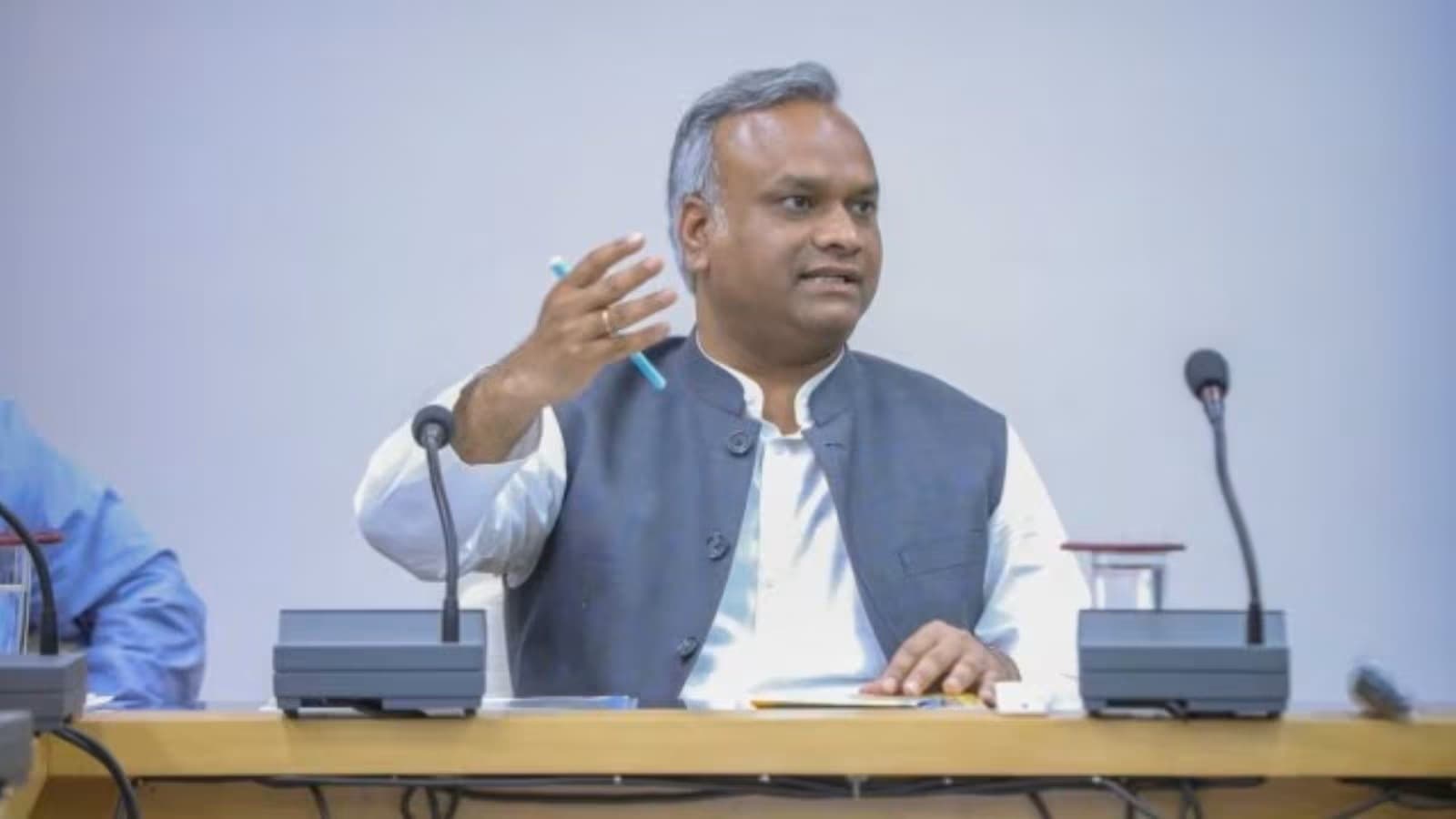
In its order dated June 27, the court dismissed the argument, stating, The contention is wholly untenable and devoid of merit.
In its order dated June 27, the court dismissed the argument, stating, “The contention is wholly untenable and devoid of merit.”
Special Judge Sandeep Patil made the observations while taking cognisance of a criminal defamation case filed by an RSS volunteer, Tejas A, against Kharge and Congress leader Mohammed Haris Nalapad. The court has issued summons to both leaders, returnable on July 21. However, the court dropped the complaint against former minister Dinesh Gundu Rao.
Kharge had argued that Tejas has not produced any documentary proof to establish that he is a member of RSS or a swayamsevak, and therefore he is not an “aggrieved person” entitled to maintain the complaint.
Special Judge Sandeep Patil noted that statements, speeches, and actions allegedly used derogatory, defamatory, and objectionable expressions against the RSS and the persons associated with it.
“The accused cannot be permitted to approbate and reprobate simultaneously. On one hand, they seek to justify their statements by referring to the RSS and its members, while on the other hand they deny the existence of such members solely to defeat the maintainability of the complaint,” the court said in its order.
Further, stating that the conduct of the accused persons in allegedly attempting to obstruct, restrict, or interfere with the activities carried out by persons associated with the RSS itself demonstrates that there are identifiable individuals who participate in and carry on such activities.
The court in the order said, “Having targeted such individuals and their collective activities, the accused persons cannot now contend that no member exists and consequently no person can maintain a complaint.”
The order added, “In the present case, the complaint and sworn statement disclose that the accused Nos. 1 & 3 allegedly made imputations against RSS and its Swayamsevaks, and the complainant asserts that he is a Swayamsevak and is aggrieved thereby. These assertions, taken at their face value, are sufficient to constitute prima facie material for proceeding under Section 356 BNS.”
The special court also referred to the judgment of the Kerala High Court in the case of Mathrubhoomi Illustrated Weekly and Others v. P. Gopalankutty and Another, which has been affirmed by the Supreme Court, wherein it held that the RSS is a definite, determinate, and identifiable body of persons, and that a member thereof possesses the requisite locus standi to maintain a complaint for defamation.
Following which the court said, “Where the complainant is a member of such a definite and identifiable body, he cannot be denied the status of an “aggrieved person” merely because the defamatory statement does not specifically mention his individual name. Such a member has sufficient legal interest and locus standi to institute and maintain a complaint for the offence punishable under Section 356 of the Bharatiya Nyaya Sanhita, 2023.”
Referring to Section 2(26) of the Bharatiya Nyaya Sanhita, which defines the term “person” in an expansive and inclusive manner. The court in the order said, “The statute does not prescribe any requirement of formal membership, registration, incorporation, or documentary proof of affiliation as a condition precedent for recognising a body of persons under the law.
The special court said, “The essence of inquiry in a defamation case is not about whether the body is incorporated or whether each individual possesses a formal membership card, but whether the body constitutes a sufficiently definite and identifiable group, against whom the defamatory imputation has been made.”
The bench in its order made it clear that it would be premature to record a conclusive finding regarding the competence of the complainant to maintain the complaint and it can appropriately be considered after allowing him to place material regarding his status, authority, representative capacity, or any other basis on which he claims to be an aggrieved person.
The bench in the order also said, “The defence that there was no intention to defame is itself a matter requiring evidence and adjudication during trial. The question whether the accused acted with the requisite intention, knowledge, malice, or good faith can only be conclusively determined after evidence is led by both sides.”
Refusing to accept the contention of the accused that a swayamsevak of the RSS cannot maintain a complaint alleging defamation of the RSS.
The court in its order said, “Prima facie, there exists a distinction between a mere admirer or fan of an individual and a person who claims to be a member, functionary, or swayamsevak of an organised body. A fan of a public personality may have no recognised connection with the affairs, activities, objectives, or functioning of the person concerned. On the other hand, as stated above, a swayamsevak or member asserts an association with and participation in the activities and objectives of the organisation.”
The court then said, “At this preliminary stage, it would be premature to reject the complaint solely on the analogy of a fan seeking to prosecute an alleged defamation of a public figure. The complainant must be afforded an opportunity to establish the nature of his association with the organisation, the rights and responsibilities attached thereto.”