Cristiano Ronaldo Vs Luka Modric Portugal Croatia Fifa World Cup 2026 Ballon Dor Real Madrid
Indian Express
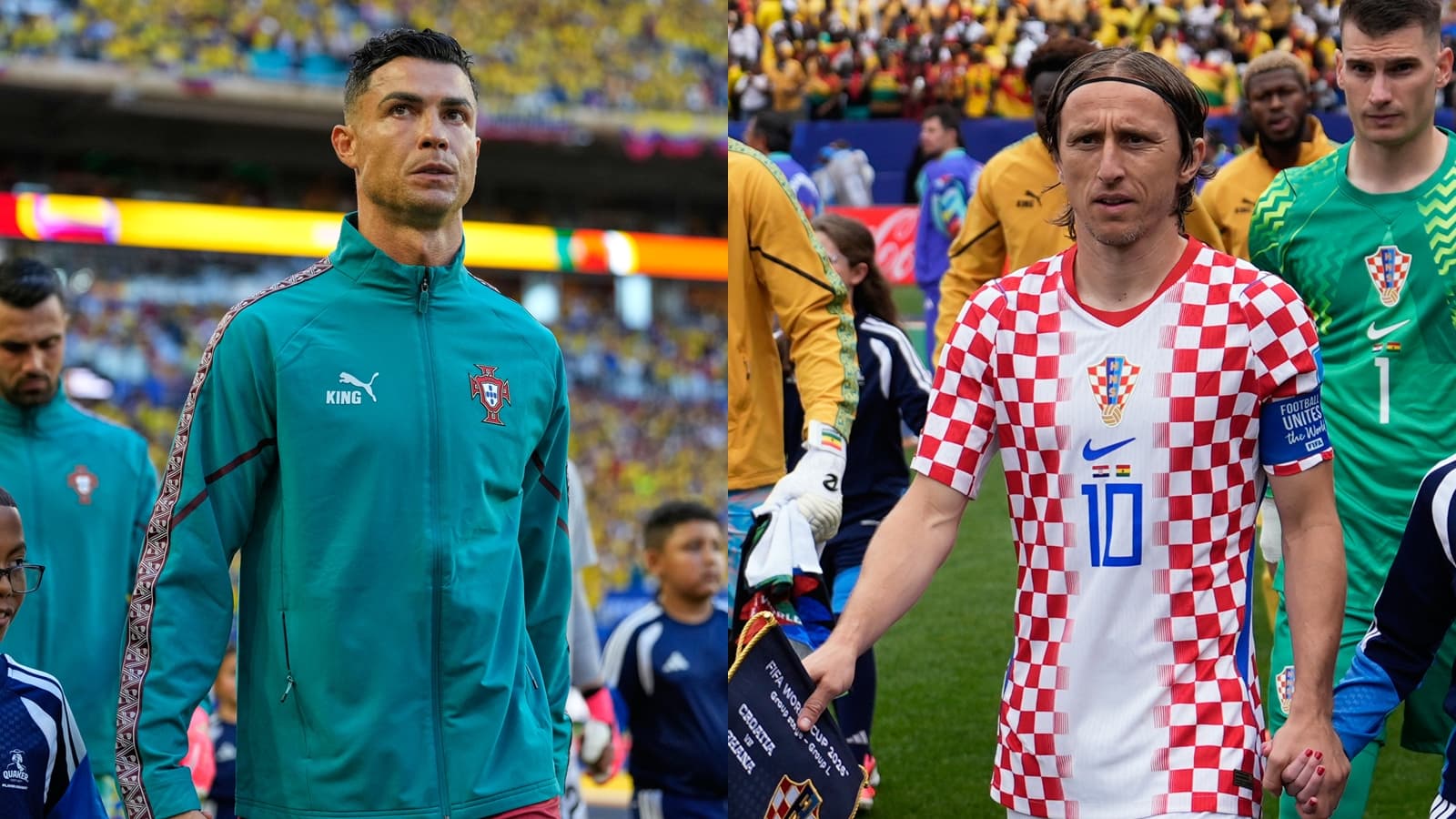
Barely anything could separate Luka Modric and Cristiano Ronaldo in 2018. They had just won a third consecutive Champions League together at Real Madrid
. Modric had then carried Croatia to the World Cup final. Ronaldo, meanwhile, finished the season with 44 club goals.
Football’s highest individual honour – the Ballon d’Or – had become a two-man debate. Modric won, before Ronaldo later acknowledged that he deserved it more.
Eight years later, there is barely anything left to unite them. They will lead Croatia and Portugal in a Round of 32 tie. Together, they are the oldest outfield players left in the tournament, their combined age stretching to 81. For one of them, in all likelihood, it will also be a final appearance on football’s grandest stage. That is where the symmetry ends.
Because while one is bending time to his will, the other has become a victim of it.
Croatia opened the tournament with a bruising 4-2 defeat to England, but Modric has since been at the heart of successive victories over Panama and Ghana. In the first of those games, no player could better the 40-year-old’s 69 accurate passes. It was not an isolated metric, either. He attempted the most line breaks among his teammates, and essentially, had carved Thomas Christiansen’s five-man defence open.
The performance felt fitting, for it came on his 200th appearance for Croatia. Defying age, the midfielder was flying after the match – almost literally, as he was being thrown into the air by joyous teammates, whose shirts read: ‘Infinite Legacy.’
For years, Ronaldo’s own legacy with Portugal had appeared similarly infinite. Now, an expiration date looms large. At Croatia’s camp, Martin Pograncic delivers an extemporaneous speech about how the squad is both privileged and fortunate to have Modric as their captain. Across the corridor, Portugal’s Joao Felix was instead answering questions about why Ronaldo should still wear the armband.
After Modric became the oldest player ever to get an assist at a men’s World Cup match, his coach Zlatko Dalic would heap praises: “Luka was truly fantastic. He’s aware that this is the last World Cup, and he is doing his best.” Ronaldo might not, but his coach, Roberto Martinez, is certainly trying his best to convince otherwise.
Data, however, paints a very different picture. No Croatian has averaged more passes per 90 minutes than Modric. None has created more chances. Should you desire to find Ronaldo’s corresponding figures in Portugal’s metrics, save a few seconds by starting from the bottom.
He has played every second of Portugal’s campaign and is yet to create a single chance. With 19.4 passes per 90 minutes, Ronaldo ranks lower than Diogo Costa, whose sole purpose is to prevent goals. Ronaldo has completed just 65 passes in 300 minutes — only four fewer than Modric managed in the Panama match alone.
Positional difference could explain some of the contrast, but it cannot explain everything. Modric also leads in terms of physicality — an aspect Ronaldo has always taken pride in. His average speed (6.2 km/hr) and distance covered in high speed (3.25 km) are both higher than that of Ronaldo (5 km/hr and 2.19 km, respectively).
An even bigger indicator is the contrast in performance between this World Cup to that in 2022. Despite being four years older, Modric is covering 770 metres more per match than he did in Qatar, while moving 0.7 km/h faster on average. Ronaldo has gone the other way. He is covering 1.5 kilometres less per game than four years ago — a dramatic decline at elite level — while his average speed has fallen by almost a kilometre per hour.
Save for two goals against debutants Uzbekistan, Ronaldo has very little to show for at this World Cup. Modric, despite not being on the scoresheet, has undisputedly been his team’s most efficacious figure. Every metric shares a common inference — Modric has been among the most involved players in his team. Ronaldo has been among the least. The influences could not be starker than they already are . And yet, football has never cared much for statistical consensus.
For six seasons, his first instinct after receiving the ball was almost subconscious: when in doubt, find Cristiano Ronaldo. For six seasons, he has known only this much to be true: Ronaldo will save you.
In Toronto, Ronaldo needs to save himself first. From the ineluctability of age, the inevitability of time. His contemporary, Lionel Messi, continues to defy it. Behind him surge football’s next era – Kylian Mbappe, Erling Haaland, Vinicius Junior. Ronaldo, once the benchmark against which every superstar was measured, no longer sits naturally among them.
Should Portugal aspire to stay alive, their captain has to step up. Be it at the cost of his friend.
Shuvaditya Bose is a Deputy Copy Editor at the sports desk of The Indian Express. ... Read More