Belgium Miracle World Cup Win Tielemans Trossard Fight Embrace Equaliser Senegal
Indian Express
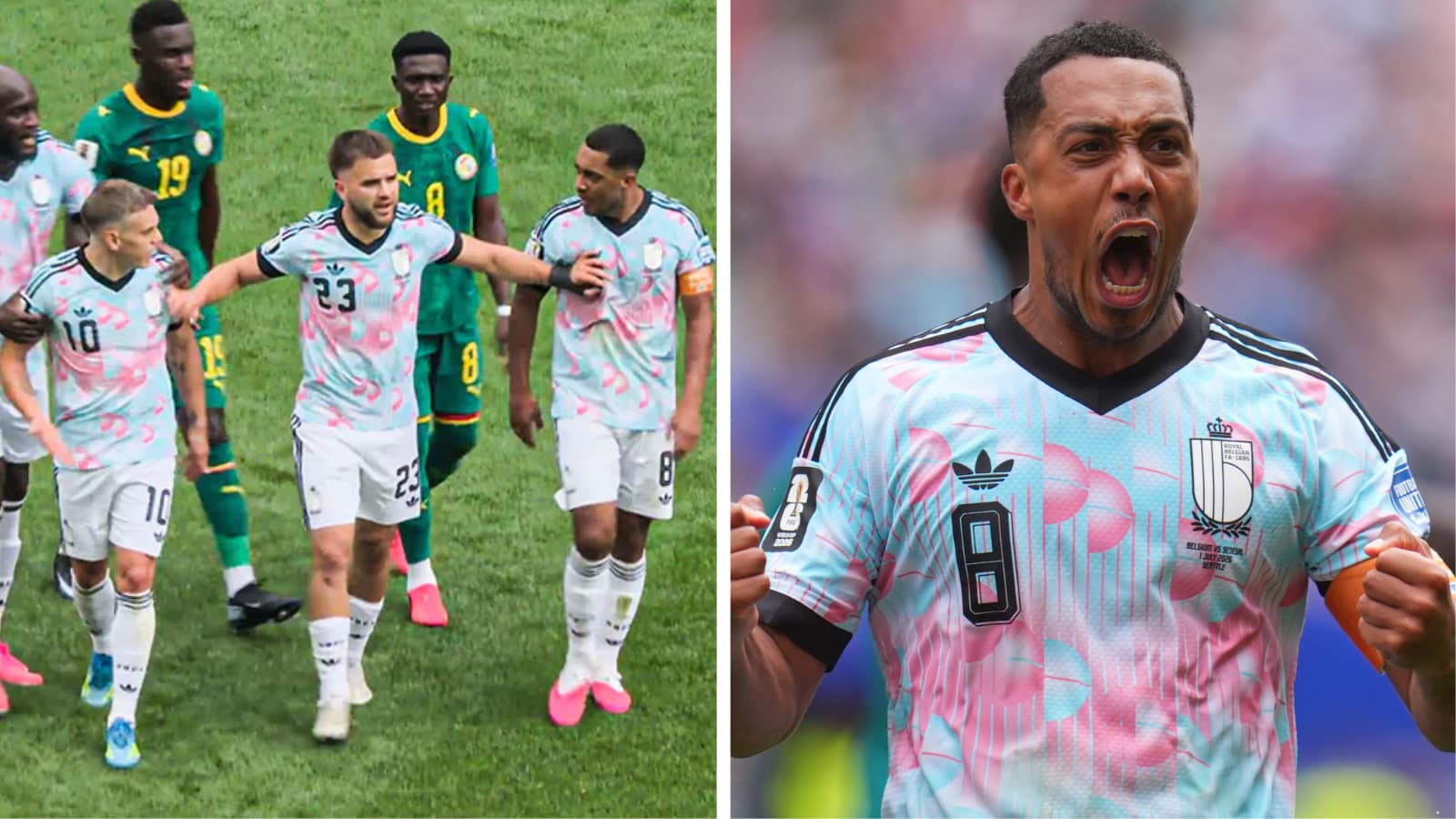
There is a delicious irony in the image that will endure from Belgium s astonishing 3-2 victory over Senegal. Not the controversial penalty in the 120+4th minute
There is a delicious irony in the image that will endure from Belgium’s astonishing 3-2 victory over Senegal.
Not the controversial penalty in the 120+4th minute. Not even the winning goal that sent Belgium into the World Cup last 16. It is Youri Tielemans embracing Leandro Trossard after heading in the equaliser in the 89th minute, moments after the pair had spent much of the second half arguing over a cross.
Belgium were staring at elimination. Senegal led 2-0, having struck through Habib Diarra in the first half and Ismaila Sarr either side of it. The Golden Generation’s final World Cup challenge appeared to be ending in Seattle.
Earlier in the second half, Tielemans had chosen to whip an early delivery into the box towards Romelu Lukaku instead of recycling possession through midfield. Trossard was furious at what he saw as the wrong decision. By the cooling break, the disagreement had escalated into a heated confrontation that teammates, including Lukaku, had to separate.
At that point, Belgium seemed to be falling apart in yet another World Cup. But Lukaku gave them hope in the 86th minute with a close-range finish, as late as Belgium had ever trailed by two goals and survived at a World Cup. Then, three minutes later, Trossard drifted down the left and delivered the cross. Tielemans arrived late, as he has done throughout his career, and powered the header beyond the goalkeeper.
Belgium’s Youri Tielemans (8) celebrates after scoring the penalty. (AP Photo/Manu Fernandez)
The very action they had argued about became Belgium’s route back into the game.
Extra time brought one final twist. Deep into the additional period, Tielemans burst into the area and went down under a challenge from Lamine Camara. Senegal protested furiously as the referee consulted VAR. After a lengthy review, the spot-kick was awarded.
At 120+4 minutes, with the match balanced on a knife-edge, Tielemans calmly slotted the penalty into the corner to complete one of the World Cup’s most dramatic comebacks.
It was a quintessential Tielemans performance: understated, intelligent and decisive. That has been the story of his career.
When Belgium’s celebrated Golden Generation emerged, the spotlight inevitably fell on Eden Hazard’s genius, Kevin De Bruyne’s vision, Thibaut Courtois’ brilliance and Lukaku’s goals. Tielemans, despite being hailed as a prodigy from the age of 16, often felt like the forgotten member of that remarkable group.
Now 29, he represents the bridge between Belgium’s fading golden generation and the team trying to build its next chapter. He debuted for Anderlecht as a teenager, became one of the youngest players ever to play in the Champions League and carried expectations that have crushed many gifted youngsters. Yet, unlike so many wonderkids, he simply kept evolving.
His journey has not been linear. Monaco threatened to become a dead end before Leicester City revived his career. His thunderbolt in the 2021 FA Cup final secured the club’s first major trophy, only for relegation to follow two years later. Again, Tielemans adapted.
At Aston Villa, Unai Emery has transformed him from an attack-minded No.10 into one of Europe’s most complete midfield conductors. He presses, dictates tempo, controls transitions and still possesses the knack of arriving in the right place at the right time.
That professionalism has long defined him. Away from the pitch, Tielemans has never cultivated celebrity. He is known instead for meticulous preparation, studying opponents, obsessing over recovery and embracing the less glamorous aspects of elite football.
Which is why Tuesday night’s comeback felt so fitting. The midfielder who spent an hour arguing about the value of a cross ultimately scored from one.
For a footballer who has spent much of his career quietly proving people wrong, the sequence from 86 minutes to 120+4 was another reminder that his greatest quality has never been spectacular passing or thunderous shooting. It is his remarkable ability to turn difficult moments into defining ones.
Over the course of a 18-year-long career, Mihir Vasavda has covered 2010 FIFA World Cup; the London 2012, Tokyo 2020 and Paris 2024 Olympic Games; Asian Games in 2014 and 2022; Commonwealth Games in 2010 and 2018; Hockey World Cups in 2018 and 2023 and the 2023 ODI Cricket World Cup. ... Read More