Beyond Trending What Is Alliance
I
Indian ExpressVerified Publisher
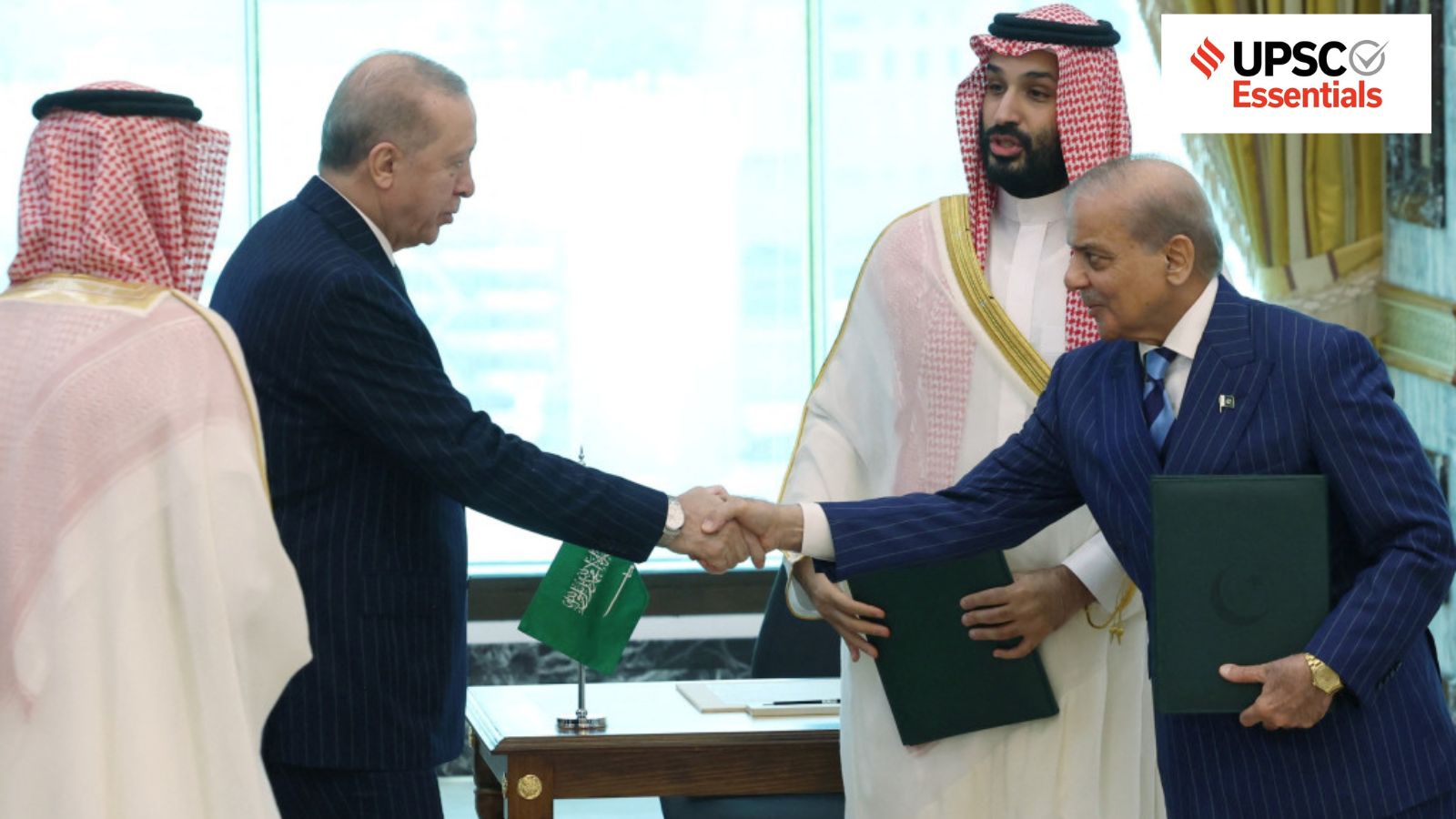
The Mecca Joint Defence Agreement, signed on August 7 by Saudi Arabia, Turkey, and Pakistan (a nuclear power), has triggered an intense debate about the evolving security architecture of the West Asian region. Although details of the agreement are not known, i The Mecca Joint Defence Agreement, signed on August 7 by Saudi Arabia, Turkey, and Pakistan (a nuclear power), has triggered an intense debate about the evolving security architecture of the West...
The Mecca Joint Defence Agreement, signed on August 7 by Saudi Arabia, Turkey, and Pakistan (a nuclear power), has triggered an intense debate about the evolving security architecture of the West Asian region.
Although details of the agreement are not known, it seeks to “strengthen collective deterrence against any act of aggression and stipulates that any armed attack against any one of the three states shall be regarded as an attack against them all.”
This commitment to collective deterrence constitutes a core logic of an alliance. But what is an alliance?
One of the world’s leading scholars of international relations, Stephen M Walt, in The Origins of Alliances (1987), defines alliance as a “formal or informal relationship of security cooperation between two or more sovereign states.”
Thus, states enter into formal or informal alliances to improve their collective security and defend themselves against a common, perceived threat. A formal alliance is formed by signing a treaty. The North Atlantic Treaty (1949), US-Japan Security Treaty (1951, revised 1960), and the Warsaw Pact (1955, dissolved in 1991) are examples of formal alliances.
In contrast, an informal alliance refers to cooperative partnerships between or among states and may involve joint military exercises, the sharing of strategic information, commitments to provide assistance during a military crisis, and even secret agreements. The German-Soviet Nonaggression Pact, also known as the Molotov-Ribbentrop Pact, which included secret provisions, is seen as an example of a secret alliance.
Moreover, an alliance can also be defensive (e.g., NATO) or offensive (e.g., the Axis Powers during WWII).
The concept of alliance is usually associated with the Westphalian state system, in which sovereign states strive to ensure their survival in the anarchic system of international relations. The international system is also defined as anti-hegemonic in character, suggesting states resist any attempt by one actor (a state, or an alliance of states) to gain power over the others.
From the realist perspective, alliance constitutes an important tool of external balancing. Major realist scholars, Hans Morgenthau and Kenneth Waltz, viewed alliance formation as a key mechanism by which states pursue balance of power.
Such realist understanding is further illustrated by Stephen M Walt. With “balance of threat” theory, he argues that states form alliances against threats – a “function of power, geographic proximity, offensive capabilities, and perceived intentions”.
An alliance carries its own advantages and disadvantages. Martin Griffiths et al. underline strategic and military advantages:
1. Alliances can help small and vulnerable states to offset the cost of defence, as they can rely on the military and nuclear capabilities of stronger states.
2. They can bring economic benefits through increased trade, aid, and loans between alliance partners, while the deployment of foreign military personnel can also be beneficial to a local economy.
3. Great powers can gain strategic advantage by having access to strategically important locations around their actual or potential enemies.
But alliance can also be a source of conflict, can be seen by a third state as a hostile act and lead to an arms race. At the same time, changes in national interests, leadership and ideologies can prompt states to rethink their alliances, they add.
Against this broader logic of alliance formation, the Mecca Joint Defence Agreement, signed in the midst of the US-Israel war on Iran, exemplifies how states seek to enhance their security by forming alliances against perceived threats.
The changing regional security environment, evident in Arab Gulf states’ reassessment of the US security guarantee and militarily dominant Israel and Iran in the region, prompts states like Saudi Arabia to strengthen their collective deterrence.
end your comments to ashiya.parveen@indianexpress.com.
Ashiya Parveen is working as Commissioning Editor for the UPSC Section at The Indian Express. She also writes a weekly round up of global news, The World This Week. Ashiya has more than 10 years of experience in editing and writing spanning media and academics, and has both academic and journalistic publications to her credit. She has previously worked with The Pioneer and Press Trust of India (PTI). She also holds a PhD in international studies from Centre for West Asian Studies, JNU. ... Read More