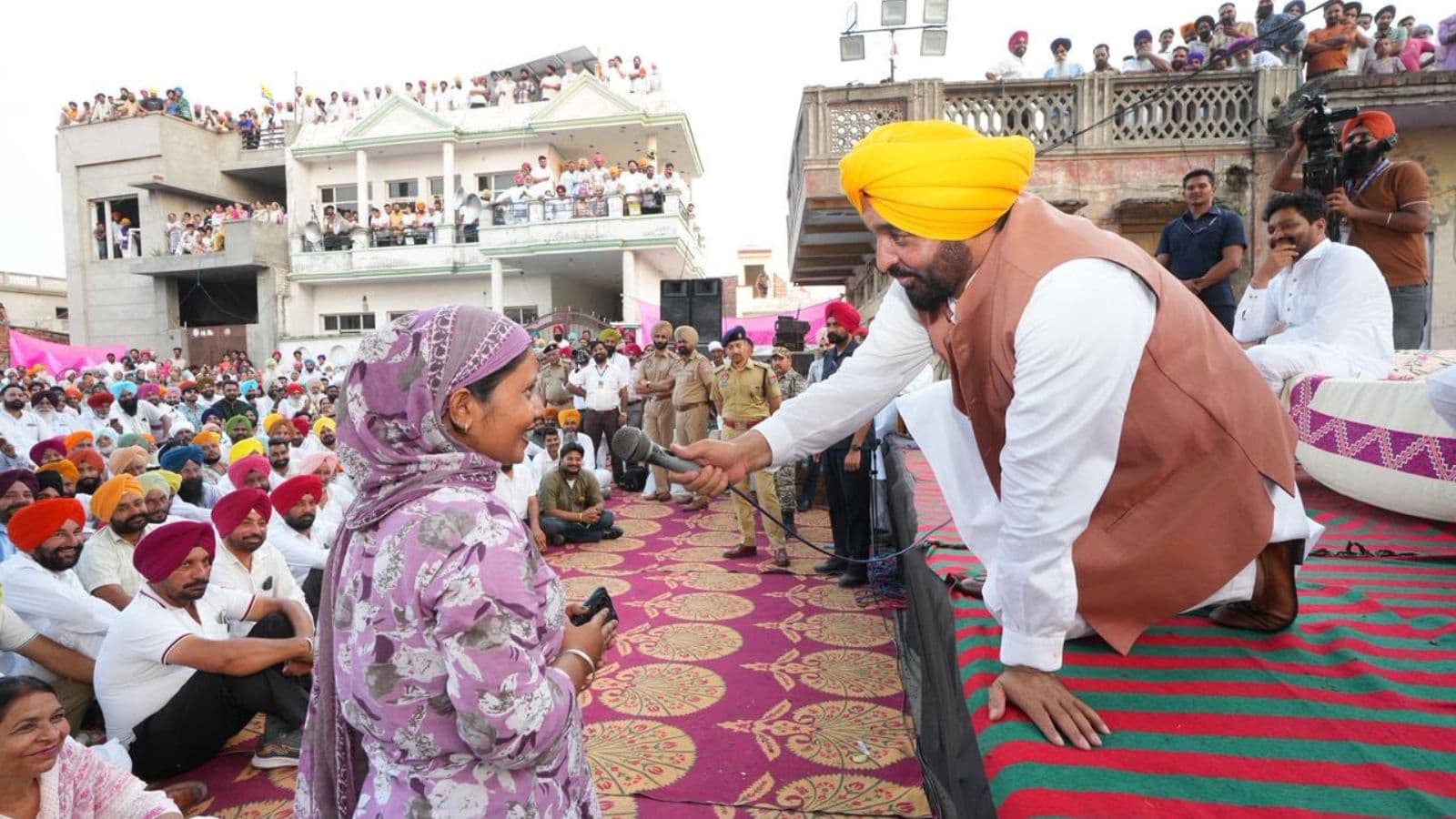
Nearly four-and-a-half years after storming to power in Punjab, the Aam Aadmi Party (AAP)-led Bhagwant Mann government is set to roll out its flagship women’s financial aid scheme, Mawan Dhiyan Satkar Yojana, on July 1. The scheme was the AAP’s “biggest guarantee” that the party gave during its campaign for the February 2022 Assembly elections.
Under this scheme, women in the general category will receive Rs 1,000 per month, while those belonging to the Scheduled Castes (SCs) will get Rs 1,500. While the AAP had originally promised these benefits for every eligible woman aged above 18 years irrespective of income, the final programme excludes income-tax payees, government employees and pensioners from its ambit. It has, however, included women who receive meagre social security pensions, such as widow and old-age pensions.
Chief Minister Mann has said that about 97% of Punjab’s women voters would benefit from the programme. As per 2022 polls, of Punjab’s total 2.15 crore electorate, women accounted for 1.02 crore or 47.45% of the voters. So, it is estimated that nearly 98 lakh women would benefit from the Mawan Dhiyan Satkar scheme.
However, the registration of the scheme’s beneficiaries had been completed for only about 39 lakh women until June 28. In its Budget for 2026-27, the AAP government has allocated Rs 9,300 crore for the scheme. Mann has also announced that its beneficiaries would receive three months’ payout, covering the April-June period, together in July.
The timing of the scheme’s launch is politically significant as the Punjab Assembly election is barely eight months away. Welfare measures meant for women have increasingly become a central electoral strategy in the state, cutting across party lines. The reason lies not merely in welfare politics but also in the changing voting patterns in the state.
There has been a sustained rise in female voters’ participation in elections, with women’s turnout exceeding that of men over the last several Assembly elections.
While the overall turnout in Punjab has steadily declined over the last three Assembly elections – from 78.62% in 2012 to 77.36% in 2017 and 71.95% in 2022 – the percentage of women voters’ turnout has been consistently higher than that of men.
In the 2012 Assembly elections, of the overall 78.62 % voter turnout, women accounted for 79.43% as compared to 77.92% of men voters. In the 2017 Assembly polls, of the total 77.36% polling, 79.33% of women voters exercised their franchise as compared to 75.63% of men. While the overall polling fell to 71.95% in the 2022 polls, women voters’ turnout stood at 74.25% as against 69.65% for men.
Punjab’s electorate grew from 1.76 crore in 2012 to 2.15 crore in 2022. During the same period, the share of female voters in it increased from 46.76% to 47.45%, while that of male voters dipped from 53.24% to 52.55%.
In light of female voters’ increasingly crucial role in determining the outcome of various elections, successive governments led by different parties have designed and implemented various women’s schemes.
The AAP government recently announced the construction of five women’s hostels in Mohali, Jalandhar, and Amritsar at a cost of Rs 150 crore, which will also be equipped with crèche facilities for working mothers.
On April 1, 2021, the then Congress government led by Capt Amarinder Singh introduced free bus travel for women in government buses. The AAP government has continued this scheme, declaring that it has spent Rs 2,042 crore on it from 2022-23 to 2025-26.
After replacing Amarinder at the helm of the government just five months before the 2022 polls, Congress CM Charanjit Singh Channi unveiled a series of measures targeted at women.
The Channi government raised the monthly honorarium of over 53,000 Anganwadi workers, mini Anganwadi workers and helpers, hiking it for Anganwadi workers from Rs 8,100 to Rs 9,500, mini workers from Rs 5,300 to Rs 6,300, and helpers from Rs 4,050 to Rs 5,100.
Nearly 22,000 ASHA workers were granted a fixed monthly allowance of Rs 2,500 apart from an incentive-based payment, Rs 5 lakh health insurance, and paid maternity leave. The Channi government also increased the honorarium of around 42,500 mid-day meal workers from Rs 2,200 to Rs 3,000, besides giving other incentives.
The 2022 elections, however, saw the AAP sweeping to power, winning 92 of the state’s 117 seats as against the Congress’s 18 seats.
Apart from continuing the free bus travel scheme for women, the AAP dispensation also carried on with the Congress government’s Ashirwad scheme, under which eligible women from economically weaker sections, SCs and backward classes are given Rs 51,000 as one-time financial assistance for marriage.
The Shiromani Akali Dal (SAD), too, attempted to consolidate its support base among women voters under its coalition governments with the BJP.
In 1997, the then Parkash Singh Badal-led government launched the Shagun scheme as a one-time assistance of Rs 5,100 for the marriage of girls from poor families, which was expanded over the years.
In its 2022 poll campaign, the SAD pledged a number of sops for women, including 50% reservation for women in government jobs and a hike in widow and old-age pensions from Rs 1,500 to Rs 3,100.
More recently, Akali Dal president Sukhbir Singh Badal has promised to increase the marriage assistance under the Shagun scheme to Rs 1 lakh if voted to power.
In the run-up to the 2027 polls, the leading contenders are thus vying again to reach out to women voters, who have clearly emerged as a decisive constituency in the state.