Delhi To Get Relief From Ammonia Spike As Hry Drain Project Nears Completion
Hindustan Times
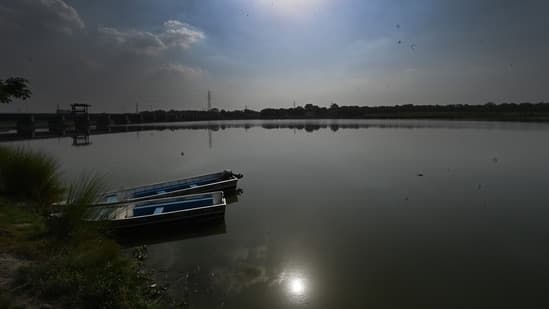
The Capital could soon get some relief from periodic ammonia spikes that impact its water supply and harm aquatic life in the last remaining clean upstream stretch of Yamuna with Haryana close to...
The Capital could soon get some relief from periodic ammonia spikes that impact its water supply and harm aquatic life in the last remaining clean upstream stretch of Yamuna with Haryana close to converting an open drain in Sonipat that feeds into the river into a closed conduit system.
In an affidavit filed before the National Green Tribunal (NGT), dated June 25, the Haryana environment department has said that 98% of the work in the laying of a twin conduit pipeline for the conversion of the 24,100-ft long open channel of polluting Diversion Drain No. 6 (DD-6) has been finished.
This, it said, will prevent spill over of industrial effluents from it into DD8. DD-8, which originates from Gohana at Mahra village and travels 68km before terminating near Dahisara village, is a freshwater drain that carries water eventually treated and supplied to Delhi, making any mixing of untreated waste a serious environmental and public-health risk.
It did not, however, specify when this work was expected to be complete.
At present, the flow from DD8 has been disconnected temporarily from Yamuna by making a raised embankment. “The entire water from DD8 and DD6 is being diverted through an abandoned drain — Najafgarh downstream Wazirabad,” states the affidavit, seen by HT.
Moreover, for identification of discharge points, the Haryana irrigation department has also surveyed the entire length of the polluting channel, “from its originating point at Samalkha town in Panipat to the exit point from Haryana at Narela border in Sonipat,” the affidavit said.
It found 35 discharge points with the drain carrying 42.7 MLD (million liters per day) of industrial waste even though it was originally a stormwater drain, not for the conveyance of untreated sewage or industrial effluents. An action plan has been submitted to the NGT to tap the inflow with a deadline of June 30, 2028, said the environment department.
This particular case dates back to July 2024 when the NGT had first taken suo motu cognisance of a media report highlighting death of thousands of fish in the Yamuna, near Burari in north Delhi. The article stated that chemical-laden water from factories had led to the mass deaths of fish.
To be sure, prior to this, the Delhi Jal Board (DJB) told the NGT that improper maintenance of DD6, which is choked with garbage, silt and effluents, is contaminating nearby drain 8 that carries treated water used for drinking in Delhi. The two drains run parallel, and frequent overflows from drain 6 leach into drain 8, causing water quality problems, the DJB said in its March 4, 2024, submission.
Ammonia spikes in the Yamuna are a chronic winter issue, generally occurring between 15 and 22 times a year, typically between December and March as the river’s flow recedes due to lack of rain upstream. The treatment plants are designed to handle ammonia concentrations up to 1 part per million (ppm). Levels exceeding this render the water, what officials say is, “untreatable” without generating toxic chloramines as a by-product.
In January, supply disruption hit neighbourhoods in north, west and northwest Delhi after dangerously high levels of ammonia in the Yamuna have forced the temporary closure of the Wazirabad and Chandrawal facilities, which together supply around 200 million gallons per day (MGD).
High ammonia is also considered toxic to fish and other aquatic organisms. In human beings and other higher animals, long-term ingestion of ammonia over 1 ppm can lead to organ damage. High concentration of ammonia can also cause a burning sensation in the throat and lead to persistent coughing.