Rajnesh Kumar On Bikash Bhattacharjee S Haunting Works
Hindustan Times
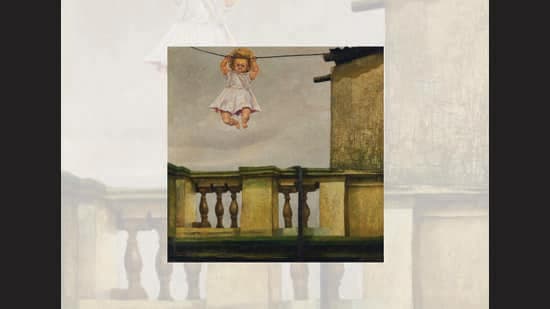
Even if you ve only glanced at a work by Bikash Bhattacharjee, who passed away in 2006, you ll probably find it hard to get it out of your head.
Even if you’ve only glanced at a work by Bikash Bhattacharjee, who passed away in 2006, you’ll probably find it hard to get it out of your head. The works are often creepy, unpleasant to look at, and may cause you to recoil. Boy From Simla (1982) depicts a figure of a young boy, in a ratty sweater, his head floating over his body. Durga (1985) is a back view of women at Pujo – but two have turned around, watching the watcher, clearly uncomfortable. But that’s also why the works are beautiful and powerful. Beyond that deliberate grotesque is incredible emotional depth, as there often is in life as well, if we only care to look.Bhattacharjee was born in 1940 in Bengal to a family that migrated from the East to West at Partition. He lost his father when he was merely six. The struggle of being raised by his widowed mother and living hand-to-mouth in bustling Calcutta became the defining feature of his work. He trained at the Indian College of Art and Draftsmanship, where he also taught for many years, and turned to realism at a time when many Indian artists were moving towards abstraction. The training helped. Bhattacherjee’s paintings are so precise in their rendering of light, fabric, skin and shadow, they’re almost photographic. They show how closely the artist looked at European Masters such as Rembrandt and Goya. Recognition came early. Critics loved his talent for observation and unusual choice of subjects. It began with dolls. The ones from the 1970s were typically plump, blond, blue-eyed little dumplings, in frothy pink frocks. In Bhattacherjee’s works, they starred in unsettling Calcutta scenes: Rummaging deep within open filing cabinets, dangling from cable wires on a terrace, playing dead under a spotlit stage, fraternising with lifeless-looking dolls as a human looks on.Consider now, that the doll is a symbol of the region’s Naxalite movement – a sign that humans have normalised heinous violence. The doll echoes the vulnerability and loss of the city’s emotional upheavals. In each painting, innocence collides with a sense of distress. The mood is almost always sinister. Bhattacharjee was also interested in showing the plight of women. He often painted women in scenes of opulence, many in their personal spaces, but with their eyes blacked out. The woman’s eyes are open in the Portrait of Bala Dasi (1980). She’s young, and wearing the white, indicating that she’s a widow. And in her hands is a mask of a wizened old face. Which is the mask, the one she’s holding or wearing? Has widowhood stolen her youth? Is this what a woman’s life is for? Bhattacharjee’s muted reds, earthy browns, faded greens, and soft whites are his palette to create a quiet yet uneasy mood. His genius lies in never expressly stating anything but inviting the viewer to observe and question. Because even lifeless dolls are telling stories. Women without eyes are forcing you to see them differently. And it’s our world that’s sinister – he’s merely pointing it out.Rajnesh Kumar’s paintings focus on the human figure as a carrier of inner conflict, existential doubt, and social complexity.From HT Brunch, June 27, 2026Follow us on