Gujarat High Court Compensation Losses Ahmedabad Riots
Indian Express
The Gujarat High Court has set aside a 1998 civil court order awarding Rs 45,400 in compensation to an Ahmedabad tailor for losses allegedly suffered during the 1986 communal riots, observing that...
The Gujarat High Court has set aside a 1998 civil court order awarding Rs 45,400 in compensation to an Ahmedabad tailor for losses allegedly suffered during the 1986 communal riots, observing that the court awarded compensation without insisting upon substantive and specific proof of the loss claimed by the plaintiff.
Justice J C Doshi allowed an appeal filed by the district collector and the state government against a 1998 city civil court decree that had directed payment of compensation for property allegedly destroyed during the communal violence on July 13, 1986.
“The learned City Civil Court, instead of scrutinising the evidence strictly in accordance with law, appears to have been swayed away by the fact that the plaintiff’s shop was allegedly damaged in the fire that erupted during the communal riots. Proceeding on that premise, the learned City Civil Court awarded compensation without insisting upon substantive and specific proof of the loss claimed by the plaintif,” the order dated June 24 read.
The court directed that any amount deposited by the state pursuant to the trial court’s order be returned in accordance with law.
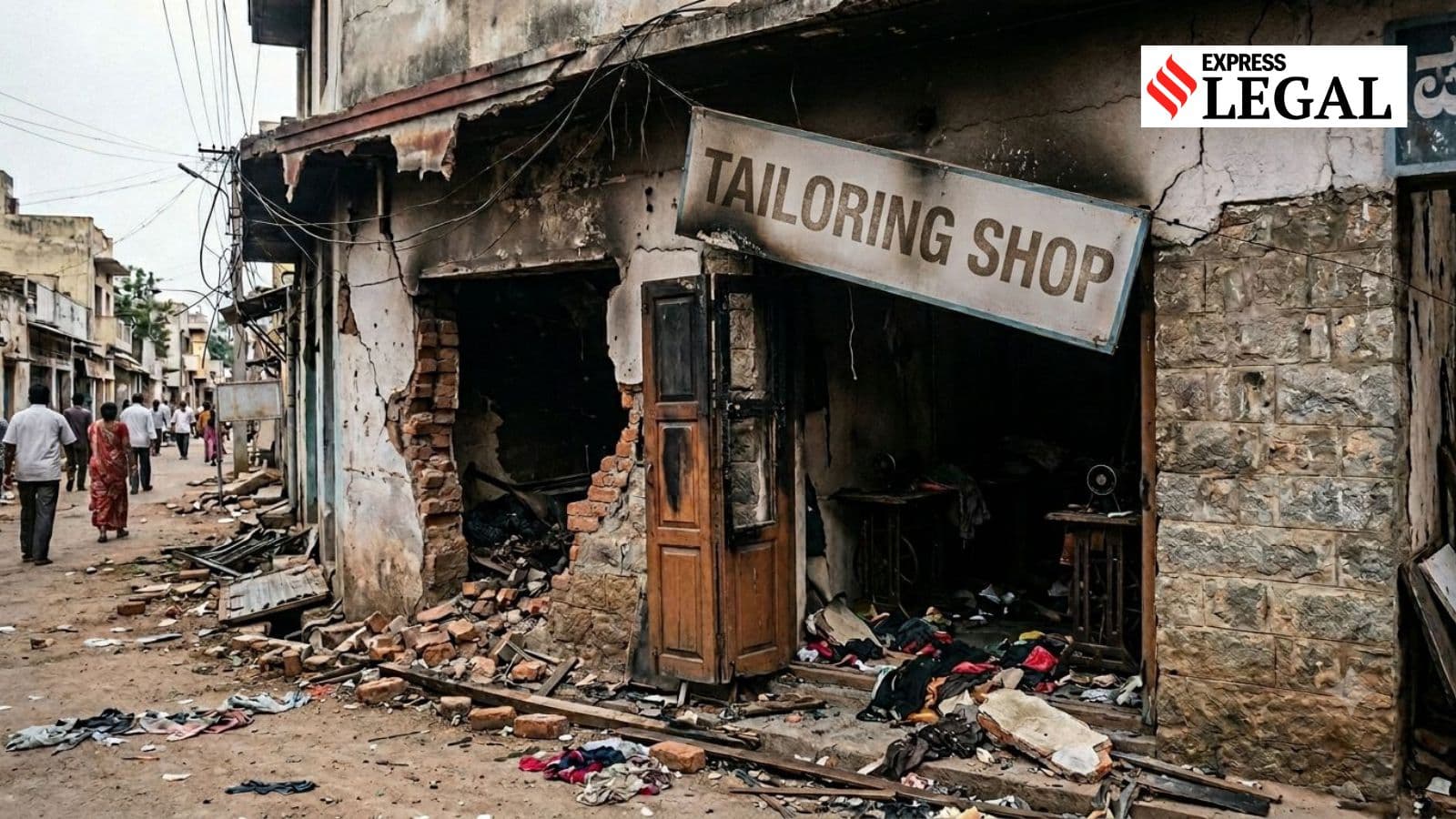
The plaintiff, who ran a tailoring shop, had claimed that a mob broke into his shop during the riots, looted articles including sewing machines, customers’ garments and other articles in the shop, and then set the premises on fire, causing losses of Rs 50,400.
He had received Rs 5,000 as ex gratia relief from the State but approached the civil court seeking the balance amount as compensation.
After considering the oral as well as documentary evidence, the civil court decreed the suit and awarded compensation of Rs 45,400 to the plaintiff.
Challenging the decision, the state argued that the plaintiff had failed to produce reliable evidence proving ownership or tenancy of the shop, the existence and value of the articles allegedly destroyed, or the actual loss suffered.
It was also argued that the plaintiff had not specifically pleaded which articles, furniture, or other items were destroyed in the fire.
On the other hand, the counsel for the plaintiff opposed the plea, contending that the state did not lead any evidence to challenge or discredit the evidence produced by the plaintiff.
It was submitted that, as the plaintiff’s evidence remained substantially unchallenged, the city civil court had rightly appreciated the evidence and decided the suit in favour of the plaintiff.
The high court observed that the occurrence of the communal riots was never seriously disputed and noted that the state itself had acknowledged the incident by granting ex gratia relief.
It however found that the plaint contained only general allegations regarding the destruction of furniture, sewing machines and other articles.
“No specific particulars regarding the nature, quantity, description, or value of the furniture, sewing machines, or other articles have been pleaded in the plaint, the court noted.
It further observed that the plaintiff, in his deposition, introduced several particulars and details which were never pleaded in the plaint.
“In the opinion of this Court, the learned City Civil Court accepted such improved version of the plaintiff as gospel truth and proceeded to decree the suit. Such an approach is erroneous and contrary to the settled principles of law,” the high court held.
The court further observed that a person seeking compensation for property damaged during communal riots must establish ownership, tenancy or lawful possession of the property through documentary evidence and also prove the extent of loss through reliable material such as valuation reports or other corroborative evidence.
The court termed the findings of the civil court as unsustainable to the extent that it had observed that the legality or illegality of the construction was irrelevant while considering the compensation claim.
“A person claiming compensation for destruction of property must first establish a lawful right or interest in the property. Mere assertion that a structure was destroyed in a fire cannot, by itself, entitle a claimant to compensation,” the high court held.
Ashish Shaji is a Senior Sub-Editor at The Indian Express, where he specializes in legal journalism. Combining a formal education in law with years of editorial experience, Ashish provides authoritative coverage and nuanced analysis of court developments and landmark judicial decisions for a national audience. Expertise Legal Core Competency: Ashish is a law graduate (BA LLB) from IME Law College, CCSU. This academic foundation allows him to move beyond surface-level reporting, offering readers a deep-dive into the technicalities of statutes, case law, and legal precedents. Specialized Legal Reporting: His work at The Indian Express focuses on translating the often-dense proceedings of India's top courts into clear, actionable news. His expertise includes: Judicial Analysis: Breaking down complex orders from the Supreme Court and various High Courts. Legal Developments: Monitoring legislative changes and their practical implications for the public and the legal fraternity. Industry Experience: With over 5 years in the field, Ashish has contributed to several niche legal and professional platforms, honing his ability to communicate complex information. His previous experience includes: Lawsikho: Gaining insights into legal education and practical law. Verdictum: Focusing on high-quality legal news and court updates. Enterslice: Working at the intersection of legal, financial, and advisory services. ... Read More