Fifa World Cup Indian Football Aiff Development Optics
Indian Express
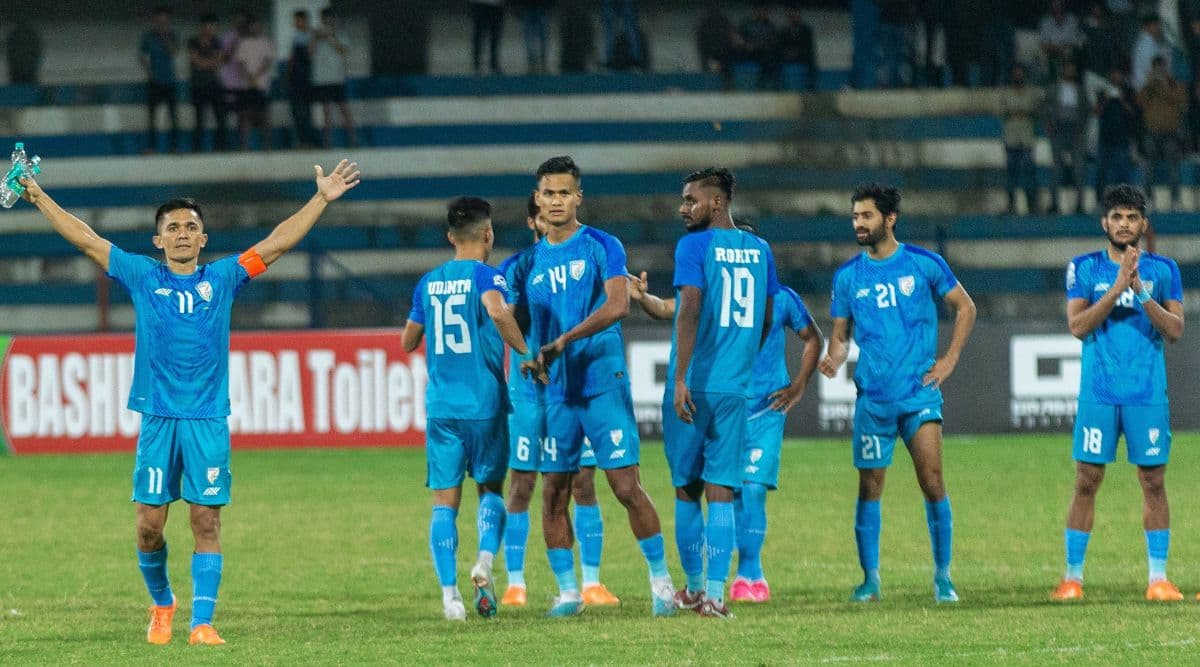
The All India Football Federation proposed changing its name to the Football Federation of Bharat. It also approved the playing of the national anthem and Vande Mataram before official matches
The All India Football Federation proposed changing its name to the Football Federation of Bharat. It also approved the playing of the national anthem and ‘Vande Mataram’ before official matches. The timing was impossible to ignore. These decisions arrived with AIFF elections looming and the political currents around Indian football growing stronger.
There is nothing inherently wrong with symbolism. Nations have always wrapped sport in identity. The problem is that symbolism has become the loudest conversation in Indian football at a moment when the sport desperately needs discussion about performance. While administrators debate names and songs, the national team has quietly slipped into irrelevance.
This World Cup has once again shown that football’s traditional hierarchy is not fixed. Countries with smaller populations, smaller economies and fewer resources have found ways to compete. Some are built on smart scouting. Others on long-term youth development. Others, on clear footballing philosophies that survive changes in coaches and administrators. The common thread is that they all built something.
India, by contrast, often appears to be rebuilding from scratch every few years. The most worrying aspect is that the conversation around Indian football has become increasingly detached from what happens on the pitch. There should be outrage about the national team’s decline. There should be debates about why India continues to struggle against opponents it once expected to beat. There should be scrutiny of talent development pathways.
Instead, Indian football has spent much of the past year dealing with administrative uncertainty. The Indian Super League, supposedly the flagship project that would transform the sport, has lurched from one crisis to another. Investors have walked away. Hundreds of players are facing an uncertain future. The credibility of the entire ecosystem has been damaged.
India has spent a decade celebrating frivolous things. Hosting the U-17 World Cup, for instance. Eighteen players from that edition are now leading their national teams at the ongoing World Cup, from England’s Marc Guehi to Japan’s Takefusa Kubo and Spain’s Ferran Torres. India’s best-trained batch, however, has slipped into oblivion. It begs a question: Is the country’s system good enough to produce elite footballers? The answer is perhaps most visible in the national team’s search for solutions.
Over the past year, much of the discussion has revolved around Overseas Citizens of India and players of Indian origin abroad. The logic is understandable. If the domestic pipeline is not producing enough quality, perhaps help can come from elsewhere. Yet even supporters of the OCI route admit that it is, at best, a short-term patch. India’s citizenship rules currently prevent OCI holders from representing the national team unless they acquire Indian citizenship. All of a sudden, the pretence of developing players has fallen, and the AIFF seems to have put all its eggs in the OCI basket.
The larger question is more uncomfortable. Why is a country of 1.4 billion people looking overseas for answers?
The obsession with OCI players risks becoming a distraction from a more fundamental problem. Scouting and talent identification within India remain woefully inadequate. Every major football nation has networks stretching into villages, schools and local leagues. India still relies heavily on a narrow professional ecosystem concentrated in a handful of states and academies.
Those who should be deciding policies are consumed by governance battles. Meanwhile, the rest of the world moves on.
Countries once considered minnows now produce players in Europe’s top leagues. Smaller football federations have embraced data, analytics and sophisticated scouting. Others have built coherent identities that survive election cycles and administrative changes.
Perhaps that is why the scenes from this World Cup feel so distant. The tournament is filled with nations that spent years making sensible decisions before enjoying their moment on the global stage.
India wants the moment without completing the journey. And if you are expecting a happy ending here, you will not find one. Not yet. Not while symbolism substitutes for substance, or while the national conversation is about names rather than footballers.
The World Cup dream is not impossible. But it is becoming increasingly unrealistic.
Unless Indian football takes drastic steps to fix its structures, strengthen its leagues, widen its scouting network and prioritise development over optics, qualification will remain what it has always been: A dream discussed every four years and forgotten for the next four.
The writer is deputy associate editor, The Indian Express, mihir.vasavda@expressindia,com
Over the course of a 18-year-long career, Mihir Vasavda has covered 2010 FIFA World Cup; the London ... Read More