Brazil Vinicius Scotland Fifa World Cup Neymar
Indian Express
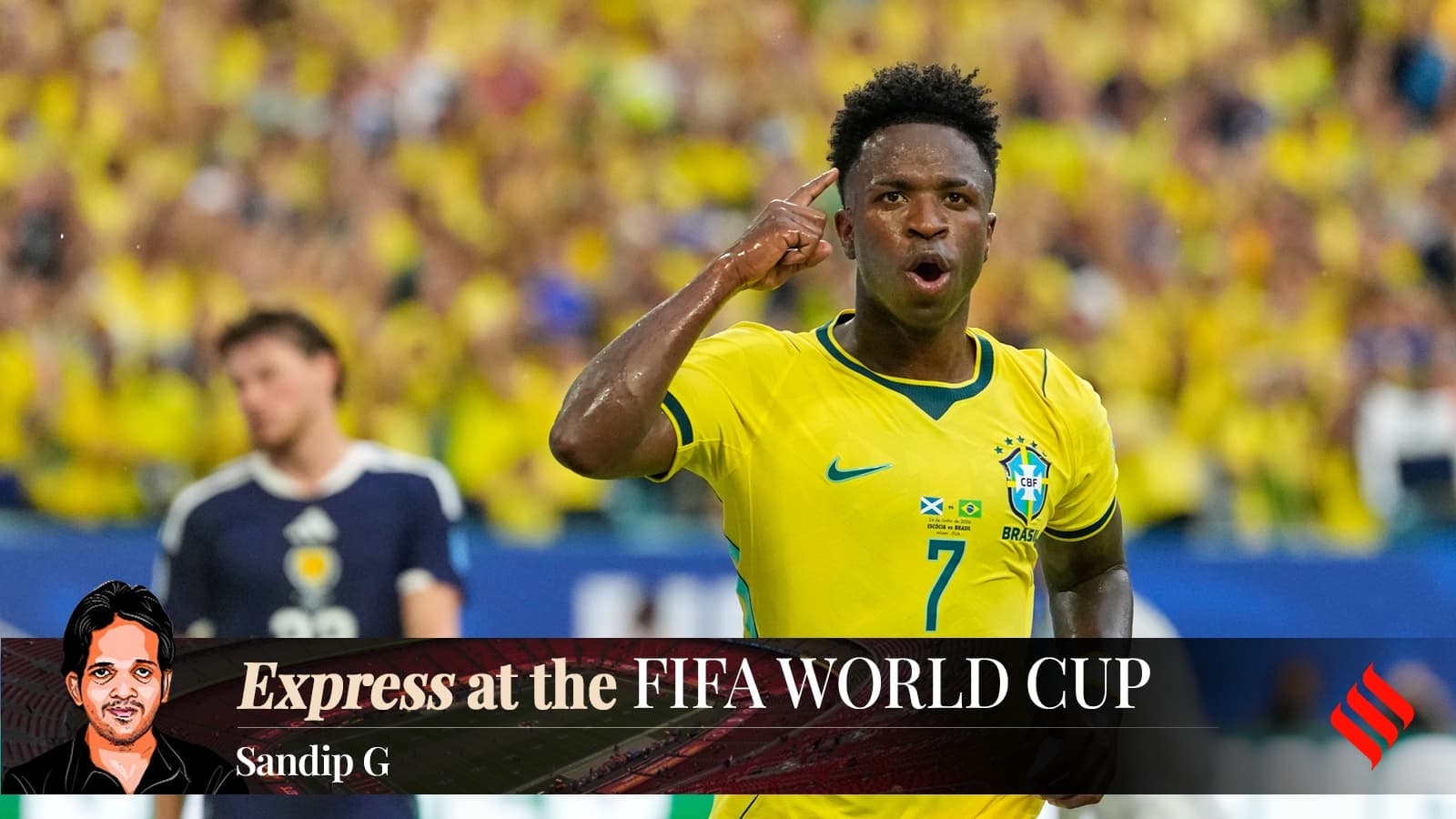
The cameras trailed Vinicius Junior into the tunnel at half time. He turned back with a waspish smile and held up three fingers
. He had pinched a pair of goals, but the goal the Video Assistant Referee chalked off, unjustifiably for him, was incensing him. Before he passed to the tunnel, he stopped beside the assistant referee and wagged his index finger with a sarcastic smile. The disallowed goal, for a contentious nudge on the defender Jack Hendry when he stole the ball, was playing in his mind, amidst the snake-hip gyration that followed the second goal.
Brazil’s third goal eventually came, but from Matteus Cunha to wrap Brazil’s most emphatic day in the World Cup, skinning Scotland, their knockout hopes at the largesse of fate.
Hard it was to argue. “It’s his torque,” Brazil’s assistant coach Francesco Mauri, noted before the World Cup. Physicists call it “the rotational equivalent of linear force,” often used in the context of an engine’s “twisting force”. “He’s a phenomenon in how he uses it. He doesn’t need to wind up the shot a lot in order to generate power. After controlling it, after carrying it, he doesn’t waste time winding up the shot. He uses his ankle and manages to place it and score. He’s scored so many goals like that.” His ankles contort, as though they are made of wax. The great Ronaldinho too possessed rubbery ankles, and it was little coincidence that they were groomed in the narrow hard courts of futsal, where close control is a requisite.
The second (officially, that is) was a humdrum header, from a delightful cross from Bruno Guimares. Vinicius, not renowned for thunderbolt headers, was a fraction late. But he leapt just enough to divert the ball goal-wards. He pointed an imaginary gun at his head, before the customary foot taps ensued. But he was there for the header, making a run from the deep after his defensive chores.
His speed goes understated. He is not an athlete’s run, like Kylian Mbappe. The audience doesn’t feel the raw speed, he does not seem to move his legs, but glides at annihilating speed. There was another instance in the second half when he wiggled past a catacomb of Scottish shirts, received the ball on the runs, passed it to Matheus Cunha, whose shot the goalkeeper blocked, but here was Vinicius almost grabbing it from his palms at the other end. There was another gorgeous side-footed pass in his own half that let Guimares free, even if the move melted away.
As with the two goals, he was there when Brazil needed him. He was their leader, the figurehead. There are a raft of seniors around him, in both age and experience. Casemiro and Marquinhos for instance; or the Jesus Christ between the sticks, Alisson Becker. But Vinicius sealed his leadership, both with action and deeds. He masterfully guided the young Rayan, his goal provider. He exhorted Cunha to calm down when the referee gave a foul against him. He urged the crowd to raise the decibels. He would remember it as an evening he felt the unconditional love of the Brazilian fans. The missing third goal would hurt him, and before walking away at the end of the game, he again held up three fingers. The magic number that would have linked him and Pele, a legacy passed on. But Vinicius is lighting up the tournament, perhaps not in extravagant insouciance myths of Brazilian football, but in a minimalistic manner that could make them a force again.