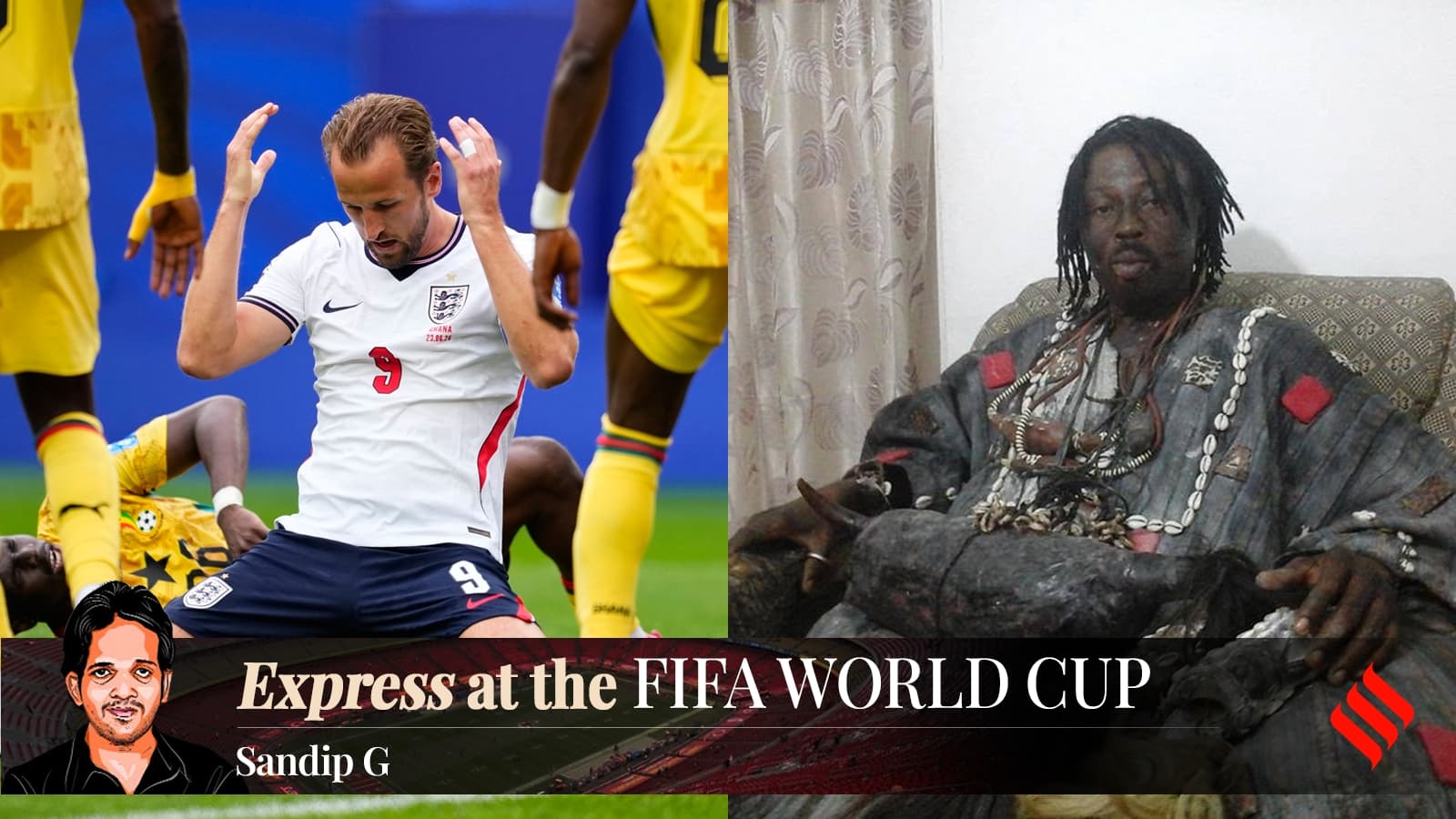
When Harry Kane miscued a rebound deep into the stands in the dying moments of the goalless draw against Ghana, an England fan turned to a Ghanaian neighbour and quipped: “Oh, the spell is working after all.” The Ghana supporter retorted: “No spell friend, he needs some shooting practice.”
The banter was about a claim made before the match by Nana Kwaku Bonsam — whose name translates as Devil of Wednesday — a Ghanaian witch doctor who told the Daily Star he had cast black magic on Kane. He had credentials of a sort: in 2014, he claimed to have engineered a knee injury that threatened Cristiano Ronaldo’s participation in the World Cup ahead of Portugal’s clash with Ghana. “I am working on Harry Kane,” he said. “I have shown what I am capable of before so I know what work I must do to stop him.” He added, with some care: “I am not wishing him serious injury. It will be just enough to stop him against my country.”
AS IT HAPPENED | England held to 0-0 draw by resolute Ghana
Back in Ghana, juju is spoken of in graver tones. “Some sections take it seriously. Even highly educated people,” says Joseph, the Ghanaian fan in the stands. “Whenever we perform badly, they believe someone has done something. When we do well again, some people would say we have done something and that’s why we are winning. I don’t believe in any of these. Most of us don’t.”
The belief runs deep enough that CAF once felt compelled to address it directly. “We are no more willing to see witch doctors on the pitch than cannibals at the concession stands,” read a 2008 CAF statement, issued after a string of incidents involving charms, powders and spiritual advisers at African tournaments. Some countries, including Zambia, have outlawed the practice.
Former Zambian player Nchimunya Mweetwa once told the BBC about his first encounter with juju. “I first encountered the use of juju at this time. The school team had a witch doctor, which we were made to believe would win us matches. After training, he would ask them to apply juju oil”.
At the 2025 AFCON final between Morocco and Senegal, the issue surfaced in a different form. Moroccan ball boys and players repeatedly attempted to remove goalkeeper Edouard Mendy’s towels throughout the match — wet conditions had made them essential for his grip. One Moroccan player was later suspended and fined by CAF for his role in the episode. Some observers framed it as gamesmanship. Others saw something else. “In Europe, people don’t understand that there is something behind it,” former Morocco coach Herve Renard said afterwards. “Was the towel charmed? In Africa, these are beliefs, and everyone is free to believe what they want.”
At the 2022 World Cup, French outlet RFI reported that several Cameroon players had been visiting a spiritual practitioner named Nji Ousseni. “Everyone wants to be selected or to be a holder. Thus for important competitions such as the World Cup or the African Cup of Nations, players often call on my services to invoke the gods in order to disturb the opponent,” Ousseni told RFI. Samuel Eto’o, as federation president, denied the report and demanded an apology.
The banter in the stands continued through the second half. The England fan nudged his Ghanaian neighbour: “Can you teach us some? We want to do magic on our opponents!” Joseph played along: “500 pounds for a session! Deal? It is not easy brother!” Another England supporter: “With that money, we could come to Ghana and learn.” When Nico O’Reilly hit the post, the Englishman asked: “You didn’t spare Nico either?”
After the game, Declan Rice said, with a grin: “Credit to Ghana, they defended well. We tried everything. Shots, headers, set-pieces… nothing worked. I don’t know… maybe the black magic was working!”