Chandigarh Scales Back Plantation Target To 4 19 L Saplings Puts Survival Rate Under Lens
Hindustan Times
Prioritising survival over sheer numbers, the UT administration has scaled back its plantation target to 4.19 lakh saplings for 2026-27, down from the 6.
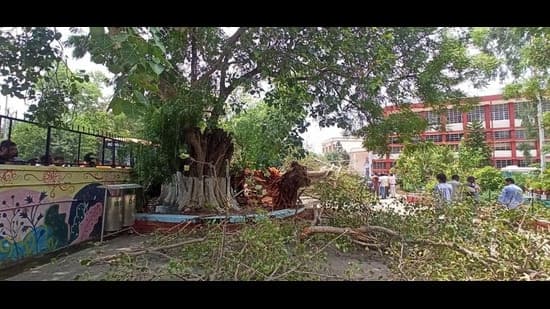
64 lakh achieved in 2025-26 after third-party monitoring found that nearly one in five saplings planted under last year’s drive did not survive.While the administration exceeded its 2025-26 target of 5.76 lakh saplings by over 15%, an overall survival rate of 79% recorded across two third-party audits in November 2025 and March 2026 pointed to gaps in maintenance and post-plantation care. “Before we set ever larger numerical targets, we need to ask whether there is actually the land and the aftercare capacity to support them,” said Harminder Pal Singh, chairperson of the department of environmental studies at Panjab University. “Chandigarh’s original plan favoured a diverse mix of species; repeating the same few trees year after year, without adequate follow-up care, often leads to high failure rates.”Officials from the UT’s department of forest and wildlife said the plantation drive will begin at the onset of the monsoon, with departments aiming to complete it by August 15 so that the remaining monsoon period through September aids natural establishment of saplings. The drive is set to be carried out across key green zones including Lake beat, Kansal and Barotiwala blocks, N-Choe bank, gardens across the city and sector roads, among others.A mix of native species—Jamun, Peepal, Neem, Shisham and Bargot among trees, and Harsingar, Hibiscus and Nirgundi among shrubs—will be planted alongside ornamentals. Of the 4.19 lakh total, 3.24 lakh saplings are earmarked for plantation by greening agencies—the forest department, engineering department and the municipal corporation, along with other stakeholders. The remaining 95,000 will be distributed—80,000 through the forest department and 15,000 through the engineering department.A senior official of the UT department of forest and wildlife said the Green Chandigarh Action Plan is monitored by the Green Chandigarh Task Group, supplemented by third-party inspections twice a year. He added that what sets the city apart from the rest of the country is the convergence of all departments including forest, engineering and the municipal corporation, working as a unified force for the mission.Chandigarh has a total forest area of 3,245.30 hectares, spread across the Sukhna Wildlife Sanctuary, Lake Reserves Forest, Sukhna Cho Reserve Forest, Patiala Ki Rao forests and the forest area at Brick Kiln Manimajra.Heritage trees-a dwindling legacyEven as the city gears up for its annual plantation push, Chandigarh’s oldest living landmarks tell a subtler story of loss. Of the 31 heritage trees recorded under UT data, only 28 remain, three have been lost, including the grand old Peepal at Carmel Convent School in Sector 9, the Peepal at the government nursery in Sector 23, and the Great Mango Tree at Vatika School for Deaf and Dumb Children.The surviving trees, ranging between 150 and 250 years old, are mapped across three trails spanning the city’s northern, central and southern sectors. “These heritage trees should not exist only as entries on a website,” Harminder Pal Singh said. “Their value must be shared with residents and visitors, the information should be actively disseminated, displayed, and accompanied by small protective green belts.”“That will keep people closer to Chandigarh’s living heritage instead of letting it fade into a forgotten legacy,” he added.