Commonwealth Foundation 2026 Short Story Prize Ai Review Granta
Indian Express
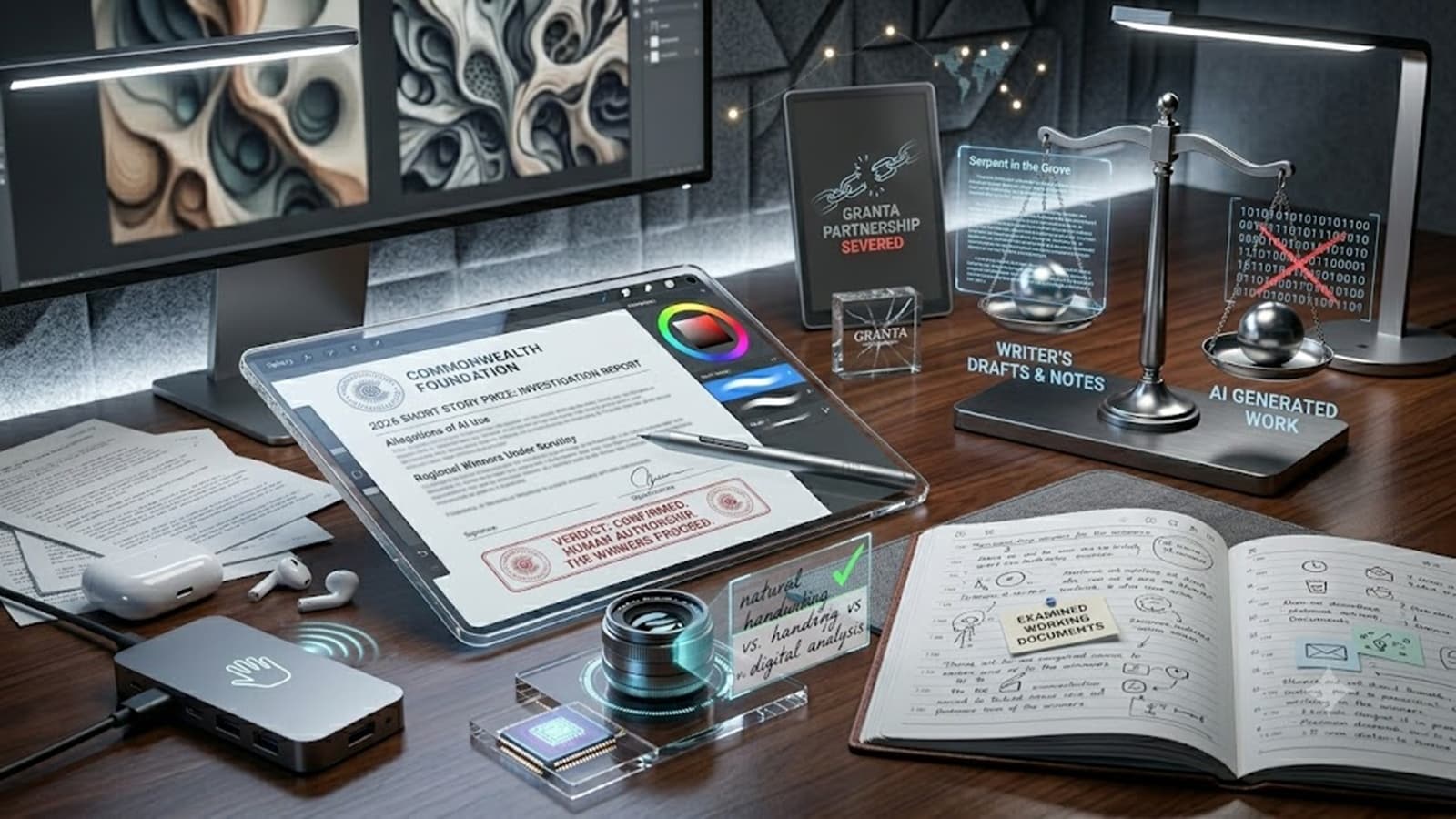
Backing the regional winners chosen by its judging panel, the scandal-beleaguered Commonwealth Foundation on Tuesday announced that it had concluded its monthslong investigation into allegations of...
Backing the regional winners chosen by its judging panel, the scandal-beleaguered Commonwealth Foundation on Tuesday announced that it had concluded its monthslong investigation into allegations of artificial intelligence use in the 2026 Commonwealth Short Story Prize, and had decided to go ahead with the finalists, whose submissions had been published in the acclaimed British literary magazine, Granta.
In a statement, director-general Razmi Farook said the Foundation had spent the past month “thoroughly investigating allegations of AI use” after concerns were raised last month about one or more of the winning stories. More than 7,800 writers entered this year’s competition, and each winning story was read by at least seven people across multiple rounds of judging, according to the Foundation.
Citing concerns over artistic ownership and consent surrounding unpublished work from across the Commonwealth, Farook said the organization does not itself use AI tools in judging, and while AI-detection software was considered, the Foundation determined that while such tools could serve as useful indicators of potential AI involvement, they cannot provide conclusive evidence on their own.
Instead, the Foundation said it relied on direct engagement with the writers, holding detailed discussions with all regional winners about their creative process, examined working drafts, time-stamped documents and notes, and consulted with judges before concluding that AI was not used to write the winning stories.
“After a thorough consultation with our judges and careful consideration of all available information, we are satisfied that AI was not used to write the winning stories. Therefore, we will proceed with the regional winners selected by the independent judging process,” he said in a statement.
The controversy traces back to mid-May, when readers began questioning the authenticity of The Serpent in the Grove, the Caribbean regional winner by Jamir Nazir. Social media users posted that Pangram, one of the more well-regarded tools of its kind despite the imperfections of AI detectors, had rated the story as 100% AI-generated.
The matter rapidly gained legitimacy after University of Pennsylvania professor Ethan Mollick wrote on social media that a wholly AI-generated story had won the prize for the Caribbean region, helping fuel wider scrutiny, and soon several critics claimed the story bore obvious markers of AI-generated writing.
Granta publisher Sigrid Rausing added another wrinkle to the saga after he revealed that the magazine had asked Claude.ai for its own assessment of the story. Rausing said the chatbot’s response concluded the piece was “almost certainly not produced unaided by a human,” adding that the judges may have unknowingly awarded a prize to a work of AI plagiarism, though that may never be confirmed with certainty.
Savvy netizens placed the submissions of all five regional winners, who were competing for the overall award through the software, and found that two other stories failed to pass muster, including Maltese writer John Edward DeMicoli’s The Bastion’s Shadow and indian-origin writer Sharon Aruparayil’s story Mehendi Nights.
In wake of the controversy, two days ago, the magazine Granta ended its 14-year publishing relationship with Granta. The literary magazine, which had hosted winning stories on its website since 2012, announced it would end the partnership entirely.
In a statement to the Guardian UK, Granta said, “For the sake of our own editorial integrity, the Granta Trust board has now taken the decision that we will no longer engage in external publishing partnerships. We will keep the Commonwealth prize shortlisted stories on our website in the public interest, and wish our former partner, the Commonwealth Foundation, all the best in its work.”
Aruparayil, a 25-year-old Indian writer who had first submitted to the Foundation at age 18, firmly denied any AI involvement in an email to The Indian Express, saying no AI tools were used at any stage of writing, editing, or developing her story, and that she could document the process to prove it. “Who will I write for if my audience is hell-bent on feeding my work to the big bad AI machine and ready to crucify me based on what it says? And what about the violation of my rights as a creative whose writing style, that took years of labour in the dark, to suddenly be a prompt away?” she had asked.
Farook acknowledged the toll the controversy has taken on the literary community, saying in the statement that the Foundation recognises the incident has been upsetting for entrants, shortlisted writers, winners, readers and judges, and understands how the growth of AI has heightened broader concerns among artists about authenticity and trust.
“We have begun discussions with relevant organisations about the appropriate use of AI checkers in the context of literary prizes. We look forward to working with writers, literary organisations and others across the sector to contribute constructively to wider discussions around AI and the creative industries,” he said.
The 2026 Commonwealth Short Story Prize is set to conclude on June 30 with the announcement of the overall winner, alongside a documentary film featuring the regional winners and the inspirations behind their work.