Delhi Hc Telegram Block Section 69a It Act
Indian Express
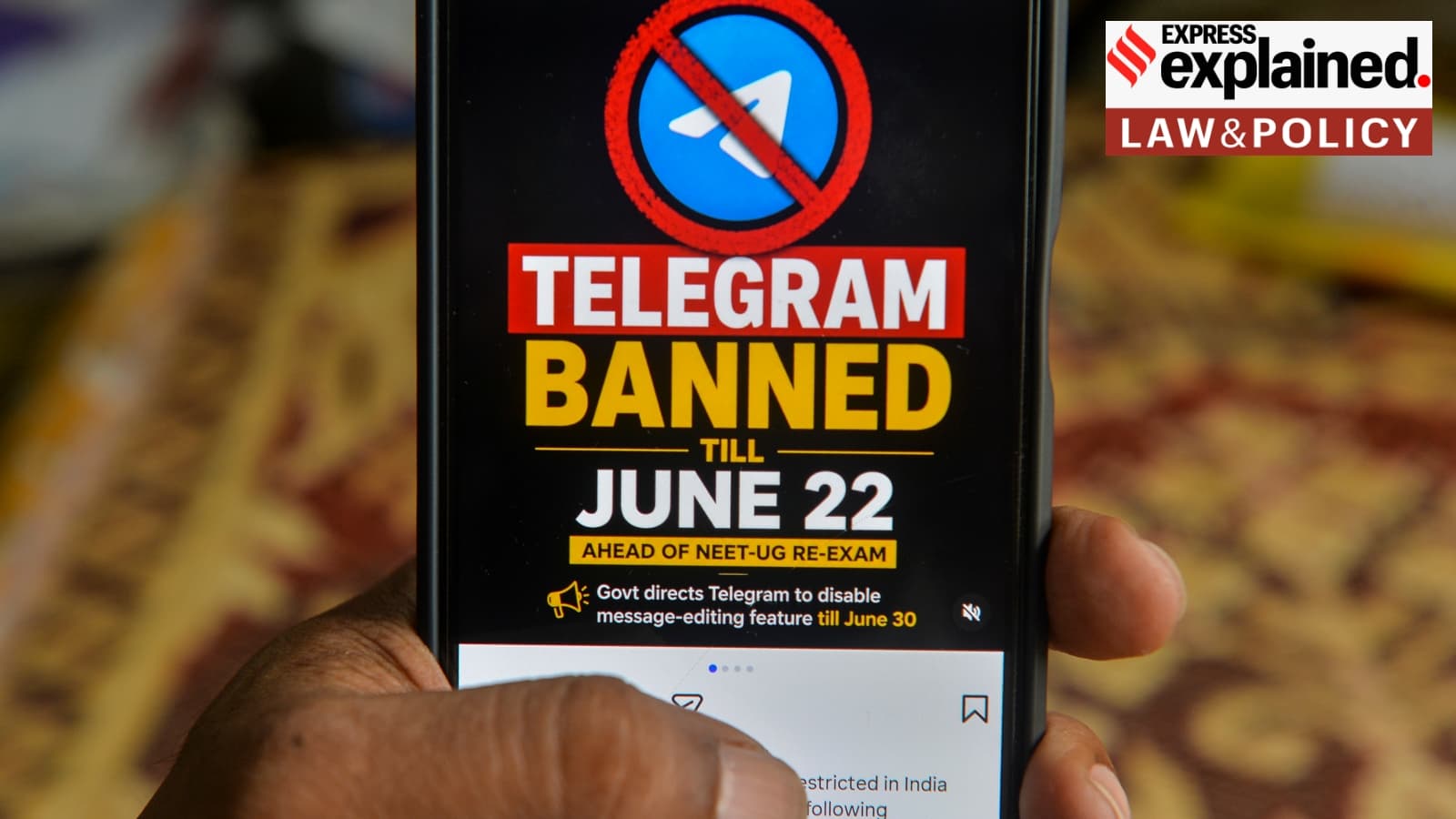
Section 69A lets the Centre block access to information where it is necessary or expedient on grounds that include public order.
Section 69A lets the Centre block access to “information” where it is “necessary or expedient” on grounds that include public order. Section 2(1)(v) of the IT Act defines “information” to include data, codes, computer programmes, software, and databases.
The Information Technology (Procedure and Safeguards for Blocking for Access of Information by Public) Rules, 2009, set out the procedure under Rule 8, which ordinarily requires a hearing before a block, and Rule 9, which lets the secretary issue an interim order first in an emergency with a hearing and then a confirmation by a committee constituted under Rule 7.
Justice Tejas Karia, on the question of whether the order showed a non-application of mind, held that the order’s reasons were sufficient given its emergency character and that the later order confirming the block could add further reasoning rather than being limited to what the interim order said.
On whether the blocking of the whole platform instead of specific content was a proportionate response, the court held that the Centre’s argument on Section 69A’s definition of information, which includes “codes, computer programmes, software and data bases”, is wide enough to cover an app’s architecture, not just the posts on it. “There is no reason to exclude an application or platform from the ambit of the said expression,” the court said.
Previous disputes involving app blocking had not squarely addressed this question. Meghna Bal, director at the technology policy think-tank Esya Centre, told The Indian Express that the interpretation was not entirely unprecedented because Section 69A had previously been used to block Chinese applications. “The language in the IT Act is broad enough to encompass applications,” she said. “The novel context here is that it’s temporary and it was done in the interest of public order.”
The court then applied the four-part proportionality text from Anuradha Bhasin v. Union Of India (2020), holding that the block was necessary because other measures had been “repeatedly found to be ineffective and inadequate” and that its short duration made it “the least restrictive measure for achieving the stated objective”.
Bal asked whether the court had sufficient technical material before it while assessing alternatives to a platform wide restriction. “This is primarily a technology matter, as technology becomes an increasingly pervasive factor in judicial determinations, it is incumbent on the judiciary to reach out to external technology experts, particularly those from civil society, to get their inputs,” she said.
“There can be no effective system of democratic checks and balances if the judiciary merely takes the word of the State when making decisions, particularly when those decisions implicate fundamental rights,” she added.
Courts haven’t had many chances to test platform-wide blocking against the least restrictive measure standard, and where they have, the results have cut both ways.
In 2024, the Delhi High Court upheld blocking of the messaging app Briar under Section 69A on national security grounds. The order noted that the provision could be used to block a “website/software/application” but did not separately examine whether an application itself falls under the definition of information under the IT Act.
In Tanul Thakur v. Union Of India, a satirical website called “Dowry Calculator” created by the journalist Tanul Thakur was blocked under Section 69A in 2018 without any notice given. Thakur spent years in the Delhi High Court simply trying to get a copy of the blocking order and a hearing, both of which the government resisted, citing the Blocking Rules confidentiality clause. By 2023, the court had moved the conversation towards a narrower fix, asking the government to consider unblocking the site if a disclaimer was added, rather than ruling on whether the original whole-site block was ever justified.
The clearest example of a full platform ban being walked backwards seen in April 2019, the Madras High Court’s Madurai bench ordered the Centre to block downloads of the short-form video platform TikTok entirely, citing pornography and child-safety concerns. The Supreme Court intervened within three weeks on appeal by ByteDance, the Chinese internet technology company ByteDance. The Madras High Court then vacated its own order, replacing the download ban with a narrower condition that the platform keep pornographic content off it, backed by the threat of contempt proceedings if it didn’t.
The Delhi High Court accepted the Centre’s position that channel-specific takedowns had repeatedly failed because mirror channels, bots, and backup channels kept reappearing. Bal said that the reasoning leaves open practical questions about whether blocking one platform addresses the underlying problem.
Follow our daily newsletter so you never miss anything important. On Wednesday, we answer readers' questions.
The order risks, according to her, treating the platform itself as the source of the problem “when actually the problematic communications being passed through it are symptoms of a deeper malaise”.