Curacao Fairytale Smallest Nation Fifa World Cup Point Room Advocaat
Indian Express
For ignorant millennials, the FIFA World Cup was a better atlas than geography lessons at school. Korea-Japan 2002 taught us where Henri Camara s Senegal was located
For ignorant millennials, the FIFA World Cup was a better atlas than geography lessons at school. Korea-Japan 2002 taught us where Henri Camara’s Senegal was located. Germany 2006 made it impossible not to know about Andriy Shevchenko’s Ukraine. South Africa 2010 prompted a generation to learn about Asamoah Gyan’s Ghana.
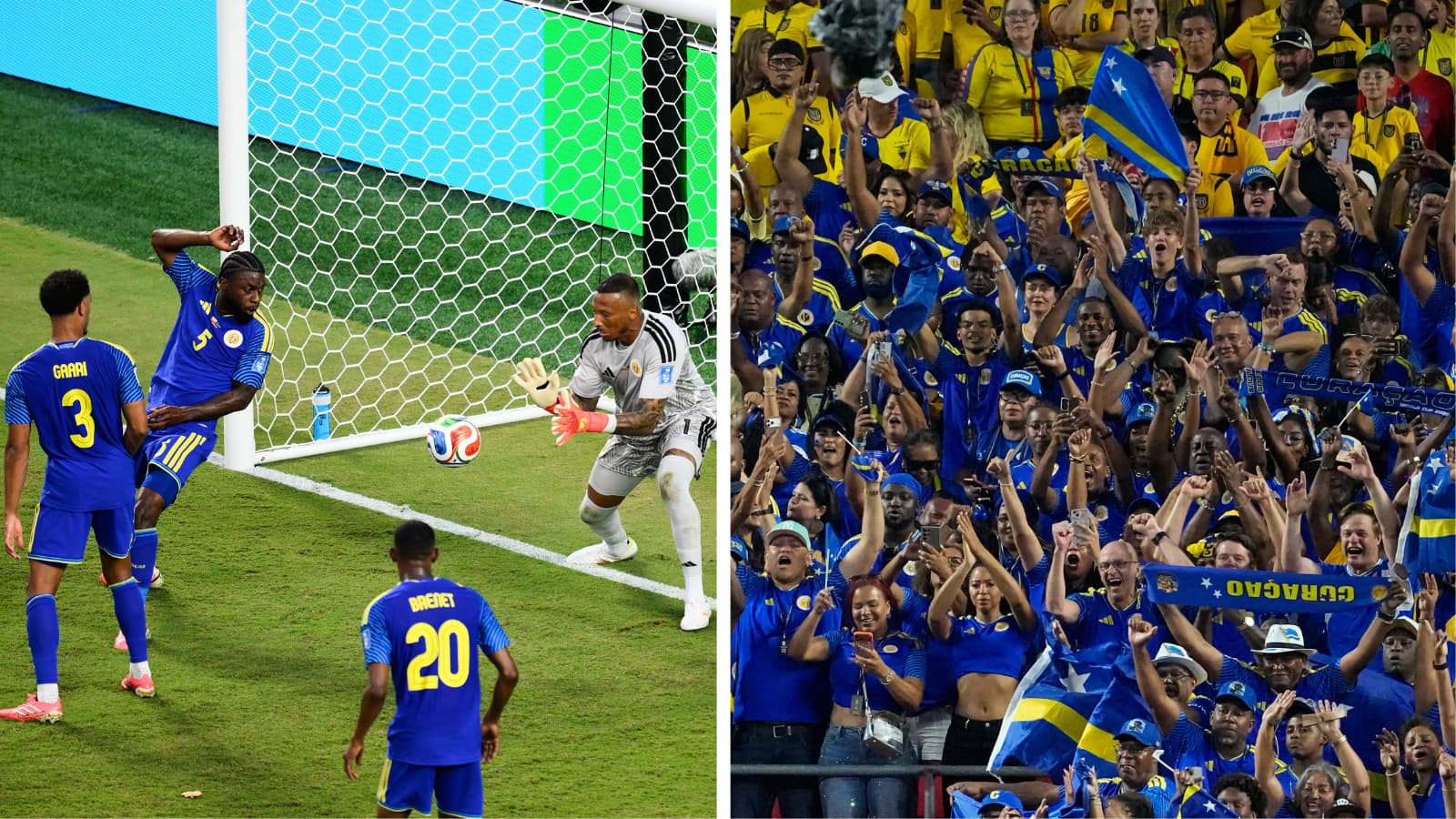
Had USA-Mexico-Canada 2026 been played in that era, we would have run into a problem. We would have scoured through the world map to find Curacao — the team that restricted Ecuador to a 0-0 stalemate on Sunday — and found nothing. They are a tiny dot on a physical map.
Senior & Co., Curaçao’s oldest distillery and the producer of the original Blue Curaçao liqueur, acknowledges the irony on its website: “The funny thing is that now many people know the term Blue Curaçao, but don’t know that Curaçao is also an island.” And you would not be accused of geographical blasphemy for the same. The island has a population of 158,000. Ranked 189th. They have an area of 444 square kilometres.
Ranked 199th. They are the smallest nation — both in terms of population and area — to ever play at a World Cup. At Kansas City, however, they demonstrated they had not travelled to the United States merely to make up the numbers.
Like every oppressed populace, Curacao has had its revolutions. Walk through the Kura Hulanda Museum, and the story of Tula will reveal itself. Inspired by the Haitian and French revolutions, Tula led an uprising. It did not yield anything significant — Tula was captured and executed before he could achieve his mission. On the lanes of Willemstad, though, his legacy lives on. The draw with Ecuador, in a similar fashion, may survive only as a footnote in the wider narrative of Group E — squeezed between Germany’s last-gasp winner and the Netherlands’ five-goal exhibition. But for those 158,000 inhabitants, it will become folklore.
In fact, players had to bear their own expenses and raise reimbursement applications. That is, if they were lucky. The first signs of transformation came through Patrick Kluivert — the Dutch icon whose mother hails from the island. He orchestrated the acquisition and naturalisation of Dutch players with Curacaoan roots. The project continues to bear fruit. One of the first players he contacted was Eloy Room. Against Ecuador, the goalkeeper produced 15 saves — the most by any goalkeeper in regulation time in World Cup history.
Room, though, is not the only member from the squad to script history. When Dick Advocaat coached the Netherlands team at the 1994 World Cup, 19 of the 25 current squad members were not even born. Against Germany on Sunday, he became the oldest coach in World Cup history, at 78 years and 260 days.
Curacao’s initiation at the grandest pedestal was unsurprisingly unceremonious. They did a Brazil — losing 7-1 to Germany. Yet, Advocaat announced after the match: “We must be proud.”
Why so? For the official attendance at that game — 68,021 — was more than one-third of the island’s population. “We only usually drive by stadiums this size. We never play there. It’s unfathomable that we’re actually playing in this huge tournament. The fans will never forget this,” he said.
It has not always been smooth sailing for Advocaat. At times, he has found himself engulfed in a battle between his players and his federation over unpaid salaries and bonuses. Earlier this year, football became secondary to him altogether. He had to vacate his role earlier this year to tend to his daughter, who was diagnosed with cancer.
Encouraging results from chemotherapy persuaded him to return, but on the eve of the decisive qualifier against Jamaica — a match in which a draw would secure World Cup qualification — he had to leave once again.
Room tried to inspire confidence. He told his coach, “Family always comes first. You don’t have to worry. We will give everything against Jamaica.”
They did. He did. Against Jamaica, and now, against Ecuador.
In the USA, Curacao is known as the land of the Jurickson Profers and Kenley Jansens. MLB greats. From Sunday, it will be equally known as the land of Eloy Rooms and Leandro Bacunas — who has been a consistent feature in the Curacao team since 2016, and has made the joint-highest appearances for the Blue Wave.
A melting pot of culture, four languages are spoken in the island daily — Dutch, Papiamento, English and Spanish.
Add a fifth to it. From now on, Curacao will also speak the language of football.