Late Monsoon Weak June Rain Amid Paddy Season Threaten Punjab S Groundwater
Hindustan Times
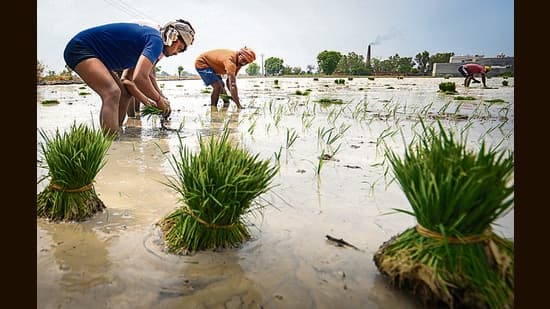
With the southwest monsoon running behind schedule and Punjab recording below-normal rainfall through June so far, concerns are growing over increased dependence on groundwater during the ongoing...
With the southwest monsoon running behind schedule and Punjab recording below-normal rainfall through June so far, concerns are growing over increased dependence on groundwater during the ongoing paddy transplantation season, which could further strain the state’s already depleted resources.
According to the India Meteorological Department’s (IMD) special weather report, Punjab recorded a 20% rainfall deficit between June 1 and June 19, receiving 21.1 mm rainfall against the normal 30.2 mm.
In comparison, neighbouring Haryana-Chandigarh-Delhi meteorological division recorded 17% surplus rainfall during the same period.
The situation has been exacerbated by the sluggish advancement of southwest monsoon, which currently remains stalled over Maharashtra in the absence of favourable meteorological conditions.
While the monsoon reached parts of Punjab on June 22 last year and covered the entire state by June 26, meteorologists say there are currently no signs of its arrival before the first week of July.
“We do not see any favourable conditions for monsoon’s timely arrival in Punjab. It usually reaches the state around June 23 or 24 and covers the entire state by the end of June. This year, its onset is delayed,” said Surender Paul, director, IMD, Chandigarh.
He said isolated thunderstorm activity was likely over the next few days, but significant rainfall was not expected during the next four to five days and temperatures will remain high.
The rainfall deficit comes at a crucial stage when paddy transplantation, which got underway on June 1, gathers pace across Punjab. The state cultivates paddy on nearly 32 lakh hectares annually and relies heavily on groundwater for irrigation.
Dr SS Gosal, vice-chancellor of Punjab Agricultural University (PAU), said adequate rainfall was critical to reducing dependence on groundwater during the transplantation period.
“Deficient rainfall or a weak monsoon further aggravates the problem of declining groundwater levels. Farmers have to transplant paddy during a fixed window, and if rainfall is inadequate during that period, they are left with no option but to rely on groundwater for irrigation,” Gosal said.
Punjab uses more than 13.94 lakh tubewells during the paddy season, many of them located in districts where groundwater has already been categorised as “overexploited”.
Gossal said PAU had developed the short-duration paddy variety PR-126 to help conserve groundwater. But he expressed concern over the cultivation of certain long-duration hybrid varieties.
“Unfortunately, some unapproved hybrid paddy varieties are available in the market. These are long-duration varieties that require more water, thereby increasing dependence on groundwater and putting additional pressure on the state’s depleting water resources,” he said.
India receives more than 70% of its annual rainfall during the southwest monsoon, making its timely arrival critical for agriculture, groundwater recharge, drinking water supply and power generation.
Karam Prakash is a Patiala-based senior correspondent covering several districts of Malwa region of Punjab. He writes on various domains, including health, agriculture, power and education.