Lionel Messi Hattrick Fifa World Cup 2026 Argentina
Indian Express
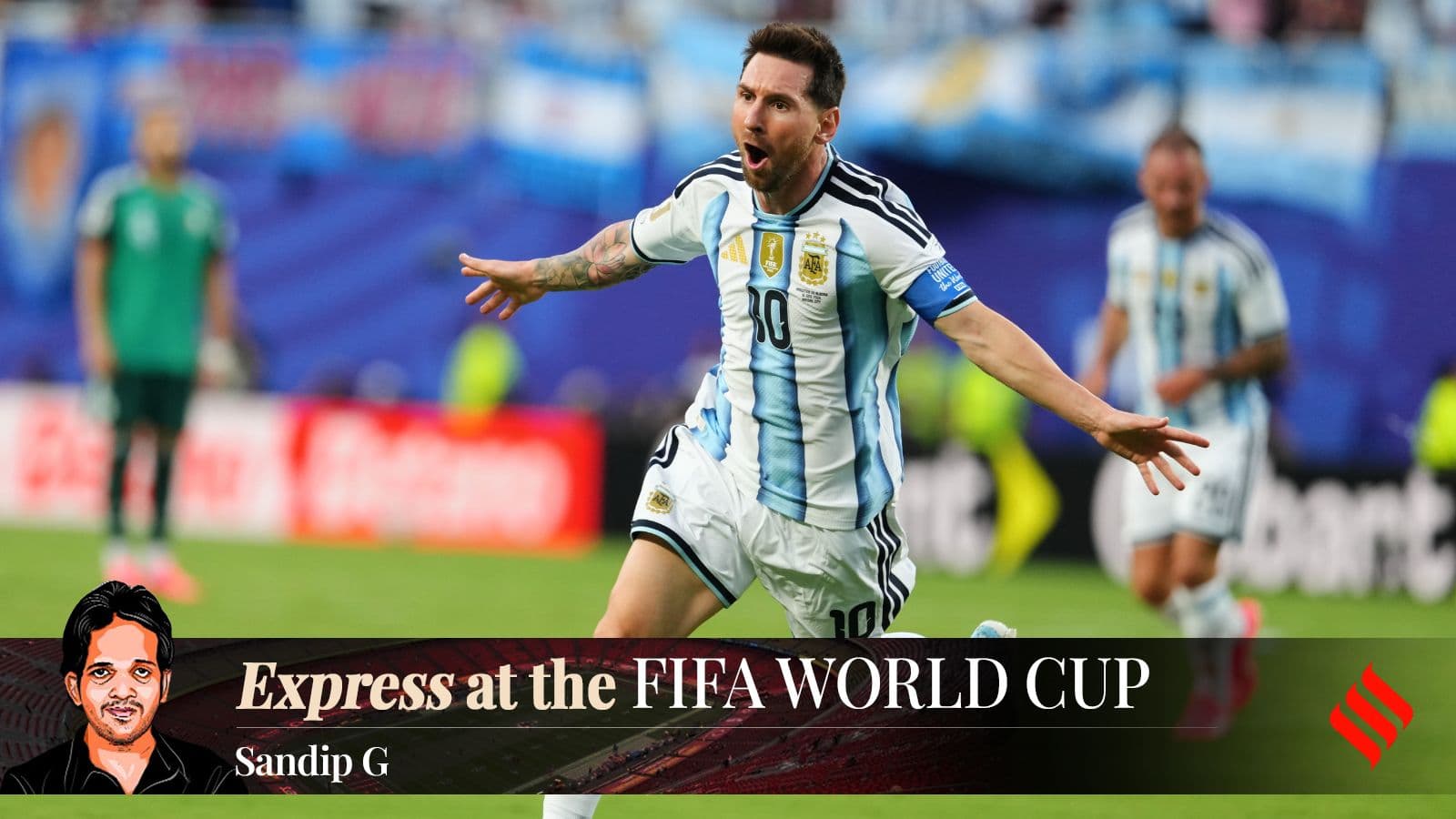
For much of the build-up to the World Cup, the questions had been familiar. Was Lionel Messi fit?
Was this one World Cup too far? At 38, carrying the load of two decades at the summit of football, could he still bend the sport to his will when it mattered most?
Ninety minutes into Argentina’s World Cup opener against Algeria in Kansas City, the answer had arrived in the form of three goals, a standing ovation and a reminder that football’s greatest stage still seems to belong to him.
Argentina began their title defence with a 3-0 win and Messi, playing in a record sixth World Cup, played the central role once again with a hat-trick that cleared the air around his fitness, and gave Argentina’s title defence wings.
It was also a night when the World Cup’s biggest stars collectively announced their presence. Kylian Mbappe scored a brace as France opened with a 3-1 win over Senegal, while Erling Haaland, too, found the net twice in Norway’s 4-1 victory over Iraq.
Mbappe and Haaland, though, seemed like opening acts before Messi came and stole the show. The oldest member of football’s superstar trio produced the most complete performance of them all.
The scoreline suggested comfort, but there had been a moment of unease for Argentina. Algeria thought they had struck first through winger Fares Chaibi, only for the goal to be ruled out for offside after a VAR review. It proved a brief interruption rather than a warning. Argentina quickly settled into the rhythm that has defined the Lionel Scaloni era: patient possession, sharp passing triangles and midfielders constantly offering angles around Messi.
The breakthrough arrived through the captain in the 17th minute. Receiving the ball outside the area, Messi – who, too, had a goal ruled out for offside in the 5th minute – shifted the angle and unleashed a powerful strike that flew beyond the goalkeeper; with a single swing of his left boot, he answered every pre-tournament doubt.
From there, Argentina controlled proceedings. Rodrigo De Paul dominated around midfield, Alexis Mac Allister conjured attacks together and Lautaro Martínez puzzled Algerian defenders with relentless movement. Yet, every promising move seemed to draw towards Messi, as if some sort of a magnetic effect. Even when he dropped deep, Algeria’s defensive block followed him, creating space elsewhere.
His second goal came at the hour mark. Argentina worked the ball into the area, chaos followed, a loose clearance fell in the path of Messis, who finished from a close range. If the first goal carried oomph, this one showed classic positional understanding.
The hat-trick arrived in the 77th minute with the sort of move that has accompanied Messi through six World Cups. Quick combinations, subtle movement, perfect timing. Argentina carved through Algeria’s defence and Messi completed the sequence with a composed finish, threading the ball through three defenders to beat the goalkeeper. It was a goal that brought the stadium to its feet. L
Algeria, who had adopted a cautious approach and even left Riyad Mahrez on the bench for long periods, struggled to cope with Argentina’s speed of thought. Their shape remained organised for spells, but every defensive line eventually fractured under the pressure of Argentina’s passing and Messi’s movement.
When Scaloni finally withdrew his captain in the 80th minute, the standing ovation was immediate and unanimous. Messi left the field smiling; his work done, Argentina’s campaign launched.
Messi came into the tournaments not in the best of form and fitness. He left the field by equalling German great Miroslav Klose’s record of most World Cup goals – 15.
And on the night when football stars shone, Argentina’s win showed that the tournament still revolved around Lionel Messi.