Sc Notice To Centre Punjab Over Rte Act Compliance
Hindustan Times
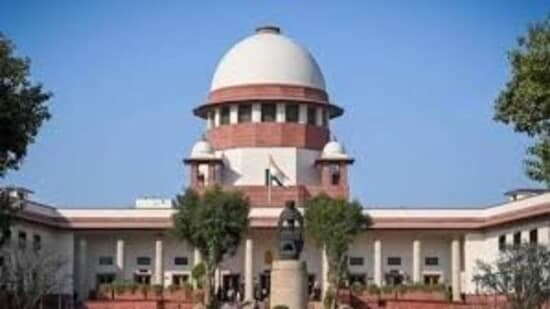
The Supreme Court on Monday sought responses from the Centre and the Punjab government on a petition alleging the non-implementation of the Right of Children to Free and Compulsory Education Act, 2009 (RTE) in the state since its inception. A bench of Chief Ju
stice of India (CJI) Surya Kant and justice V Mohana passed the order on a petition filed by a retired bureaucrat, KS Raju, who claimed to be involved in the formulation of the 2009 Act.
Raju, who filed the petition through his trust called the KS Raju Legal Trust, appeared in person and informed the bench that private schools in Punjab are not adhering to section 12(1)(c) of the RTE Act, which requires admission of children belonging to economically weaker sections (EWS) of society to the extent of at least 25% at the entry level.
Since Raju had earlier approached the high court, the bench noted that the state government filed an affidavit there indicating that 476 children under EWS were admitted across private, unaided schools in the state.
“Have you identified the schools which are not doing it? Since you are working in this field and may have your own sources, why don’t you do a pilot study for some distant, remote districts such as Fazilka and find out how many private schools there are, what is the total number of admissions, how many EWS students have been admitted. When you get this information, we will have some material.”
The bench said that in big cities like Ludhiana and Jalandhar, people are more likely to get good government schools. “We are more concerned about the distant areas in the state,” the bench told the petitioner.
The court even enquired from the petitioner on the policy prevailing in the state. The petitioner said that the amount of fees fixed by the government is paid to the schools. At one point during the hearing, the court was wary of the petitioner’s interests. “We hope you are not fighting for the private schools to get the fees from the government,” the bench remarked, to which Raju said that he retired as a senior bureaucrat from the Central government and has been deeply associated with the RTE Act and its implementation.
He said that in 2012, the Supreme Court judgment in Society for Unaided Private Schools in Rajasthan v Union of India case, made it mandatory for all private, unaided schools to implement the RTE Act. By a subsequent decision in Pramati Educational & Cultural Trust (2014), this judgment was reaffirmed. Despite this, he added, the Act has not been implemented throughout the state. Repeated appeals by the Union government and other statutory bodies have not yielded any results.
“Under the Right to Information Act too, I have not obtained information from the state agencies,” Raju said. The bench said that RTI responses are based on the questions asked. “The problem with RTI is that they will respond to the questions as framed by you,” the bench said.
In 2025, the Punjab and Haryana high court, acting on Raju’s petition, issued directions to enforce the 2009 law. He later filed a contempt plea following inaction by the state to comply with the court’s orders. As the directions of the high court remained unimplemented, Raju approached the top court seeking a direction to the Centre to take steps under Article 256 of the Constitution, which empowers the Centre to issue directions for implementing a Parliamentary statute.
The petition filed before the top court said, “Sustained non-compliance with Parliamentary law, disobedience of binding judicial directions and resultant deprivation of rights under Articles 14 (right to equality) and 21A (right to free and compulsory education) may attract the responsibility of Union under Article 355 to ensure that the governance of the state is carried on in accordance with the provisions of the Constitution.”
As the admission cycle for 2026-27 is expected to be completed by July, the petition sought the establishment of a transparent, time-bound and effective implementation mechanism in Punjab for operationalising the provisions of the Act, and for a dashboard providing information on available seats, admission schedule, application process, reimbursement framework, among other details that can be easily accessed by the public.