Our Highways Are Back On Track
Hindustan Times
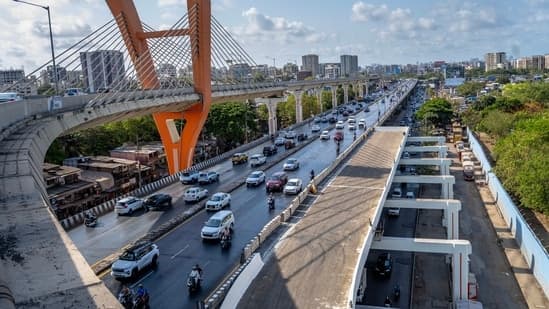
India's road safety challenge remains significant. According to data tabled in Parliament by the ministry of road transport and highways (MoRTH), accidents on national highways claimed about 52,609 lives in 2024, and in the first six months of 2025 alone, that
number had already crossed 26,770. The pattern points to a structural issue: National highways make up just 2.1% of India's road network yet account for nearly 30% of all road accidents. Engineering quality and long-term maintenance accountability are increasingly recognised as critical to reversing this trend.That is where India’s public-private partnership (PPP) model was supposed to deliver, but where, over the past decade, the framework has faced significant headwinds. Today the government is attempting to fix that, not by abandoning PPPs, but by rebuilding the framework. Public spending has powered India’s highway expansion in recent years, but it has also crowded out private investment. The numbers are stark. Build-operate-transfer (BOT) highway projects, which place construction and revenue risk on private developers, have been nearly absent in the past couple of years. It is not a lack of market interest but rather limitations in the underlying framework that made risk allocation overly one-sided and, in practice, difficult to finance. If the government wants private capital back, the PPP model must first earn back credibility.PPP is often treated as a financing tool, which misses the point. It is fundamentally a quality mechanism.When a private concessionaire builds and operates a highway over a 20-30-year horizon, it has skin in the game beyond construction. Revenues depend on usage. Usage depends on quality, safety, and reliability. That alignment is what drives better long-term outcomes. When projects stall, that discipline disappears.If designed right, BOT remains the most efficient model because the problem was never the model itself; it was how risk was allocated within it.The principle behind the latest Model Concession Agreement (MCA) revisions is simple. Risk should be borne by the party best placed to bear it.Earlier frameworks violated this principle. Traffic and revenue risk, highly uncertain and often policy-driven, was pushed almost entirely onto concessionaires. When projections fell short, there was little recourse. Projects turned into financial traps. Banks pulled back. The pipeline collapsed. The new reforms attempt to correct that asymmetry.The revised framework introduces a two-sided mechanism. During the first seven years of operations, if traffic falls more than 10% below projections in the initial years, the government provides calibrated revenue support. Beyond that, projects are given more time through concession extensions. At extreme shortfalls (beyond 20%), developers can exit under defined conditions.But there is a trade-off. On the upside, traffic exceeding projections by more than 10% leads to a proportional reduction in the concession period. In effect, gains are partially clawed back. That raises a legitimate question: While downside risk is now cushioned, is upside sufficiently attractive? Investors will watch closely how this balance plays out in practice.Beyond traffic, several long-standing concerns have been addressed.When a concessionaire defaults, lenders previously had the right to substitute a new operator, but exercising that right was painfully slow, and projects would rot in limbo for years. The new rules give the government itself the authority to step in and substitute the concessionaire, guaranteeing lenders over 80% of outstanding debt in the process. Projects keep moving. Lenders stop panicking. Other technical changes matter deeply for execution. Land handover requirements have been strengthened, with a higher threshold (95%) required before project commencement and clear timelines for completing the balance. Compensation mechanisms for authority defaults are now formula-driven across both construction and operational phases. Dispute resolution has been streamlined to avoid prolonged arbitration cycles.Even operational accountability has been strengthened through mandatory accident analysis and penalties linked to design or maintenance failures. Individually, these may seem incremental. Collectively, they address the exact friction points that made PPP projects difficult to finance and manage.The case for fixing PPP is not just about attracting capital; it is about improving outcomes. Recent reforms, including the removal of financial criteria for consultants who design roads, greater emphasis on technical competence, and stronger quality oversight mechanisms, reflect a growing recognition that the problem runs deeper than financing structures. High-quality roads generate consistent toll revenues, lower maintenance costs, and longer asset life. More importantly, they build user trust. PPP aligns incentives toward that quality. Without it, infrastructure risks becoming a volume game, focused on kilometres built rather than performance sustained. India doesn’t lack capacity; the challenge is to restore the trust and bring private capital back for the long haul.The policy architecture is now moving in that direction. Recently, MoRTH revised BOT bidding guidelines to allow sovereign wealth funds, infrastructure funds, pension funds, and private equity to directly bid for highway projects--a category previously restricted to construction companies. This is a meaningful signal: patient, long-horizon capital is exactly what highway PPPs need, and opening the door to it addresses both the financing gap and the accountability gap simultaneously. If the framework reforms hold and investor confidence returns, India's roads could finally deliver not just on scale, but on quality and safety.(The views expressed are personal)This article is authored by Anuj Gupta, MD, BowerGroupAsia.