Golden Harvest Bumper Sales Man Tripled Income
Indian Express
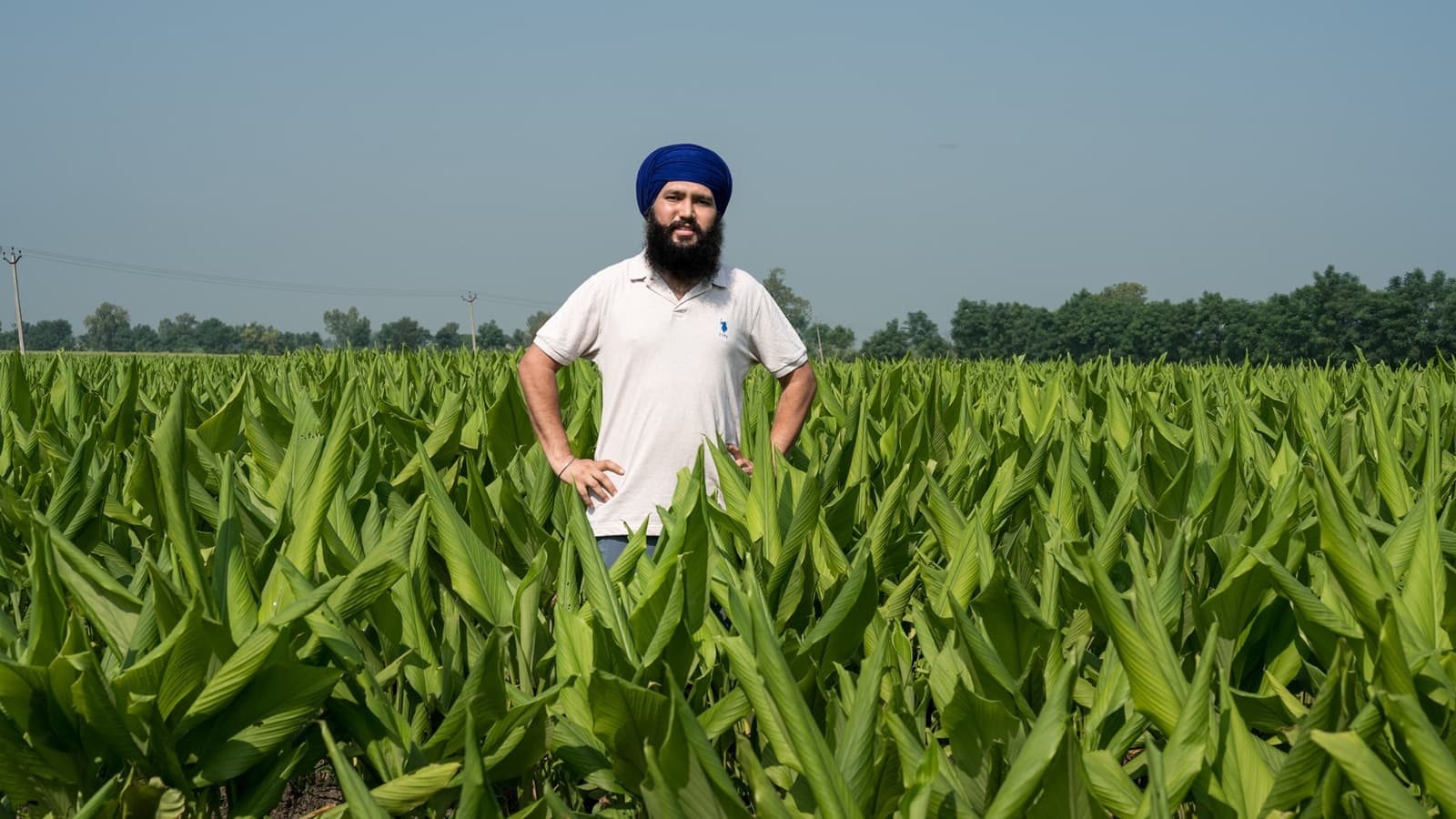
Educated youths moving away from agriculture might be a common view. Amid this increasing distance, Atinderpal Singh (33) has created his brand Samra Turmeric Farm, which has emerged as an example of value created through scientific knowledge, direct marketing
and consumer trust. From Barnala’s Kattu village, he completed his masters in Agronomy from Punjab Agricultural University (PAU), Ludhiana, in 2015, after which he taught at a college for a year. However, what intrigued him was agriculture — it led him to his family’s 15-acre farm. He spent two years cultivating traditional wheat and paddy crops. Soon after, at the age of 26, he introduced turmeric on two acres in 2019, experimentally. It soon turned into success, encouraging him to expand turmeric cultivation to nine acres by 2022. His goal? To produce and sell adulteration-free turmeric. His shift from traditional crops to turmeric increased his crop production value from Rs 1.25 lakh to Rs 4 lakh per acre in the first year — more than three times higher. Earlier, the nine acres of wheat and paddy generated about Rs 11 lakh annually; today the same land with turmeric generates nearly Rs 38 lakh annually with 40 per cent profit margin. Atinderpal’s shift to turmeric was driven by his resolve to counter the widespread issue of adulteration. During the two years when he cultivated wheat and paddy, he also assisted a friend who was developing a turmeric-processing machine, with statistical analysis. (Express Screengrab) “In 2015, after completing my MSc, I started teaching at a college. However, my heart was always in agriculture… joined my father, Sarabjit Singh, in cultivation.” During the two years when he cultivated wheat and paddy, he also assisted a friend who was developing a turmeric-processing machine, with statistical analysis. The work gave him an opportunity to visit markets, and research institutes like Central Food Technological Research Institute (CFTRI), Mysuru, and the Indian Institute of Spices Research, Kozhikode. “I came across studies showing that turmeric powder is often adulterated with chemicals such as Metanil Yellow and Lead Chromate to enhance colour and density. Lead Chromate is a known carcinogen. That disturbed me. Turmeric is used in almost every Indian kitchen several times a day. If people cannot trust even such a basic ingredient, there is a serious problem.” He decided to grow turmeric on two acres as an experiment, and wanted complete control over the journey from field to kitchen to guarantee purity. Atinderpal established his own processing unit at a cost of about Rs 12 lakh. After harvesting, the rhizomes are cleaned, boiled, dried, graded, ground and packed at the facility. “I was determined not to sell in wholesale markets… if I had to sit on a roadside cart and sell it directly, I would do that. The product had to reach consumers without losing its identity.” For the first two years, he marketed his turmeric by travelling. Through announcements at village gurdwaras, he informed residents about the turmeric. He also carried packed turmeric and sold it directly to consumers. Even his turmeric exports to Canada are made directly to retail customers. Word spread steadily, and people not only appreciated the quality but also the transparency. All the stages, from cultivation and boiling to drying, grinding and packaging, were carried out under his supervision. “Today, we don’t have to look for customers… our entire turmeric production is sold directly from the farm.” Atinderpal credits much of the success to his father’s support. “My objective was never to sell only to a selected few… everyone deserves access to an unadulterated product at a reasonable price,” he says. “I could sell it at a much higher price, but I do not want to increase my profits at the cost of economically weaker consumers,” he says. Today, he produces around 100 quintals of fresh turmeric annually, yielding about 17 quintals of turmeric powder after processing. His turmeric is sold at Rs 250 per kilogram, while a 400-gram pack costs Rs 100. He uses farmyard manure per acre each season, and paddy straw as mulch to suppress weeds and conserve moisture. Irrigation is limited to four or five watering cycles, he says. He says, “Turmeric cultivation helped return many birds and beneficial insects, which had disappeared. The ecological balance in the fields has improved significantly.” Turmeric is planted in April and harvested in March next year. After extensive experimentation, he adopted the high-performing Pragati variety. Unlike many perishable crops, turmeric can be stored and processed throughout the year. The venture has also created local employment to 25 to 30 people, mostly women. “If we do not cultivate our own land and build value around our produce, corporations will eventually take over that space. Farmers need to retain control over cultivation, processing and marketing,” Atinderpal says. With demand growing steadily, he is also considering other products of turmeric by forming a Farmer Producer Organisation (FPO) to bring more farmers into the model.