New Delimitation Formula Will It Help The Telugu States
Great Andhra
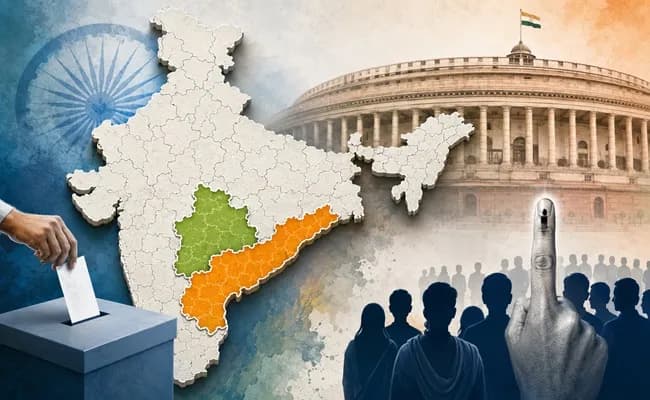
The latest proposal by the Prime Minister s Economic Advisory Council (PM-EAC) on the delimitation of Lok Sabha constituencies has once again triggered a nationwide debate. In its latest
The latest proposal by the Prime Minister’s Economic Advisory Council (PM-EAC) on the delimitation of Lok Sabha constituencies has once again triggered a nationwide debate.
In its latest recommendations, the council suggested increasing the number of Lok Sabha constituencies from the current 543 to 824.
Instead of proposing a blanket 50% increase in the existing number of Lok Sabha seats in every state, the council has come up with a new formula.
Under this formula, rather than redrawing all constituencies across the country, the council suggested focusing on 170 constituencies.
Of these, 59 existing constituencies would be divided into two segments, while another 111 would be divided into three, with the objective of improving voter representation and electoral participation.
For Andhra Pradesh, the council proposed dividing the Visakhapatnam, Rajampet, Kadapa, Anantapur, Kurnool and Nandyal parliamentary constituencies into three constituencies each, while Machilipatnam would be split into two.
In Telangana, the Hyderabad, Secunderabad, Malkajgiri and Medak constituencies have been identified for three-way division, while Chevella is proposed to be divided into two constituencies.
According to the council’s estimates, the proposed restructuring could increase voter participation by 2.32% nationally, translating into an additional 22.3 million votes.
The report projects that Andhra Pradesh could witness a 3.52% increase in voter turnout, while Telangana could record a rise of 6.55%.
Language-based polarisation emerged as a key factor in the recommendations.
The Hyderabad constituency recorded a linguistic polarisation score of 0.12. It has approximately 1.066 million Urdu-speaking residents, while Telugu speakers constitute 28% and Hindi speakers around 5.15% of the population.
The report noted that constituencies with higher linguistic polarisation generally record voter turnout levels that are 11 to 13 percentage points above the average.
It estimated that dividing Hyderabad could increase voter participation by 27.87 percentage points in each newly created constituency, while a similar exercise in Secunderabad could result in an increase of 26.93 percentage points.
In Andhra Pradesh, Nandyal at 0.117, Rajampet at 0.114, Kadapa at 0.105 and Visakhapatnam at 0.052 were identified as constituencies with notable linguistic polarisation scores.
The council projected that splitting Visakhapatnam could raise voter turnout by 15.88 percentage points, Kadapa by 15.39 points, Rajampet by 14.47 points and Nandyal by 14.22 points.
The recommendations also propose a substantial increase in parliamentary representation for the southern states.
Andhra Pradesh’s Lok Sabha seats would increase from 25 to 38, Telangana’s from 17 to 26, Karnataka’s from 28 to 42, Tamil Nadu’s from 39 to 59 and Kerala’s from 20 to 30.
Sources said a fresh delimitation Bill based on the new formula could be introduced in Parliament during an upcoming session.