Mexico Cathedral Football Stadium Maradona Never Left
Indian Express
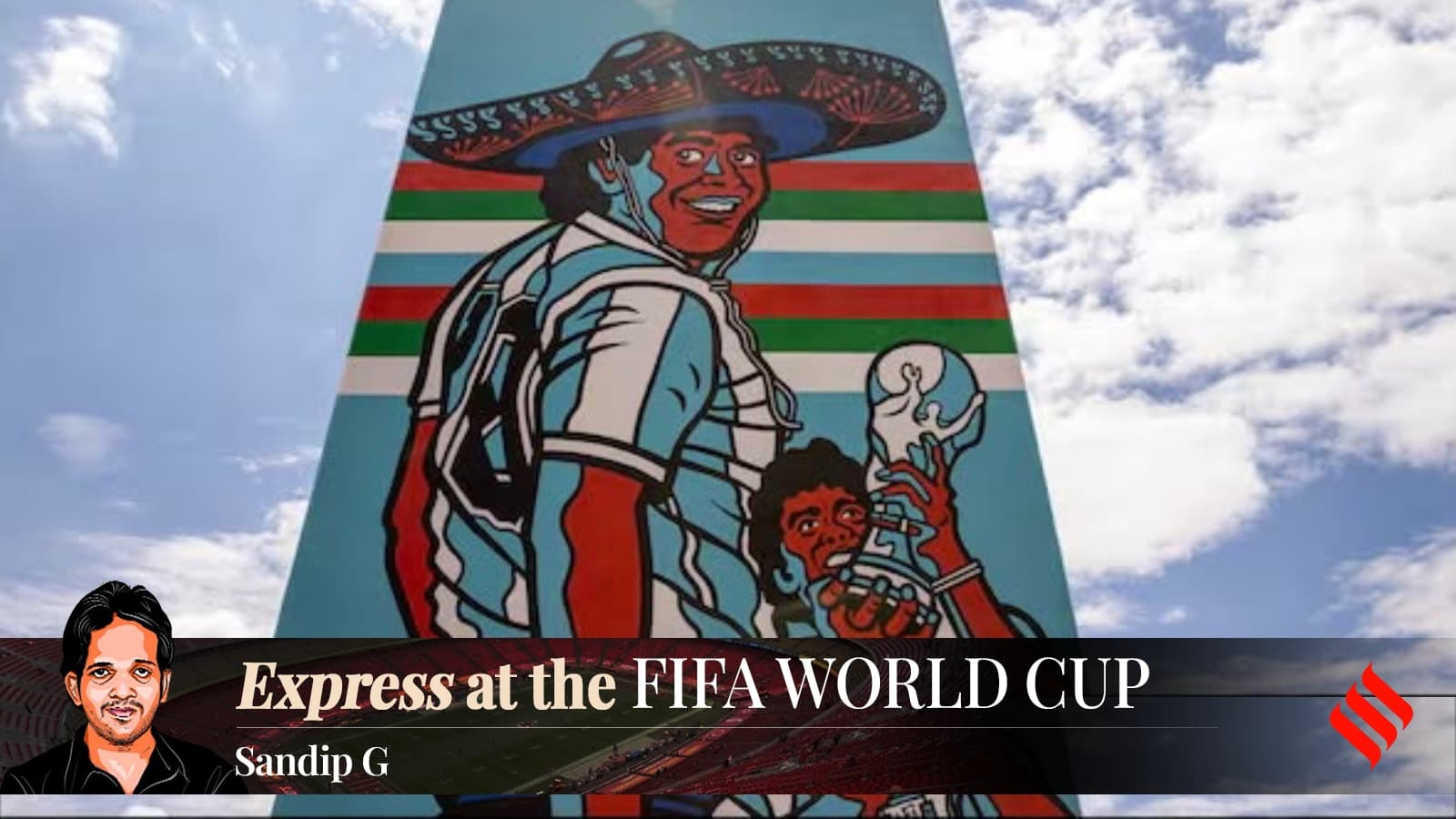
The security officer near tunnel eight of Azteca Stadium is tired. A small crowd has gathered at the alley leading to the dressing room and he is holding them back
. On the wall nearby hangs a photograph: Diego Maradona on the shoulders of his teammates after the 1986 quarter-final at this very stadium, hair fanned out like a halo. Some try to bribe their way past, but the security officer doesn’t move.
Near the stadium café, there used to be a small bronze statue of Maradona’s ‘Hand of God’ goal. It was removed during renovation before this World Cup. “We had to make some space, but it will be restored soon,” says Juventino Gonzales, who runs the stadium tours.
The goal that made him and unmade England, boxed up in storage beneath the stadium where it happened. Azteca and Maradona have given each other footballing immortality.
“Almost every visitor comes in search of Maradona memorabilia. Some get so emotional that they even cry,” says Gonzales. When Maradona died over five years ago, thousands turned up at the Azteca. “He is not Mexican, but he is kind of a hero here. Every year on his death anniversary, people come and place bouquets. Last time, we kept a mural of him in a churro hat,” he says.
Outside, the rumbling streets around the Azteca are stacked with taco and torta stalls. Martina’s has a torta named after every legendary footballer. The Maradona torta is hot on one side and sweet on the other. “Poco diablo,” says Martina, the cafe owner. A little devil. Her husband watched that 1986 game live, she says. “The World Cup brought us happiness,” Martina says, “and Maradona was a big reason.”
The earthquake had come the year before the 1986 World Cup and took everything from the country. Nine months later, Maradona arrived.
Inside the press pack that day was Luis Caledron, then at Excélsior, now long retired. He remembers the press conferences. Journalists from Argentina and England would press Maradona on his personal life, trying to unsettle him. “He rattled them more than they did him. He liked the reporters who asked good questions, and gave them long answers,” he recalls.
He also remembers a story about the famous 1986 Argentina jersey. Since the original match jerseys were too heavy, coach Carlos Bilardo needed something lighter, with two days to go for their opening game. The manufacturers said it was too late.
So Bilardo sent second-choice goalkeeper Héctor Miguel Zelada into the city. Zelada had played in the local league for years and knew where to go when official channels were closed. He went to Tepito — a barrio so notorious that even the police tread carefully. Counterfeit Rolex, fake Gucci, gang shootouts: Tepito has its own rules.
Zelada found twenty blue jerseys, the away kit. They came without the crest. He knew some tailors near the club stadiums. The jerseys were ready in time. “That jersey wouldn’t have been more than fifty pesos,” Caledron says. It sold at an auction for $9.28 million.
Two years before his death, Maradona returned to Mexico. Not to the capital that had made him immortal but to Culiacán — its blood-lit alleys the headquarters of the Sinaloa cartel, El Chapo’s city. The jokes wrote themselves.
At his first press conference as the coach of the Mexican second-division football club Dorados de Sinaloa, he didn’t deflect. “I had a lot of missteps in my life. I assume this responsibility like someone who holds a child in their arms,” he said.
During a training session, Rubio Rubin — an American forward on the squad — missed his final shot in a finishing drill and began walking off. Maradona called after him. Rubin said he was done. “You don’t end on a miss,” Maradona said. “Always on a goal.” Rubin went back, scored, and was told he could leave. He later recalled the moment to FIFA. Maradona’s line stayed with him: you don’t end on a miss.
Maradona called the club the family. A staff member said: “He’s identified with a city that people thought would be the death of him. Culiacán is rescuing Maradona in an unimaginable way.” When his contract ended and a renewal couldn’t be agreed on, there was no bitterness. “I’ll leave Culiacán with the best memory in the world,” he said.
Caledron saw him occasionally during those years. “He was the same man, all energy and joy. But the bigger fun was when he visited for Showball — a type of indoor football — in the mid-2000s. The touch never left him.”
Outside tunnel eight, the security officer is still at his post. The next group of tourists has found the passage. They are already slowing down, looking in, calculating their chances. Somewhere below them, in a storage room, the Hand of God waits to be restored.