Mumbai Chor Bazaar Vintage Camera Shop Ahmed House Collection Leica
Indian Express
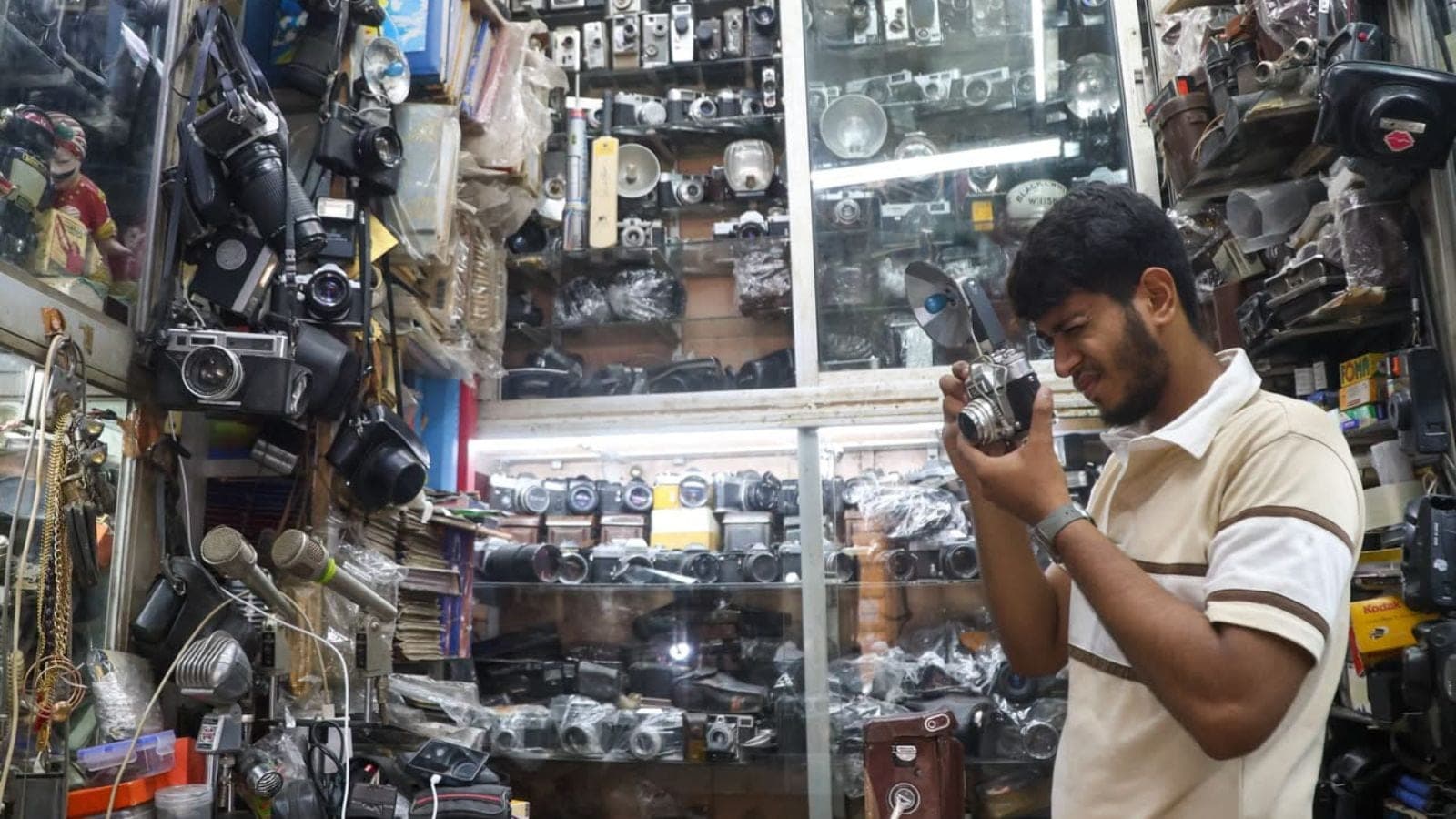
The cameras begin appearing long before one reaches the counter at Ahmed Camera House and Miniature Shop in Chor Bazaar. Vintage film cameras sit packed inside glass cabinets, spy cameras peek out
from crowded shelves, and old lenses, flash units, photographs and miniature collectibles compete for space in every corner of the narrow shop.
But the real surprise lies five minutes away.
Inside an ageing British-era building, the Ahmed family’s warehouse holds what may be one of Mumbai’s largest private collections of vintage photographic equipment. Cramped into a single room are hundreds upon hundreds of cameras stacked on shelves, inside cupboards and across tables. Film cameras sit beside movie cameras, lenses, film recorders and miniature spy cameras. In one corner rests a Morse code transmitter. Wooden field cameras lean against walls while rare pieces await restoration or identification. The collection is so large that moving through the room requires carefully squeezing between stacks of equipment.
Every camera in the collection was acquired within India. Many came from shuttered studios, old estates and South Mumbai households, while others were purchased from collectors and dealers over decades of searching.
“What you are seeing is only the front,” said Mohammed Ahmed, whose father founded the shop. “There is a lot behind it. We have around 2,000 to 3,000 cameras. We have never counted them properly.”
In a neighbourhood once famous for antique dealers and camera traders, Ahmed Camera House has become something of a survivor. According to the family, it is now the last dedicated camera shop remaining in Chor Bazaar.
“Before the lockdown there were many camera shops here,” Mohammed said. “The old owners retired, some shops shut down and everything changed after Covid. Earlier there were around 1,500 to 2,000 shops in the market and everybody’s business was running. Now the market is completely different.”
The story of the shop begins more than 50 years ago with a hobby. Founder Iqbal Ahmed was working at a camera store when he developed an obsession with old cameras. Instead of simply selling equipment, he began collecting it.
“I was doing service in a camera shop when I was young,” he recalled. “While working there, collecting cameras became a hobby. Slowly I kept collecting and selling. Whatever interesting camera I found, I wanted to keep.”
Over the years that hobby grew into one of Mumbai’s largest private collections of vintage photographic equipment. Many of the cameras came from shuttered studios, estate sales and old South Mumbai families.
Among the collection’s prized possessions is a World War II Leica camera, carefully preserved by the family. The shop also houses rare 8mm, 16mm and 35mm movie cameras, wooden field cameras and dozens of miniature spy cameras, including a collection of Minox cameras that Mohammed says remains one of his father’s favourites.
“Even today we have eight to ten Leica cameras,” he said. “They are very rare. One of them dates back to World War II. It’s not something you can easily find.”
The collection’s reputation gradually spread beyond Mumbai’s antique market. Collectors, photographers, filmmakers and museum curators began visiting the shop in search of rare equipment.
According to Mohammed, several cameras from the collection have been acquired by Museo Camera – Centre for the Photographic Arts in Gurugram. “A lot of cameras have gone from here to museums,” he said. “Many of the wooden cameras and flash cameras there came from our collection.”
The film industry has also become a regular customer. The family rents out cameras as props for film and television shoots, and several pieces from the collection have appeared on screen.
If the shop once depended on foreign collectors and tourists, its customers today are increasingly Indian. Many are students discovering film photography for the first time. “When you use a film camera you get a different look,” Mohammed said. “Students like that aesthetic. They want to know how photography was done before digital cameras and mobile phones.”
“I still buy something if I find it interesting,” Iqbal said. “That habit never left me.”
Naresh S is a Trainee Correspondent with The Indian Express, based out of Mumbai. A graduate of Xavier’s Institute of Communication (XIC), he has an avid interest in civic issues and policy-related domains. At present, he reports on the transport sector, covering suburban railways, BEST bus serives and aviation with a propensity for in-depth analyses and researched-focused reportage. Core Coverage Areas: Naresh reports on Mumbai’s urban mobility and public systems, with a focus on transport infrastructure, commuter safety, and policy execution. His reporting is research-driven and data-backed, aimed at explaining how large public systems function or fail, for everyday commuters. Transport (Primary Beat): His main beat is transport, covering Mumbai’s suburban railways and BEST bus services. His reportage in this domain spans detailed coverage of events like the Mumbra train accident and its safety implications, as well as follow-up reporting on long-standing gaps such as the delayed implementation of automatic doors on Mumbai local trains. He also tracks infrastructure projects, operational disruptions, and policy decisions affecting daily commuters, often through explainer-style stories. Aviation (Secondary Beat): Naresh also covers aviation and airport infrastructure, including reporting on the Navi Mumbai International Airport project. His aviation coverage has included the IndiGo flight disruptions in December 2025, focusing on passenger impact, regulatory response, and systemic issues within civil aviation operations. ... Read More