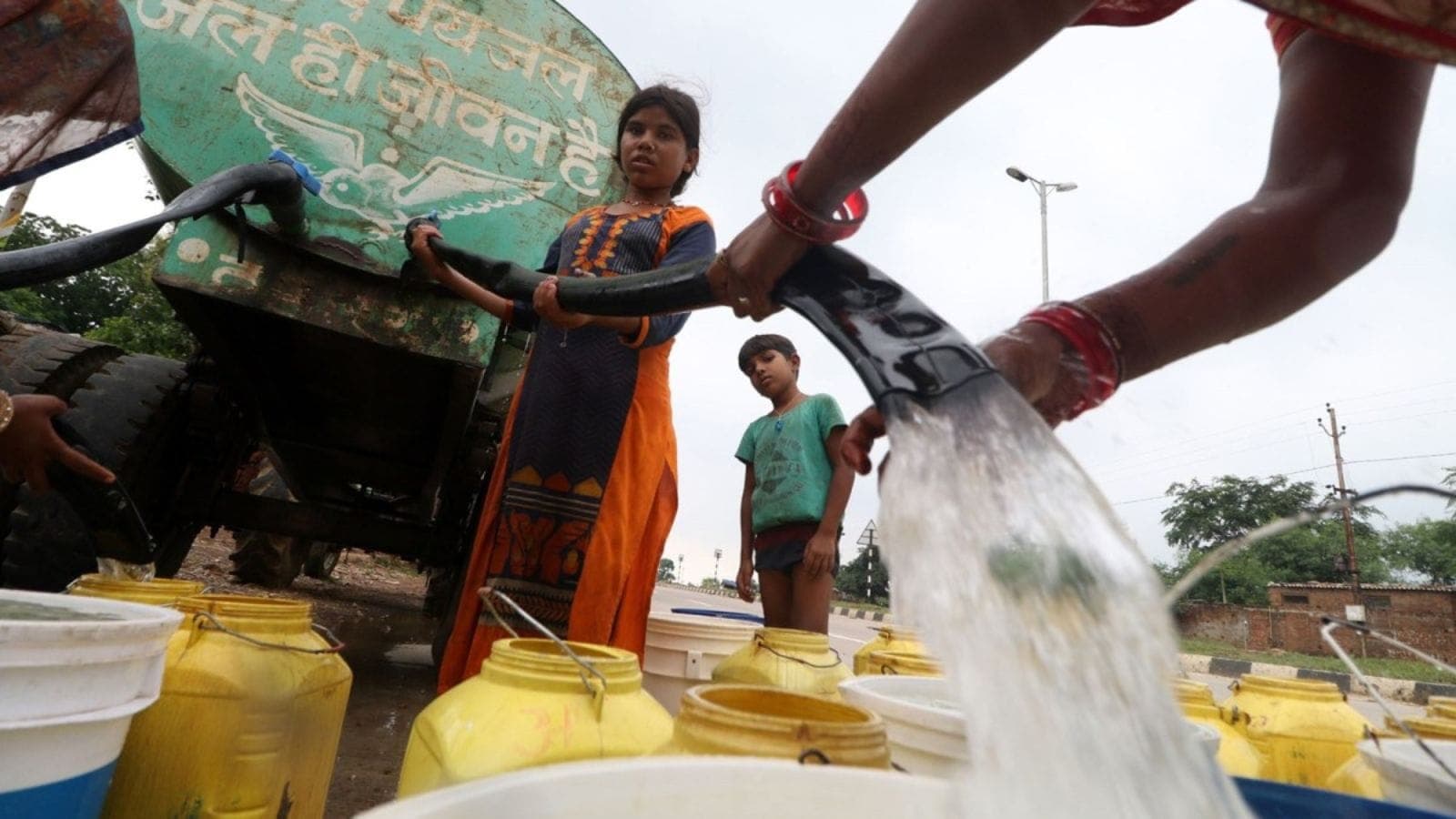
The Mumbai Water Tankers Association called off its indefinite strike on Tuesday evening after Chief Minister Devendra Fadnavis directed Mumbai s suburban and city district collectors to withdraw
The Mumbai Water Tankers Association called off its indefinite strike on Tuesday evening after Chief Minister Devendra Fadnavis directed Mumbai’s suburban and city district collectors to withdraw notices issued to tanker operators, the association said.
Tankers were back on the road by 7.30 pm.
“We convened a meeting with CM Fadnavis who called the collectors and asked them to withdraw the notices. The collectors have issued that no action will be taken. We will be given written correspondence over the next four days. Taking account of the dire circumstances in Mumbai, we called off our strike,” Amol Mandhare, secretary general of the MWTA, told The Indian Express.
The MWTA, the apex body of water tanker suppliers in Mumbai, supplies 2,000 million litres of water daily to residential and commercial establishments across the city. It has a registered fleet of over 2,000 tankers, each with a capacity of 10,000 litres.
The strike had begun Monday after the state government’s district Tehsildar office issued notices to owners and operators of ring-wells and borewells asking them to stop supplying water to tankers and obtain a fresh licence from the Central Ground Water Authority (CGWA). Under CGWA guidelines, a licence is issued to a well-owner only if the well sits on a land parcel of at least 200 square metres, and only one tanker can fill water from a single well.
The association opposed the notices, arguing that the procurement of meters is expensive in Mumbai as they are not manufactured in Maharashtra and have to be sourced from outside the state.
With the strike in its second day, MWTA representatives met Fadnavis on Tuesday afternoon. Following the meeting, the collectors directed the association not to reply to the notices. The collector’s office is also set to write to the BMC to take cognisance of the discussion and draft guidelines around the CGWA norms.
The strike hit residents hard. Dipti Thakur Desai, secretary of Highland Tower in Kandivali’s Akurli area, said building residents including senior citizens had been struggling since Monday. “While the strike was announced from June 8, we did not receive adequate supply from BMC on June 7. Due to the lack of BMC supply as well as the strike, we were left tackling a massive crisis on a war-footing on Monday. Our residents encompass senior citizens and bedridden patients who faced the worst impact. On Tuesday, we received some BMC water which helped but the situation remains critical,” she said.
Manoj Ganguli, a resident of Rainforest Kanakia in Marol, said his society extended water cut timings on Tuesday. “We are heavily reliant on water tankers and had already imposed a water cut on Monday. On Tuesday, we increased the timings to 12 pm to 6 pm and 11 pm to 5 am. If the strike had continued, our problems would only have worsened,” he said. In commercial clusters like Marol Plaza, offices had implemented half-days as early as Monday.
The strike coincided with an ongoing 10 per cent water cut across Mumbai, deepening an already acute water crisis in the city. This is the MWTA’s third strike in four years. Earlier in 2025, the association had called a strike after the BMC sent letters to well owners asking them to provide an NOC complying with the latest CGWA norms.
Nayonika Bose is a Senior Correspondent with The Indian Express’ Mumbai bureau. While in the early stages of her career, her focused reporting on local governance and community welfare already demonstrates clear Expertise and Trustworthiness in covering essential civic issues impacting Mumbai's residents. Expertise & Authority (E-E-A-T) Specialized Focus: Nayonika's reporting is dedicated to civic and community issues, providing readers with highly relevant, ground-level information about the functionality and administration of India's largest metropolitan area. Core Coverage Areas: Her articles highlight a strong focus on the fundamental quality of life and public safety in Mumbai, including: Civic Infrastructure: Reports on critical failures and initiatives related to public works, such as the recurring problem of unauthorized building collapses in Navi Mumbai, the construction of new infrastructure projects (like the Dahisar-Bhayandar Link Road and the Mahalaxmi cable-stayed bridge), and the maintenance of essential city services (e.g., manhole cover theft). Urban Governance & Crisis Management: Provides detailed coverage of the Brihanmumbai Municipal Corporation's (BMC) response to major crises, particularly during the monsoon (e.g., heavy rainfall, water cuts, and public health concerns like dengue and malaria) and large-scale public safety incidents (e.g., the hoarding collapse fallout). Community Welfare & Rights: Reports on key social issues, including the financial aid scheme for persons with disabilities, the struggles of Mumbai's hawkers protesting eviction drives, and the dangers faced by workers due to the continuation of manual scavenging in water tanks. Cultural & Heritage Reporting: Covers significant community stories, including the restoration of British-era fountains and the history of institutions like the 126-year-old Chinchpokli cemetery, showing a breadth of interest beyond pure administration. Tweets @nayonikakb ... Read More