Germany 7 Brazil 1 Slaughter At The 2014 World Cup Creates Sport S Most Famous Scoreline And Brazil S Darkest Moment
Hindustan Times
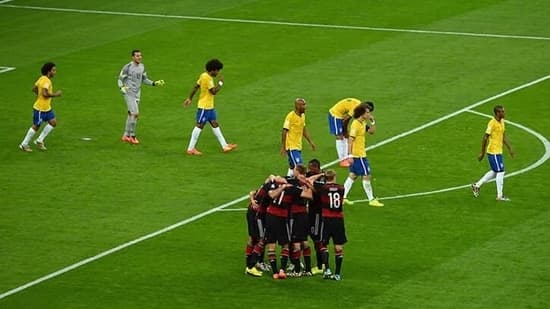
The single most famous scoreline in a football match in the history of the sport. Germany s 2014 FIFA World Cup semifinal demolition of Brazil is a match that most sports fans and even most casual
The single most famous scoreline in a football match in the history of the sport. Germany’s 2014 FIFA World Cup semifinal demolition of Brazil is a match that most sports fans – and even most casual watchers – won’t need any sort of introduction to. 7-1 is a set of numbers that evokes this match and no other: ask people what they think the most memorable football match is, particularly of this generation, and Brazil’s nightmare in Belo Horizonte will almost always top the list.
This is simply not what football matches at this juncture of any tournament are meant to look like. With a spot in the final on the line between two of the most successful teams in World Cup history – Brazil as five-time champions, Germany then with three to their name – it was expected to be a tight, competitive, cagey encounter.
Instead, it was the victims of Brazil’s run that made the biggest impact to their day out, a day to rival the infamous Maracanaco of 1950, a humiliation on par with their upset at the hands of Uruguay that day. With Thiago Silva suspended with too many bookings, and their best player Neymar Jr. carried off the field in a river of tears after sustaining a tournament-ending injury vs Colombia, Brazil were set to look like a shadow of themselves.
Germany had been efficient in their route to the semifinal, if not spotless: they opened their tournament by thrashing Portugal, but a draw against Ghana and needing extra-time to get past Algeria showed that there were gaps to exploit. But when they descended on the Mineirao stadium, they left nothing behind.
The scoring was opened in the 11th minute as Thomas Muller got on the end of a corner to side-foot past Brazilian keeper Julio Cesar, who picked the ball out of his net for the first of many, many times that evening.
The real implosion began in the 23rd minute: over the next seven minutes, Germany tore apart Brazil again and again, scoring four goals and leading 5-0 before even half-an-hour on the match clock.
Miroslav Klose took sole lead of the World Cup scoring record, stroking in his 16th after his original shot had been parried away. A minute later, Germany advanced again, and the Brazilian defence collapsed: the ball found its way across to Toni Kroos at the edge of the box, who hammered a powerful low left-footed shot to make it 3-0.
The fans didn’t even have time to react and let the dire situation sink in. As soon as they restarted, Kroos proceeded to hunt down Fernandinho from his blind side, rob him of the ball, trade a 1-2 with Sami Khedira, and end the contest inside 26 minutes by making it 4-0.
Brazil had started the day with 220 World Cup goals to their name, Germany right behind them. But in the space of half-an-hour, Germany overtook their hosts: in the 29th minute, a loose ball bounced through for another open opportunity for Brazil, Mesut Ozil lining up Khedira to make it 5-0, and leave Belo Horizonte shellshocked, and in tears over what they had witnessed.
That would stop the bleeding for the next 40 minutes, but the damage was done. Brazilian fans, the most passionate on the planet, were left heartbroken, some of the most lasting and stirring images of the World Cup’s history as their team imploded in improbable fashion. Andre Schurrle would add a couple more midway through the second half, the second of these a fine thumping finish in off the crossbar from a narrow angle.
In the last minute of the game, Oscar would wriggle his way through and fire past Manuel Neuer to give Brazil a consolation goal – but one which would only make the scoreline of this match all the more notorious, as even calling it a consolation feels generous when Germany had completed the massacre an hour earlier.
There is not much purpose in trying to dissect or analyse the match – Brazil were simply second-best to every loose ball, every pass from Germany just agonisingly out of reach for the defenders, shooting lanes opening up wide enough for Germany to find the space right between the fingertips of Julio Cesar and the post. On a different day, Germany might only convert two or three of these, giving Brazil some measure of hope even on a bad day – but on this occasion, it was humiliation and not much else on the menu for the heartbroken hosts.
Germany would go on to ensure they hadn’t expended their goals too early – it took them nearly two hours to get through Argentina in a battle against Brazil’s great continental rivals, as Mario Gotze chested and volleyed into the net to give Germany their fourth.
Has Brazilian football ever quite recovered from that debacle? Two more World Cups since, and two more harrowing knockout losses, first to Russia and then to Morocco. Brazil are a team who pride themselves on their footballing pedigree, but the 7-1 might have shifted something in their DNA. Entering 2026, the question on every fan’s lips is the same: how do they get their mojo back?
Kartikay Dutta is a sports writer with the Hindustan Times Sports Desk, having joined in August 2024 to further his professional journey and pursue his long-standing ambition of working in sports media. With a strong interest in cricket, tennis, and football, Kartikay focuses on exploring the deeper layers of sport beyond the immediate action on the field. His work centres on producing insightful long-form and analytical pieces that examine the stories behind performances, teams, and tournaments. He is particularly interested in narratives that intersect with culture, history, and politics, helping readers understand how modern sport evolves within a broader social context. Before joining Hindustan Times, Kartikay worked with leading digital newsrooms in India, where he developed a strong foundation in data-driven storytelling. He is skilled at using statistics, records, and historical trends to uncover patterns and perspectives that add depth to match coverage and sports features. His approach combines research with narrative clarity, allowing complex sporting developments to be presented in an engaging and accessible manner. Kartikay also has a growing passion for multimedia storytelling. He actively explores how photographs, videos, and graphics can enhance sports journalism by illustrating not only what happens during competition but also the preparation, strategy, and operational dynamics behind the scenes. Through this evolving skill set, he aims to contribute to a more immersive and modern form of sports storytelling that connects audiences more closely with the games they follow.Read More