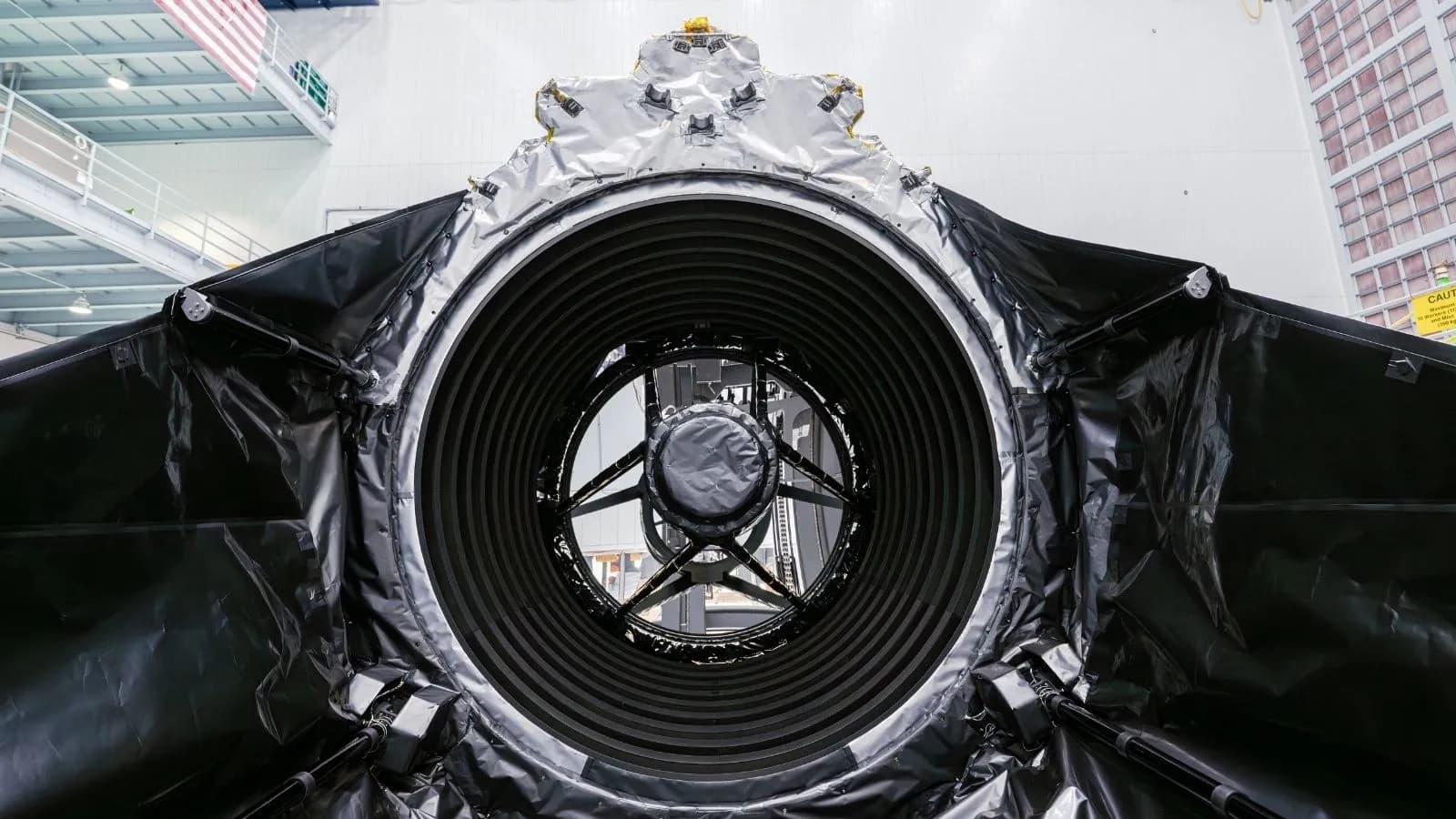
Nasa has confirmed that its Nancy Grace Roman Space Telescope will launch on August 30, 2026, advancing the previously targeted timeline by about eight months.
With less than three months remaining before liftoff, teams are completing the final stages of preparation at Nasa’s Goddard Space Flight Center in Maryland before shipping the observatory to Nasa’s Kennedy Space Center in Florida later this month.
Once it arrives at Kennedy, engineers will conduct a detailed inspection to ensure the telescope and its components were not affected during transport. The observatory will then undergo a series of powered tests and launch rehearsals ahead of fueling operations.
Roman will be loaded with approximately 290 gallons (around 1,100 litres) of hydrazine fuel before being attached to the adapter that will connect it to a SpaceX Falcon Heavy rocket. The heavy-lift launcher will send the observatory toward its destination at the second Sun-Earth Lagrange point, or L2, located roughly four times farther from Earth than the Moon.
Before launch, the telescope will be enclosed inside a protective payload fairing designed to shield it during ascent through Earth’s atmosphere.
Roman is expected to become one of Nasa’s most powerful space observatories. During its planned five-year primary mission, the telescope will survey vast regions of the cosmos using a combination of a wide field of view and high-resolution infrared imaging capabilities.
Scientists expect Roman to detect and study millions of galaxies, thousands of exoplanets, black holes, and other cosmic objects. The mission is specifically designed to investigate major mysteries surrounding dark energy and dark matter while also advancing the search for planets beyond the solar system.