Why Kylian Mbappes France Play Like A Bunch Of Street Footballers
Indian Express
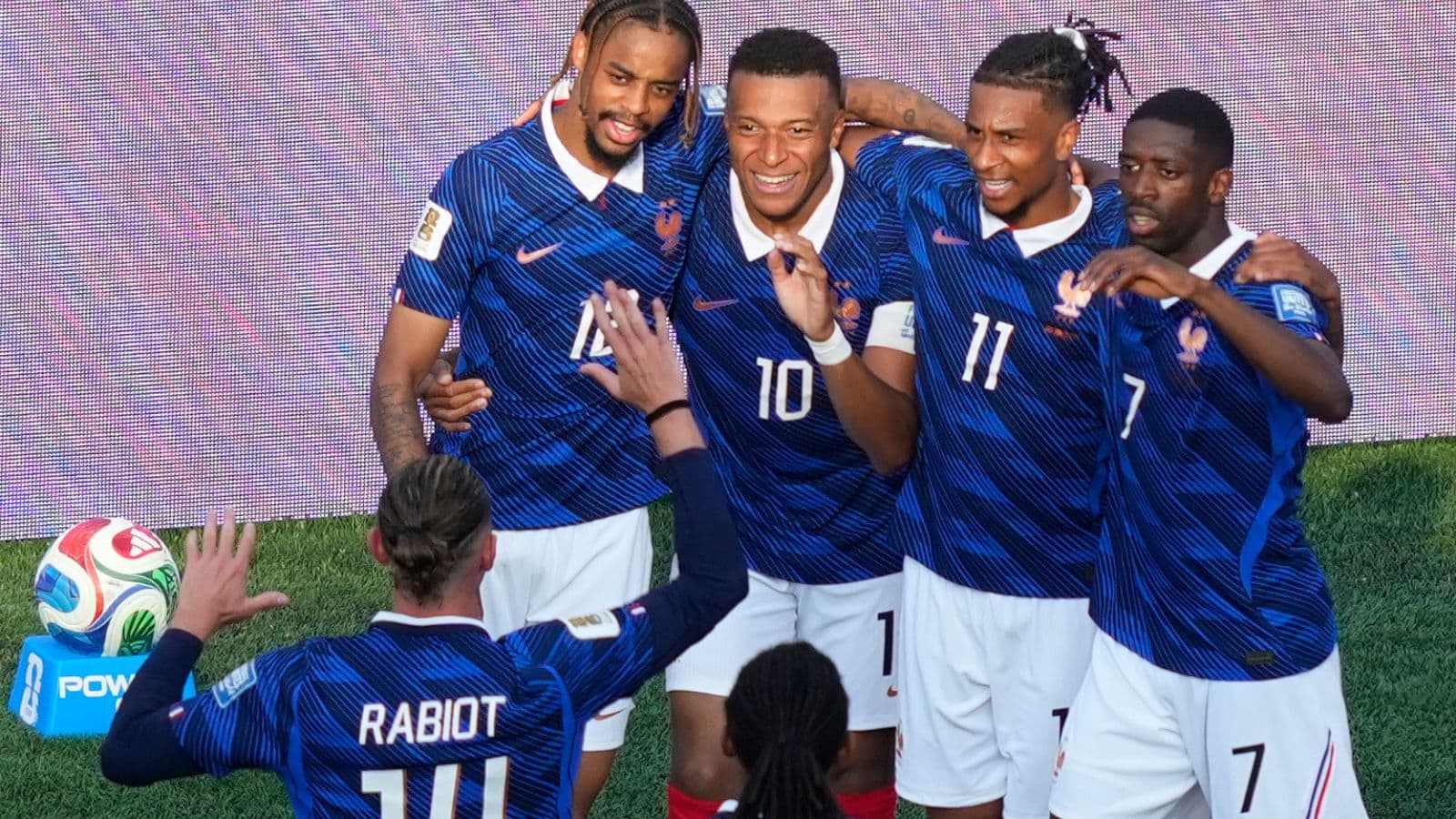
Three Swedish defenders stood almost shoulder to shoulder, forming a yellow wall between Kylian Mbappe and the goal. There was nowhere obvious to go
. So, instead of forcing the issue, Mbappe simply stopped. He rolled the ball backwards, inviting the nearest defender to take a step forward. That was the cue he had been waiting for.
In an instant, he was moving again. His hips swayed one way, the ball darted another, and a crowded penalty area suddenly opened up. By the time the other Swedish defender realised what had happened, Mbappe was already wheeling away in celebration.
The goal was a result of breathtaking speed, but even more breathtaking audacity. Most footballers, confronted by three defenders, search for the safer pass. Mbappe saw them as an audience – and put on a show.
Watching France at this World Cup, that feeling keeps returning. Didier Deschamps’ side does not resemble a meticulously-drilled international team so much as a bunch of street footballers who happen to be wearing blue shirts. Every attack carries an extra feint, an unexpected flick or an invitation to a one-on-one duel.
The footballing soul of this French team lies well beyond the cafes and boulevards of central Paris. It lives in the banlieues – the working-class suburbs that ring the capital – where generations of children have learnt the game inside fenced cages, on concrete courts and tiny artificial pitches squeezed between apartment blocks. There, football is stripped to its essentials. Space is scarce, time even scarcer, and mistakes are punished instantly. If you cannot beat your opponent 1v1, you simply do not keep the ball.
Those cages have quietly become the world’s greatest football academy.
Midfielder Zaire Emery told FIFA before the World Cup: “Before being professional, we used to play in the streets. That’s where we learnt.”
Manu Kone, who plays as a double pivot, added: “You play with the skills you learned in the neighbourhood.”
No metropolitan region produces elite footballers on the scale of Greater Paris. Analyses of the squads at this World Cup show that 53 players were born in the Île-de-France region, representing more than a dozen countries, while 99 France-born footballers are featuring across the tournament. Only 23 of them play for France. The rest wear the colours of Algeria, Morocco, Democratic Republic of Congo, Senegal, Tunisia, Ivory Coast, Haiti and several other nations. The suburbs of Paris have become football’s most remarkable export source, supplying talent to much of the world.
The remarkable thing is not merely the numbers. It is that so many of those players, regardless of the badge on their chest, seem to share the same footballing language.
In the cages of Bondy, Sevran, Sarcelles, Clichy-sous-Bois, Montreuil and Aulnay-sous-Bois, tricks are not performed for applause. They are practical solutions. A body feint buys half a yard of space. A roulette escapes a tackle. A nutmeg keeps possession alive. Lose the ball, and you might spend the next five minutes watching from the sidelines while others play. Every child quickly learns to receive under pressure, protect the ball and glide through crowds. Flair is not encouraged; it is demanded.
Mbappe is the finest expression of that culture. And he is hardly alone – 11 others in this French team, including William Saliba and Rayan Cherki – have benefited from the system.
By the time many of these youngsters arrive at Clairefontaine, France’s celebrated national academy, the essential qualities have already been formed. The academy teaches structure, positioning and decision-making. The cages have already taught them courage, balance, deception and instinct.
That is why this French side often feels different from every other heavyweight at the tournament. Their football possesses an unmistakable swagger. For opponents, it is maddening. For spectators, irresistible.
There is, of course, far more to France’s success than street football. Deschamps has built a tactically disciplined side, physically imposing and defensively resilient. Yet, what elevates this team beyond being merely efficient is the freedom its players bring from the places where they first fell in love with the game.
Which is why Mbappe’s goal against Sweden felt strangely familiar. It was the latest reminder that somewhere beneath the choreography of elite football still lives a child from the cages of Bondy. With three defenders in his way, he stops and waits. Then, with a feint, a burst and a flash of imagination, he turns a World Cup knockout match into a street game once again.
Over the course of a 18-year-long career, Mihir Vasavda has covered 2010 FIFA World Cup; the London 2012, Tokyo 2020 and Paris 2024 Olympic Games; Asian Games in 2014 and 2022; Commonwealth Games in 2010 and 2018; Hockey World Cups in 2018 and 2023 and the 2023 ODI Cricket World Cup. ... Read More