The 100 Year Glacier Mystery Scientists Finally Crack Secret Behind Antarcticas Blood Falls
Indian Express
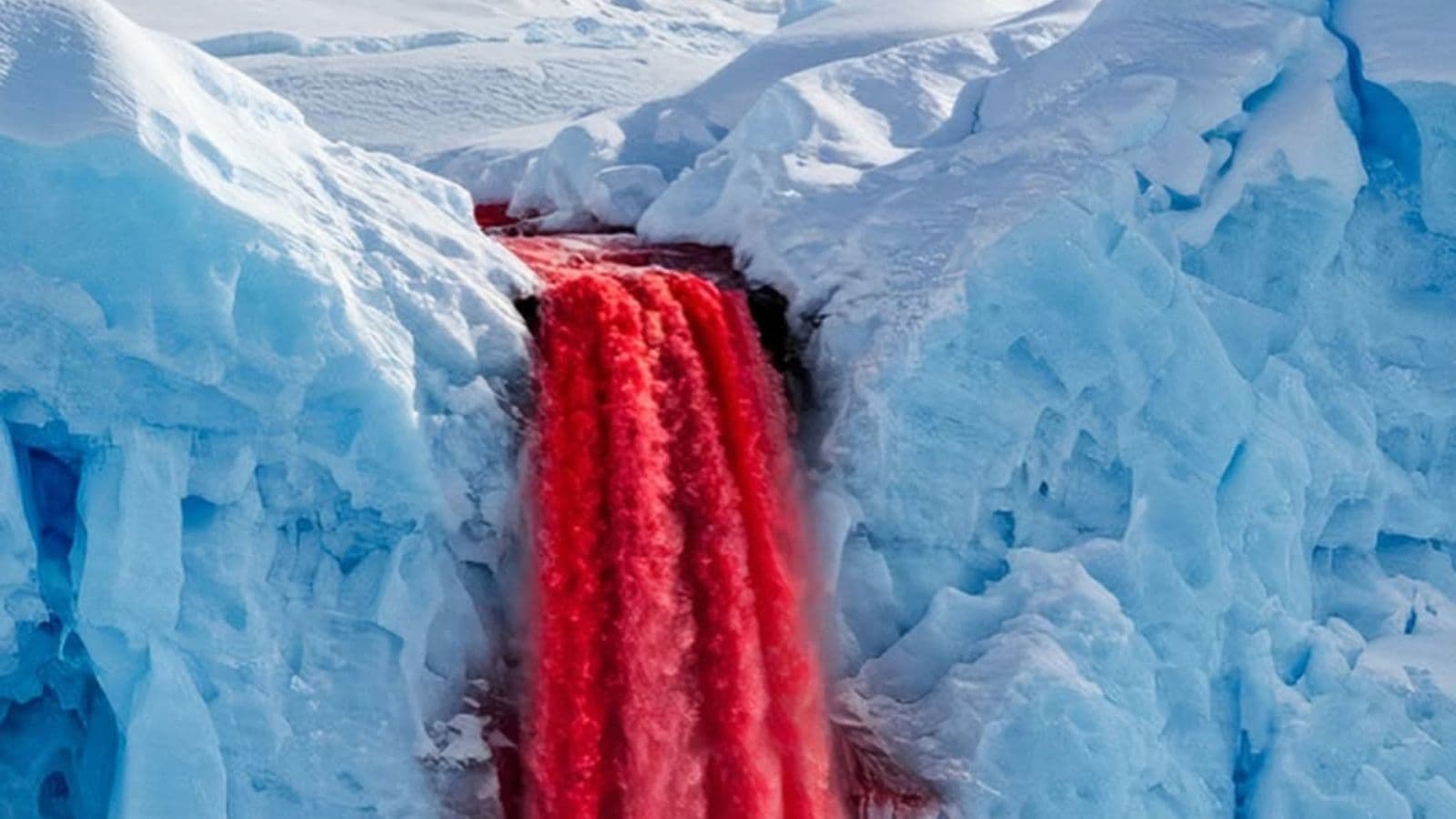
One of Antarctica s natural wonders is the deep-red Blood Falls, which has puzzled scientists for more than 100 years.
One of Antarctica’s natural wonders is the deep-red Blood Falls, which has puzzled scientists for more than 100 years. The striking crimson waterfall, which spills from the Taylor Glacier into Lake Bonney in Antarctica’s McMurdo Dry Valleys, has often been mistaken for flowing blood. But researchers now say they have finally pieced together the science behind the phenomenon.
First discovered in 1911 by Australian geologist Griffith Taylor, Blood Falls has fascinated explorers and scientists alike due to its unusual appearance. The rust-coloured water emerging from beneath the glacier has long fuelled speculation about its origin.
It’s not blood; it’s iron-rich brine. Scientists now know that Blood Falls is formed by iron-rich brine trapped beneath the Taylor Glacier, rather than by blood or volcanic activity.
According to research recently published in Antarctica Science, the water originates from an ancient underground reservoir of extremely salty liquid that lies beneath the glacier. Pressure generated by the glacier’s movement occasionally forces this brine through hidden channels inside the ice and out onto the surface.
Once exposed to air, the iron dissolved in the water reacts with oxygen, forming iron oxides, the same process that creates rust. This oxidation gives the waterfall its dramatic reddish-brown colour.
A major breakthrough came in 2017 when researchers from the University of Alaska Fairbanks used radar imaging to map a network of pressurised channels beneath the glacier.
The team traced the brine’s journey through approximately 300 metres of hidden pathways inside the ice before it emerged at Blood Falls.
The findings helped explain how the liquid could continue flowing despite Antarctica’s freezing temperatures.
The answer lies in the brine’s exceptionally high salt content. Researchers say the water contains such high concentrations of dissolved salts that its freezing point is significantly lower than that of fresh water.
When combined with heat released during the freezing process, the salty liquid remains fluid even beneath one of the coldest glaciers on Earth.
Scientists now consider Taylor Glacier the coldest known glacier with continuously flowing liquid water.
Researchers have found that the ancient brine contains microorganisms that have survived beneath the glacier for potentially millions of years, isolated from sunlight and Earth’s atmosphere.
These microscopic particles contain elements including silicon, calcium, aluminium and sodium, helping researchers better understand both the chemistry behind Blood Falls and how microbial life survives in such extreme conditions.
The discovery has implications beyond Antarctica, as similar salty environments may exist beneath the icy surfaces of worlds such as Mars or Jupiter’s moon Europa.
Although Blood Falls may no longer be a scientific mystery, it remains one of Antarctica’s most extraordinary natural phenomena and continues to provide researchers with valuable insights into glacial processes, extreme environments and the possibility of life in icy worlds beyond Earth.