Making Of Spider Julian Alvarez Argentina World Cup Quarterfinal Hero
I
Indian ExpressVerified Publisher
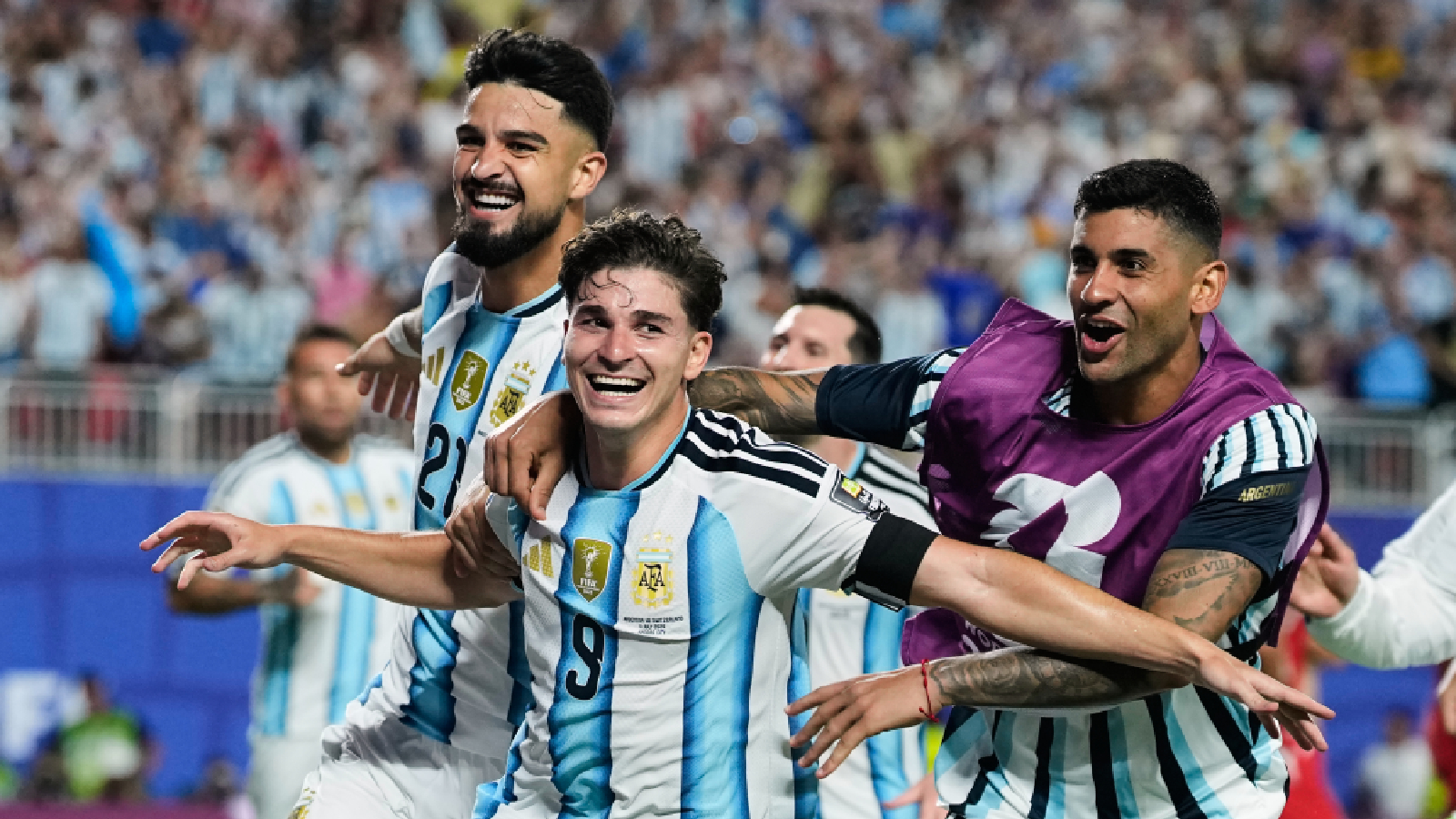
He waited until Argentina needed him most. With scores tied at 1-1 Switzerland retreating deeper by the minute in extra time, Julian Alvarez collected the ball just outside the penalty area, shifted it onto his right foot and, with barely any backlift, bent a He waited until Argentina needed him most. With scores tied at 1-1 Switzerland retreating deeper by the minute in extra time, Julian Alvarez collected the ball just outside the penalty area, shifted...
He waited until Argentina needed him most.
With scores tied at 1-1 Switzerland retreating deeper by the minute in extra time, Julian Alvarez collected the ball just outside the penalty area, shifted it onto his right foot and, with barely any backlift, bent a sublime curler beyond Gregor Kobel into the far corner. It was the kind of finish that belongs in World Cup montages — precise, composed and almost understated. There was no wild celebration, only clenched fists and teammates engulfing the man who has quietly become Argentina’s most reliable big-game scorer as they won 3-1 to set-up a semifinal date with England.
Long before he was deciding World Cup quarter-finals, however, Alvarez was simply La Arana — the Spider.
The nickname came not from a marketing campaign or a comic-book obsession but from the dusty football grounds of Calchin, a farming town of barely 2,500 people in Cordoba province. As a child, opponents joked that the skinny forward seemed to have more than two legs. Every loose ball somehow found its way back to him. “I remember one goal, when he was about eight or nine, when he beat four or five rivals and scored a rabona goal,” his first coach Rafael Varas told the Manchester City website. “That’s when I realised we had a different kind of player, who could be a world star.”
His teammates recalled they felt like he has ‘six or seven legs’, like a spider. The nickname stuck, and today every goal is followed by his now-familiar Spiderman celebration – by spreading his arms wide and extending his thumb, forefinger and little finger like Spiderman.
Calchin remains central to understanding Alvarez.
His first brush with greatness arrived almost too soon.
He turned Alvarez into a striker who hunted defenders before hunting chances. By the time Manchester City signed him in 2022, he had already won the Copa Libertadores and established himself as one of South America’s brightest prospects. Pep Guardiola later remarked that what stood out was not merely his finishing but “his work ethic”, while teammates frequently marvelled at the way he pressed as though every lost cause could still be won.
That quality has made him indispensable for Argentina.
Lionel Messi remains the conductor, but Alvarez supplies the relentless movement around him. He stretches back lines, closes down centre-backs and creates spaces others exploit. It is easy to forget that at the 2022 World Cup he began as a substitute before forcing his way into Lionel Scaloni’s starting XI. By the end of the tournament, he had scored four goals, including two against Croatia in the semi-final, and formed a partnership with Messi that transformed Argentina’s attack.
Three-and-a-half years later, his importance has only grown.
Against Switzerland, Messi spent long periods shackled by Murat Yakin’s disciplined defensive structure. Chances were scarce and spaces even scarcer. It took a player whose game is built on instinct rather than extravagance to find the breakthrough. Alvarez did exactly that, curling Argentina into the semi-finals with a finish that encapsulated everything he has become: technically gifted, tactically intelligent and utterly unfazed by the occasion.
For all the medals that have arrived in rapid succession — a World Cup, Copa America, Champions League and league titles — there remains something refreshingly uncomplicated about Alvarez. He is not the loudest voice, nor the biggest personality, nor even Argentina’s biggest star.
He is simply the Spider. And when Argentina’s web begins to fray, he invariably seems to be the one holding it together.
Over the course of a 18-year-long career, Mihir Vasavda has covered 2010 FIFA World Cup; the London 2012, Tokyo 2020 and Paris 2024 Olympic Games; Asian Games in 2014 and 2022; Commonwealth Games in 2010 and 2018; Hockey World Cups in 2018 and 2023 and the 2023 ODI Cricket World Cup. ... Read More