Karna Struggle Paternal Court Orders Add Father Name Ivf Child
I
Indian ExpressVerified Publisher
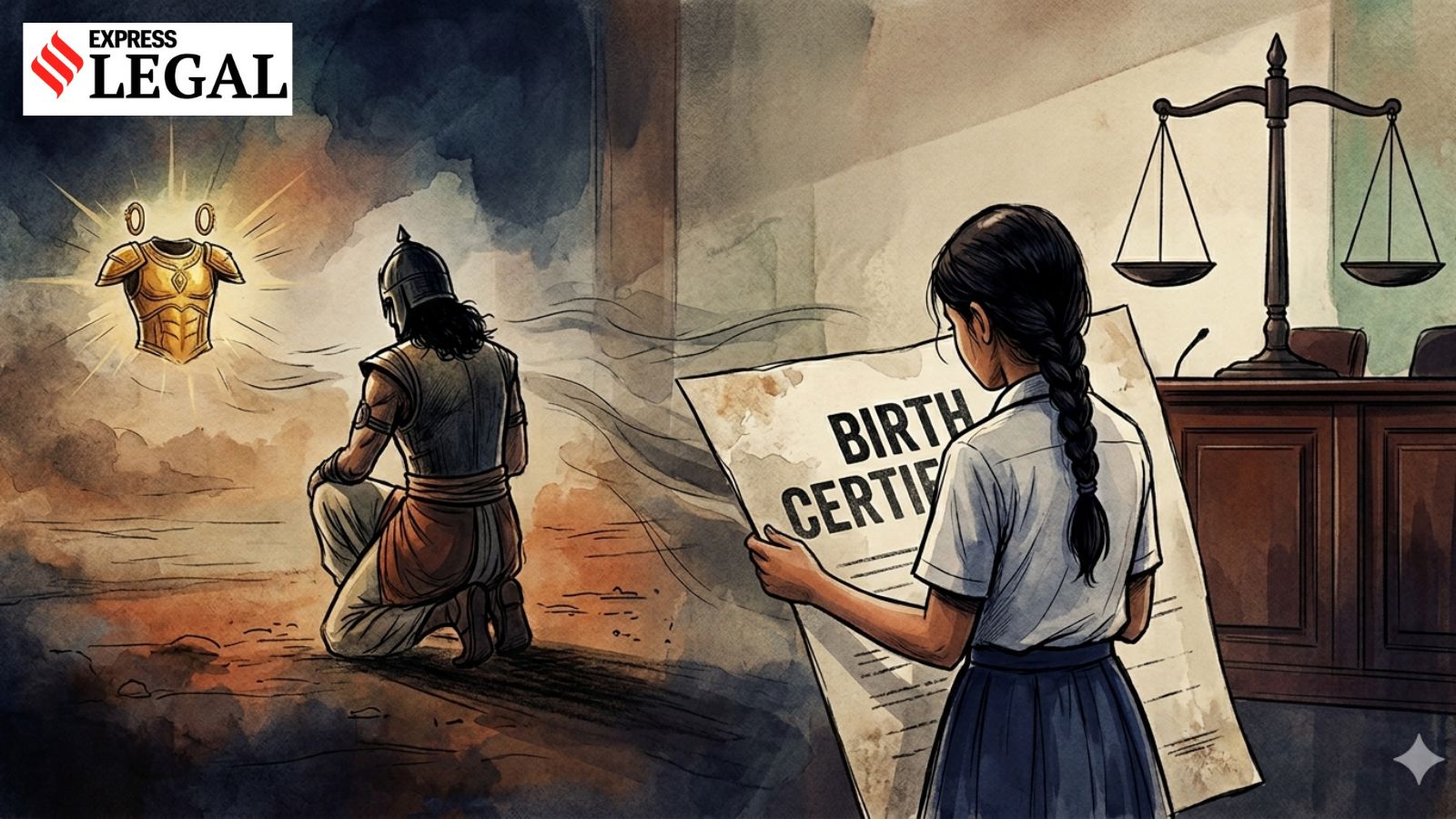
Drawing parallels with Karna s lifelong struggle for recognition in the Mahabharata and recalling Charles Dickens scathing observation that the law is an ass , the Kerala High Court has stepped in to erase what it called a psychological wound carried by a 13-y Drawing parallels with Karna s lifelong struggle for recognition in the Mahabharata and recalling Charles Dickens scathing observation that the law is an ass , the Kerala High...
Drawing parallels with Karna’s lifelong struggle for recognition in the Mahabharata and recalling Charles Dickens’ scathing observation that “the law is an ass”, the Kerala High Court has stepped in to erase what it called a psychological wound carried by a 13-year-old girl, born out of IVF, whose father’s name was left blank in her birth certificate.
Holding that the law must record life rather than resist it, the court directed authorities to recognise the child’s acknowledged biological father and issue a corrected birth certificate.
Justice P V Kunhikrishnan delivered the judgment on June 1 while allowing a petition filed by a woman and her husband.
The court was hearing their challenge to the refusal of local authorities to add the man’s name to the birth certificate of their elder daughter, who was born through IVF in 2012, before the couple married.
“I considered the psychological trauma of a child born to an unwed mother, from the angle of the character ‘Karna’ in the ancient epic ‘Mahabharata’. Here, in the present, the second petitioner is the child’s father, but the law does not permit it. Viewing from another angle to the story of “Mahabharata”, it can be said that “Karna” is not alone; his parents also want to declare his paternity to the world,” the court asked on June 1.
A complex character in the Mahabharata, Karna was born to princess Kunti before her marriage through a divine boon granted by the sun god.
Abandoned at birth, and raised by a charioteer’s family, he grew up unaware of his royal lineage and faced repeated humiliation over his social status despite being one of the greatest warriors of his generation.
His struggle for acceptance, recognition and identity became a defining theme of his life. Even after discovering that he was Kunti’s eldest son and the brother of the Pandavas, Karna remained torn between his birth and upbringing.
It is this lifelong quest for acknowledgement and the emotional burden of concealed parentage that Justice P V Kunhikrishnan invoked while discussing the psychological impact of leaving a child’s father’s name blank in official records.
Mr Bumble, a character in Charles Dickens’ novel Oliver Twist, said in a courtroom that the “law is an ass”, of course, in connection with that story, the court observed.
The novel was published in 1838, which means it is about two centuries old. Even now, some legal provisions in our country are like an ass. But in such situations, it is the duty of the constitutional court to interpret such laws with a human touch.
At the heart of the judgment is the court’s concern for the emotional and psychological impact on the child. “A blank space can wound more deeply than words,” Justice Kunhikrishnan wrote.
“For a child, the blank space against the father’s name in her birth certificate is not merely an empty column, but it is a question mark on her legitimacy, a whisper of stigma, a wound inflicted by her parents’ past quarrel,” the court said.
The judge noted that there was no dispute regarding the child’s parentage. Both parents acknowledged her as their daughter, and the father had expressly accepted his biological relationship with her.
“The issue is not one of paternity, it is of posterity. What will be the psychological trauma when she becomes an adult? The parents’ mistake will be a wound to the child,” the court said.
The court accepted that the Registration of Births and Deaths Act, 1969, contains no specific provision allowing such a correction.
Nevertheless, it held that the high court’s extraordinary powers under Article 226 of the Constitution could be invoked to prevent injustice in exceptional cases.
“This Court sits to ensure that the law does not become the last instrument of psychological cruelty to a child who was never at fault. The law is meant to record life, not to resist it. In this case, life has moved on, but the law has refused to keep pace,” the judgment said.
Allowing the petition, the court quashed the panchayat’s rejection order and directed the authorities to:
The ruling is likely to have implications for cases involving children born through assisted reproductive technologies, live-in relationships and single-parent registrations, where parents later seek to regularise official records.
More fundamentally, the judgment sends a message that procedural rigidity cannot be allowed to overshadow a child’s right to identity, dignity and belonging.
Vineet Upadhyay is an Assistant Editor with The Indian Express, where he leads specialized coverage of the Indian judicial system. Expertise Specialized Legal Authority: Vineet has spent the better part of his career analyzing the intricacies of the law. His expertise lies in "demystifying" judgments from the Supreme Court of India, various High Courts, and District Courts. His reporting covers a vast spectrum of legal issues, including: Constitutional & Civil Rights: Reporting on landmark rulings regarding privacy, equality, and state accountability. Criminal Justice & Enforcement: Detailed coverage of high-profile cases involving the Enforcement Directorate (ED), NIA, and POCSO matters. Consumer Rights & Environmental Law: Authoritative pieces on medical negligence compensation, environmental protection (such as the "living person" status of rivers), and labor rights. Over a Decade of Professional Experience: Prior to joining The Indian Express, he served as a Principal Correspondent/Legal Reporter for The Times of India and held significant roles at The New Indian Express. His tenure has seen him report from critical legal hubs, including Delhi and Uttarakhand. ... Read More