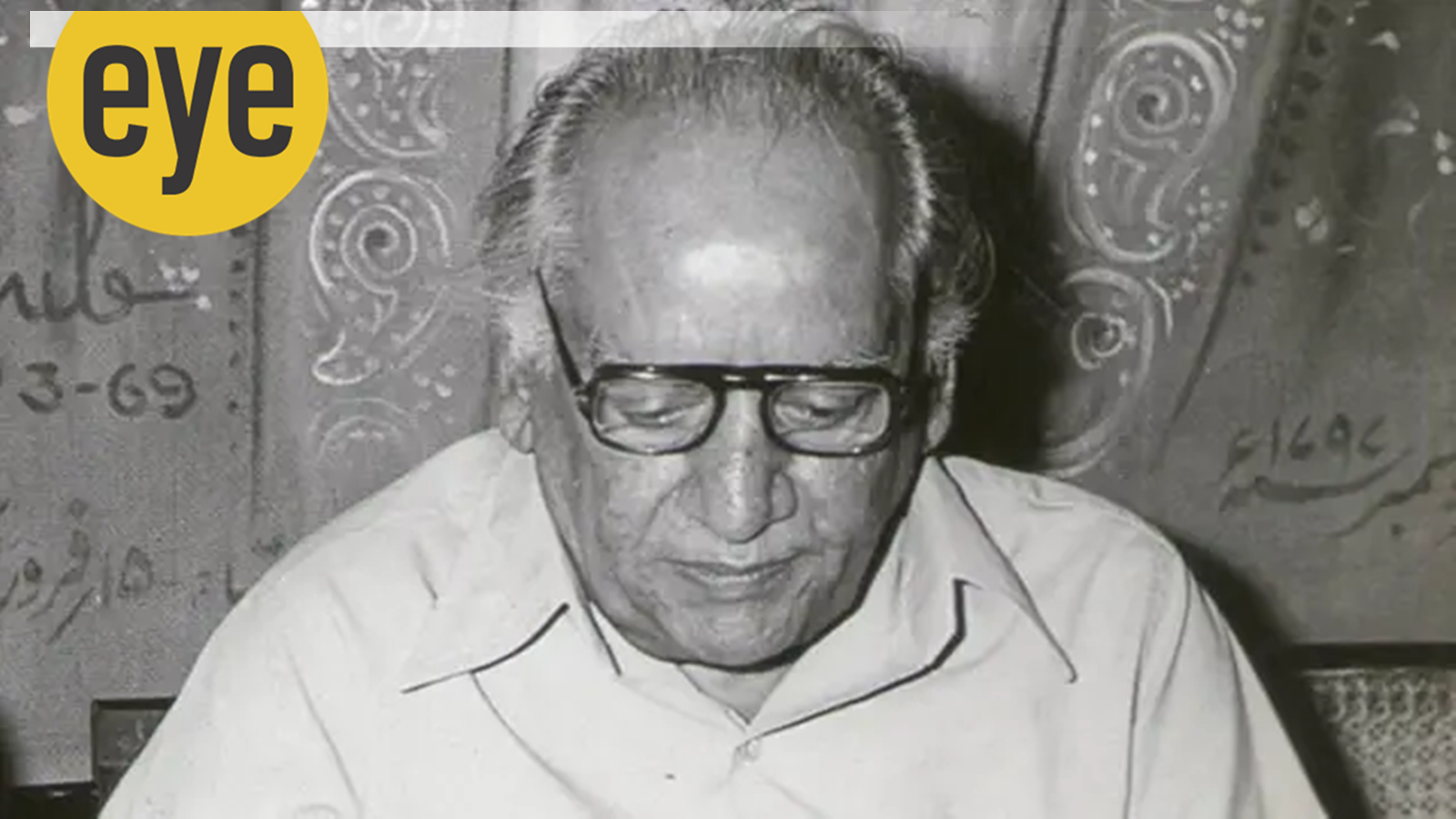
A sitting judge of the Supreme Court of India. Striking factory workers. University teachers on dharna. Students from elite management and technical institutes building bridges of solidarity with less privileged peers from government-funded universities. Citizens across the country filling the streets in angry demonstrations against the CAA, SIR or paper leaks. Different places, people, circumstances, yet when it comes to finding a voice they find it in the words of the Urdu poet Faiz Ahmad Faiz (1911-1984). Belonging to the much-reviled neighbouring country, writing in a language viewed with mistrust,
. University teachers on dharna. Students from elite management and technical institutes building bridges of solidarity with less privileged peers from government-funded universities. Citizens across the country filling the streets in angry demonstrations against the CAA, SIR or paper leaks. Different places, people, circumstances, yet when it comes to finding a voice they find it in the words of the Urdu poet Faiz Ahmad Faiz (1911-1984).
Belonging to the much-reviled neighbouring country, writing in a language viewed with mistrust, if not hostility, by certain sections of Indian society, invoking a set of symbols and images that are unabashedly drawn from an Islamic framework, relying upon a prosody and vocabulary that is exquisitely musical, though often drawn from the world as he saw it — what is the secret behind the enduring appeal of his words? That too of a man who died over 40 years ago, and had last visited India in the early 1980s when millennials, let alone Gen Z, were not even a word!
And yet, miraculously, he has remained in the public consciousness of successive generations of Indians, his words pulled out, like rabbits from a hat, to instantly invoke resistance, protest, solidarity. If anything, as the juggernaut of change rolls slowly but surely across India, he has had a second coming of sorts: with more transliterations than ever before in Devanagari and Roman, sharp and sassy memes and Insta-worthy posters, his face and words popping up on mugs, coasters and tote bags. Why?
Yes, he is a fantastic poet, possibly the last of the greats who were rooted in the classical tradition, equally comfortable with the time-honoured ghazal as also the newer nazm, which he made uniquely his own. Yes, the test of good poetry, in fact any literature, is that it must rise above its time and circumstance and continue to speak to readers long years after it was first written. And, yes, in the words of Mirza Ghalib, our very own master of the Urdu ghazal, who famously declared: ‘Goya ye bhi mere dil main hai ….’ (this too is hidden in my heart), Faiz touches his listener’s heart in unexpected ways, making one gasp and then sigh.
But there are other great poets, both homegrown and from across the hated border; Habib Jalib, Ahmad Faraz, Jaun Elia being some who enjoy a fair amount of popularity in India. Why does Faiz rise above them like a colossus? Why is he the default option when it comes to singing songs of protest? Why are Hum Dekhenge, Mujhse Pehli Si Mohabbat Mere Mehboob Na Maang, Nisaar Main Teri Galiyon Pe Ai Watan Ke Jahan, Bol ke lab azaad hain tere… the chosen anthems of resistance for Indians? And not just in pockets of north India where these words can be understood but in towns and cities where the words may be unfamiliar but the sentiment is not.
For, it is a truth universally acknowledged that injustice, tyranny, persecution have a universal language. When Faiz speaks of dipping his pen in his heart’s blood, or creating a garden in one’s heart when the outside world turns hostile, he holds out hope; when he talks of being unable to walk with one’s held high or breathe under the weight of oppression, he is bearing witness for all those who have been humiliated or tortured. Or even when he invokes images from Islamic history such as removing idols from inside the holiest sanctum, Faiz speaks at a subliminal level, one that is beyond narrow sectarian differences.
Coming to his most recited poem, the solemnly sonorous, eminently singable Hum Dekhenge, perhaps it ‘speaks’ across the picket fence of language and location because it contains a promise: One day the oppressed will occupy their rightful place when the tyrants will be vanquished and Truth shall prevail. Written in 1979 in response to General Zia-ul-Haq’s repressive regime, it is as much a song for Faiz’s country reeling under a dictator as for people anywhere in the world fighting oppression at any time. For India and Indians today, it is a prophecy.
Jalil is a Delhi-based writer, translator and literary historian