Collection
New Four Winged Dinosaur Fossil China
Indian Express
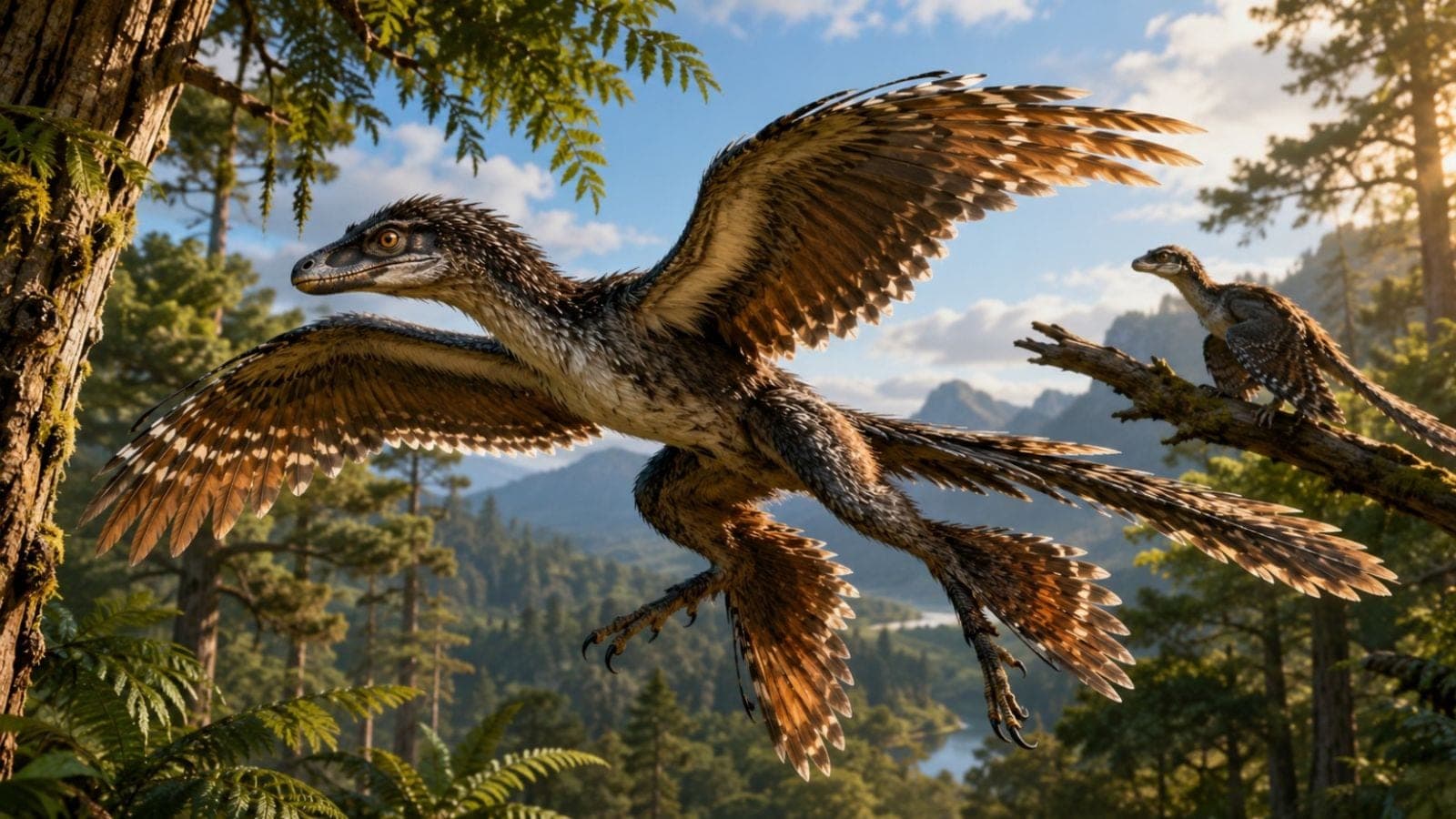
When people hear the word dinosaur , they often imagine a giant animal walking on two or four legs. However, a newly discovered dinosaur fossil from ancient China is once again changing the way
When people hear the word ‘dinosaur’, they often imagine a giant animal walking on two or four legs. However, a newly discovered dinosaur fossil from ancient China is once again changing the way scientists think about prehistoric creatures.
Researchers have identified a new relative of Velociraptor that appears to have had not two, but four wing-like structures made of feathers. The discovery is offering fresh clues about one of evolution’s biggest mysteries: how flight evolved in the ancestors of modern birds.
The newly identified species belonged to a group of small feathered dinosaurs known as dromaeosaurs, close relatives of the well-known Velociraptor.
What makes this creature particularly unusual is the presence of long feathers not only on its front limbs but also on its hind limbs, creating four wing-like surfaces in total.
The finding adds to a growing list of dinosaurs that do not fit neatly into the category of either a ground-dwelling dinosaur or a flying bird. Instead, they appear to represent evolutionary experiments that took place millions of years before modern birds emerged.
Scientists do not believe the extra wings were used for powered flight in the same way modern birds use their wings. Instead, researchers think the feathered hind limbs may have helped the animal glide between trees, control its movements while descending, and improve its stability and manoeuvrability in the air.
The additional wing-like surfaces likely acted as aerodynamic control structures, helping the dinosaur balance and steer while gliding through forest environments.
According to the study, the fossil suggests that early feathered dinosaurs may have been experimenting with different ways of moving through forests long before bird flight evolved into the form we recognise today.
The dinosaur was discovered in China, which has become one of the most important places in the world for understanding how dinosaurs evolved. The country’s fossil deposits have preserved remarkable details, including feathers, skin impressions and other soft tissues that rarely survive for millions of years.
These discoveries have transformed scientists’ understanding of dinosaurs over the past few decades. Once viewed primarily as giant reptiles, many dinosaurs are now known to have been covered in feathers and to share close evolutionary links with the birds we see around us today.
The findings were reported in a study published on June 4 in Annals of Carnegie Museum by researchers led by Ling-Qi Zhou, Matthew C. Lamanna of Carnegie Museum of Natural History, and Jingmai K. O’Connor of the Field Museum.
(This article is curated by Paramita Datta, who is an intern with The Indian Express.)