Collection
Lionel Messi 2022 World Cup Win Final Fling 2026 Argentina
Indian Express
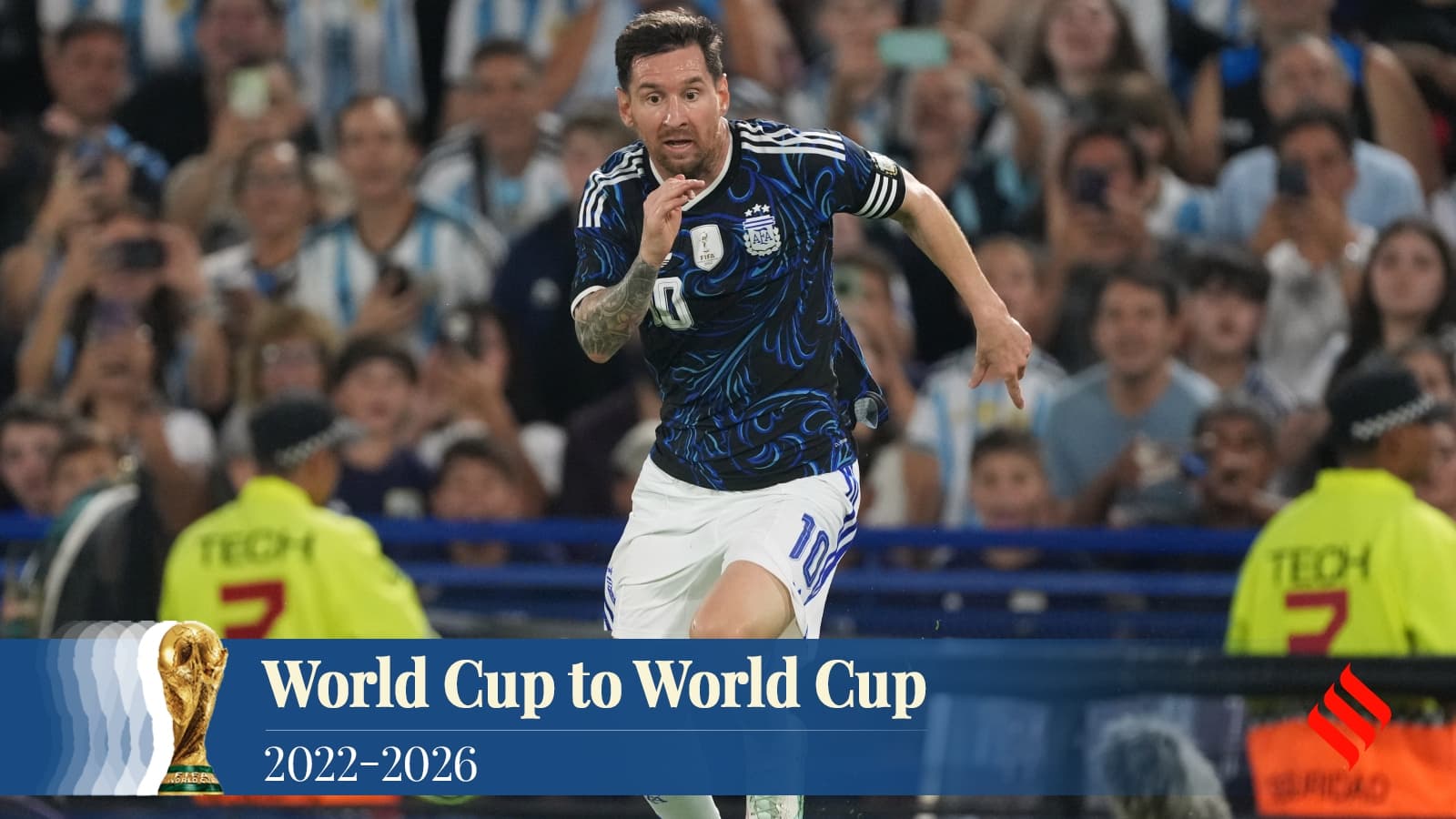
The last image of Lionel Messi at the 2022 World Cup looked like the final frame of a film. The country that had spent decades trapped between nostalgia and frustration had finally found peace...
The last image of Lionel Messi at the 2022 World Cup looked like the final frame of a film.
The country that had spent decades trapped between nostalgia and frustration had finally found peace through a footballer who carried both emotions inside him.
Four years later, the story arrives at another strange crossroads. When the World Cup kicks off across the United States, Mexico and Canada – a sprawling, commercial, multilingual spectacle spread across a continent – Messi, rather improbably, will still be at the centre of it.
There is something almost cinematic about the route his career has taken since Qatar. The boy who crossed the Atlantic at 13 for growth-hormone treatment in Spain has returned to the Americas as football’s most recognisable face, carrying the World Cup into the very market FIFA has always dreamt of conquering completely.
When Messi joined Inter Miami in 2023, the move was initially framed as retirement disguised as ambition. America has long been football’s soft landing spot – a glamorous final stop for ageing superstars. Pelé did it. David Beckham did it.
But Messi’s arrival felt different because he didn’t come to America as a fading star searching for comfort. He arrived as the reigning world champion.
Suddenly, Major League Soccer (MLS) stopped feeling peripheral. Stadiums transformed. Celebrities lined the touchlines. Children in pink shirts screamed his name in cities that barely followed ‘soccer’.
In many ways, even FIFA could not have scripted the transition better.
The greatest footballer of the era moved to the continent hosting the next World Cup just as the sport there reached a cultural tipping point. America had spent decades trying to import football prestige. Messi brought it instantly.
And through it all, Argentina followed him.
One of the most fascinating threads connecting Qatar 2022 to US-Mexico-Canada 2026 is that Messi’s career arc no longer mirrors Argentina’s suffering.
For most of his time with the Albiceleste, Messi represented longing. Every tournament defeat deepened the national neurosis. The lost World Cup final of 2014 and the back-to-back Copa America defeats that followed turned Messi into football’s saddest genius. Even his brief retirement from international football in 2016 felt symbolic of a country permanently exhausted by disappointment.
Under head coach Lionel Scaloni, Argentina stopped obsessing over ghosts. The team became emotionally lighter, tactically clearer, and less dependent on Messi performing miracles. Younger players stopped worshipping him from a distance and began competing alongside him naturally. Julian Alvarez pressed defenders like a street-fighter. Rodrigo de Paul became Messi’s bodyguard and emotional amplifier. Enzo Fernandez brought swagger. Emiliano Martínez brought madness.
For the first time, Argentina looked like a modern football team instead of a shrine to its own history.
Messi changed, too. The explosive dribbler who once tore through entire midfields stopped trying to dominate every second and instead manipulated matches in moments. A pause. A disguised pass. A glance before a through ball.
That evolution is why 2026 no longer feels impossible. At 39, Messi will not arrive at the World Cup as the sport’s best athlete. But he may still arrive as its sharpest mind.
And there is poetry in where this final act unfolds. Mexico carries the ghosts of Maradona and 1986. The United States represents football’s commercial future. Canada symbolises the sport’s expanding geography. Messi somehow connects all three ideas at once: history, spectacle and globalisation wrapped in one player.
By then, his relationship with Argentina may resemble something deeper than fandom. He is no longer merely their greatest footballer. He has become a national reference point, a shared emotional language.
Even the pressure feels transformed now. In Qatar, Messi played as though chased by destiny. Every touch carried urgency. Every match felt loaded with consequence. In 2026, there may instead be a strange freedom surrounding him. The burden has vanished because the story is already complete.
Which is precisely what makes the possibility of one final run so seductive.
Sport rarely grants perfect endings. Most legends fade slowly, painfully, inevitably. Their final tournaments become reminders of time’s cruelty. But Messi’s post-2022 journey has unfolded differently. Rather than declining sharply, he has drifted into something mythological – half-footballer, half-symbol.
And perhaps that’s why the image of Messi walking into the 2026 World Cup feels so powerful.
Not because he still has something left to prove. But because football, somehow, still cannot imagine its biggest stage without him.
Over the course of a 18-year-long career, Mihir Vasavda has covered 2010 FIFA World Cup; the London 2012, Tokyo 2020 and Paris 2024 Olympic Games; Asian Games in 2014 and 2022; Commonwealth Games in 2010 and 2018; Hockey World Cups in 2018 and 2023 and the 2023 ODI Cricket World Cup. ... Read More