Hazratganj is the nerve centre of Uttar Pradesh. Within a few kilometres lie the offices from where the state is governed, residences of senior bureaucrats and ministers, key police establishments and the office of the chief fire officer—the first point of contact whenever a fire emergency is reported in the city. Security personnel, police officers and government officials crisscross these roads every day, making it one of the most monitored and visible parts of Lucknow.
Yet, hidden in plain sight amid this corridor of power is another reality. Coaching institutes packed into commercial buildings, restaurants operating from basements, hotels tucked inside narrow lanes and markets crowded with shoppers continue to function with glaring fire-safety concerns. An HT ground report across Hazratganj, covering several areas from Point Zero (GPO) and its adjoining localities, found multiple instances of blocked exits, single-entry buildings, congested access routes and establishments operating in spaces where evacuation during an emergency could prove challenging. If such vulnerabilities exist in the state’s most watched administrative hub, a troubling question arises: what might be the state of fire safety in the rest of the city?
Naval Kishore Marg: Coaching, shopping centres (Less than 1 km from Point Zero)
Narhi: Residential neighbourhood and commercial hub (500 metres from Point Zero)
As the HT team moved into the narrow, bustling lanes of Narhi—an area that has gradually transformed from a residential neighbourhood into a dense commercial hub—it found a maze of lodges, hostels and budget hotels operating from converted houses. Many of these two and three-storey buildings are located on lanes so narrow that even two-wheelers struggle to pass each other, leaving no chance for a fire tender to reach the spot during an emergency. One such establishment, a hotel, was found operating with a staircase barely four feet wide serving as the sole access to the upper floors. There was no separate emergency exit or visible fire-safety infrastructure. Similar conditions prevailed across several nearby lodges and hostels, where hundreds of guests, students and working professionals reside. HT also found multiple libraries functioning from building basements, adding to concerns over evacuation in the event of a fire. The combination of congested access roads, mixed land use and inadequate escape routes paints a worrying picture in one of the city’s busiest localities.
Indira Bhavan: Govt offices (1.9 km from Point Zero)
Gutka wrappers, instead of sand, in firefighting bucket
Indira Bhavan houses several government offices and witnesses regular movement of officials and visitors. During the ground check inside the building, HT found that fire-fighting buckets were missing from almost every floor. At several locations, only the metal stands meant to hold the buckets were present. On some floors, where three buckets were supposed to be installed, only one bucket was found. As per standard practice, these buckets are meant to be filled with sand for emergency use. However, on the fourth and fifth floors, HT found that the lone bucket placed on a three-bucket stand was filled with gutka wrappers and spit residue instead of sand. On several other floors, fire safety equipment that should have been readily accessible was found pushed into extreme corners and covered with waste materials. In the event of an emergency, locating and using such equipment could prove difficult. A similar situation was observed at Jawahar Bhavan, located adjacent to Indira Bhavan, where fire safety equipment appeared either inaccessible or poorly maintained.
Shri Ram Tower: Gadget hub (800 metres from Point Zero)
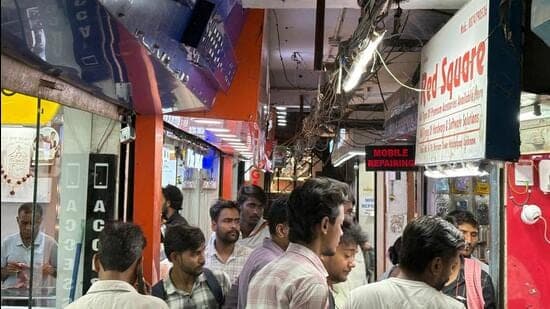
The next visit was to Shri Ram Tower, known as one of the city’s major hubs for mobile phone sales and repair businesses. The six-storey building, including the ground floor, also has a basement and houses dozens of shops dealing with electronic goods and repair work. During the visit, several fire extinguishers were found to have crossed their validity period, while expiry stickers on many others were torn or unreadable. Fire hose nozzles were found entangled in electrical wiring, raising concerns over their usability during an emergency.
HT also found that overhead sprinkler systems in several sections of the building were covered with hanging wires. In some places, the sprinkler heads themselves were obstructed, potentially affecting water dispersal in the event of a fire.
The building consists of multiple galleries and shop clusters on each floor. However, sprinkler pipelines appeared to cover only limited sections, leaving large portions of the premises without visible sprinkler coverage.
Although the building has multiple entry and exit points, many of the passages are narrow and congested, which could hamper evacuation during an emergency.
Burlington Chauraha: Basement shops (1.1 km from Point Zero)
At a commercial complex near Burlington Chauraha, HT found additional shortcomings. The complex has a basement where several shops were operating. However, no fire sprinklers or fire extinguishers were found in the basement during the inspection.
Electrical wiring was also found fixed against wooden structures and partitions, increasing the risk in case of a short circuit. On the first floor, which houses around 15 shops, only one fire extinguisher was found. Fire hose pipelines installed near staircases also appeared inadequate, with lengths seemingly insufficient to reach shops located at the far end of the floor.
Naka Hindola: Electronics hub (2.5 km from Point Zero)No space for fire tenders
The visit also covered the densely populated Naka area, known for its concentration of electrical goods markets, hotels and banquet halls. The locality is characterised by narrow lanes and congested construction, leaving little room for fire tenders and emergency vehicles to manoeuvre. Several establishments, including shops, hotels and banquet halls operating from basements, were found with little or no visible fire safety infrastructure. Many of the buildings stand wall-to-wall with virtually no gap between structures. Such construction patterns significantly increase the risk of a fire spreading rapidly from one property to another.
During the inspection, several establishments were found operating with expired fire extinguishers, while others appeared to have no visible fire-fighting equipment at all.
The findings raise concerns about fire safety compliance in some of the city’s busiest and most important buildings, many of which are located close to Lucknow’s administrative centre.
Aminabad Market (Approx 2 km from Point Zero)
In Aminabad, there is a market running in a basement, hardly leaving space to walk. Despite a fire at Garbar Jhala in 2023, no lessons have been learnt. Due to narrow lanes and traffic, fire departments have kept one fire tender on standby near Jhandewala Park, but it may be of little help in case of a big fire.
Aakash Ghosh is a senior correspondent with Hindustan Times, based in Lucknow. He covers crime and policing in Uttar Pradesh, with a focus on developments in the state capital. His reporting also spans key beats such as railways, science and technology, and culture and heritage. He has a keen interest in off-beat and human-interest stories that foster a strong connection with readers. Prior to his stint in Lucknow, he trained and worked with multiple print and digital newsrooms in Mumbai, Patna and Kolkata.Read More