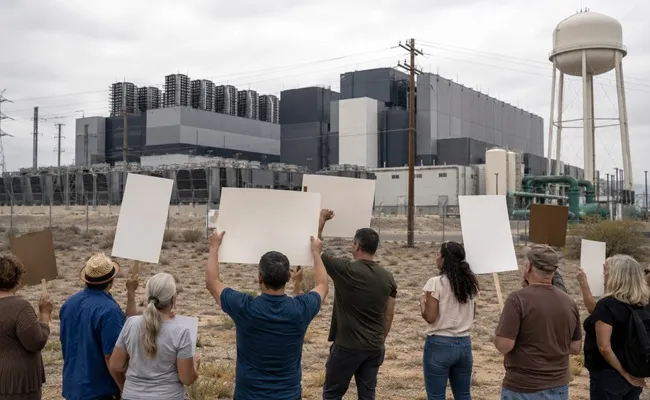
Across major U.S. cities, residents have protested against new data centres in their communities. Their concerns go beyond technology. People fear that these large facilities could put pressure on already limited water supplies, increase electricity demand, and harm the local environment, while the promised economic benefits may not reach everyone. But, keeping the people ignorant or not much aware of the protests in the USA, Visakhapatnam is emerging as a data-centre destination, placing the city at the centre of India’s artificial-intelligence infrastructure race. Google has begun construction of a planned
. Their concerns go beyond technology.
People fear that these large facilities could put pressure on already limited water supplies, increase electricity demand, and harm the local environment, while the promised economic benefits may not reach everyone.
But, keeping the people ignorant or not much aware of the protests in the USA, Visakhapatnam is emerging as a data-centre destination, placing the city at the centre of India’s artificial-intelligence infrastructure race.
Google has begun construction of a planned $15 billion AI hub in Vizag, with gigawatt-scale computing capacity. The project is being developed with AdaniConneX and Airtel.
The government says the investment could reshape Vizag’s economy, promising thousands of direct jobs, wider employment opportunities and more technology companies. But these claims are not convincing everyone.
Many residents and observers remain sceptical about how many jobs will actually reach local communities, especially when data centres need highly skilled workers.
Beyond this, the biggest concern is water. Data centres need large amounts of water and electricity to keep powerful computer systems running and cool. This has become a wider issue globally as the rapid growth of AI increases demand for data centres.
The joke was clearly meant to be shocking, but its message was simple: AI data centres can use a surprising amount of water.
The campaign even jokingly asked people to send their urine to an AI data centre. Behind the humour is a serious question about how much water society is willing to use for AI.
That question is especially important for Vizag. The city already faces concerns over water availability. Activists have also raised questions about how large data-centre projects could affect local water resources.
The government and project proponents dispute those concerns. Google says it will use advanced air-cooling technology, while authorities say residential and rural water sources will not be diverted.
The wider issue is public trust. Big investment numbers and promises of jobs may sound attractive, but people also want to know what the projects will mean for their daily lives.
Will local people get enough jobs? Will water remain available? Who will pay for additional infrastructure?
For Vizag, transparency will be important. Water use, electricity demand, environmental safeguards and local employment should be publicly measured and regularly disclosed. This can help residents judge whether the promised benefits are actually reaching the city.
If managed well, data centres could help Vizag move from an industrial economy towards technology and digital services. But growth should not come at the cost of basic resources.
Vizag’s data-centre moment should therefore not be judged only by investment figures.
The real test will be whether these projects create meaningful local benefits while protecting water, power resources and the environment.
Former Andhra Pradesh Chief Minister Y.S. Jagan Mohan Reddy visited Hyderabad on Friday to attend a wedding ceremony at Jalavihar. Jagan came to the city…
The YSR Congress Party on Friday alleged that the case relating to the June 16 incident in Hyderabad, in which a young man died after…
The prolonged legal battle by senior politician and former MP Vundavalli Arun Kumar against the Margadarsi Group, founded by late media baron Ch. Ramoji Rao,…