Two Tribal Talukas Face Off In Gujarat Over 3000 Acres Forest Dept Caught In Middle
I
Indian ExpressVerified Publisher
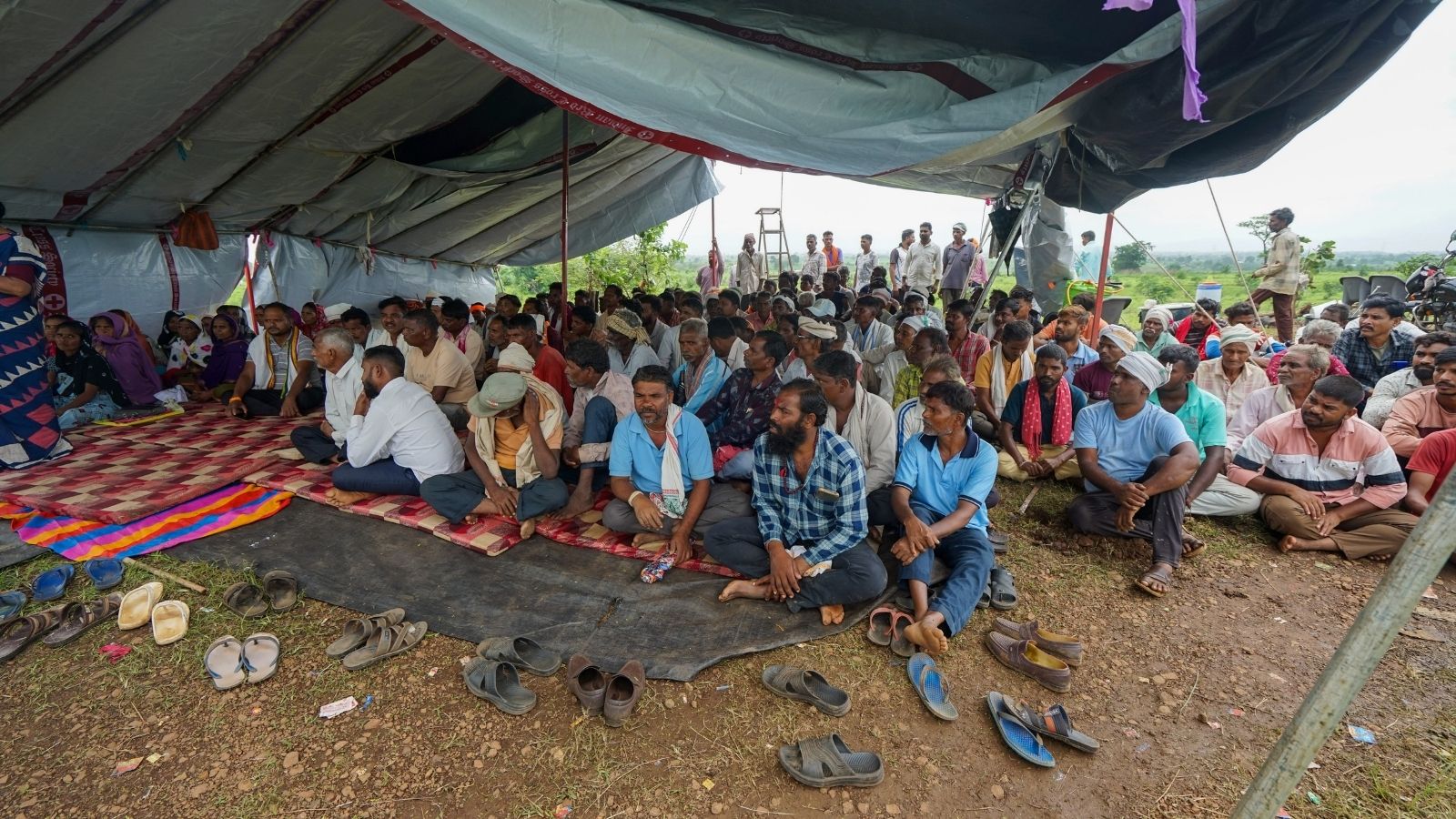
As she sits on a relay fast under a tarpaulin tent in the fields in Gujarat’s Narmada district, Leela Vasava flips through a file of documents. Behind her, men and women sit silently, watching her. The rain-bearing clouds overhead threaten rain. But so far, it has deterred neither Leela nor her companions. For the last 10 days, Leela and her companions from 12 tribal villages in Narmada’s Sagbara taluka have been holding a sit-in protest to demand the right to keep cultivating 3,000 acres of forest land in Umarpada taluka
As she sits on a relay fast under a tarpaulin tent in the fields in Gujarat’s Narmada district, Leela Vasava flips through a file of documents. Behind her, men and women sit silently, watching her.
The rain-bearing clouds overhead threaten rain. But so far, it has deterred neither Leela nor her companions.
For the last 10 days, Leela and her companions from 12 tribal villages in Narmada’s Sagbara taluka have been holding a sit-in protest to demand the right to keep cultivating 3,000 acres of forest land in Umarpada taluka in Surat district, claiming that they have been doing the same for two decades.
“Since late 2024, we have been ousted from the fields. The forest department has termed us ineligible,” the 52-year-old Leela, a former BJP leader and ex-president of the Sagbara taluka panchayat, tells The Indian Express.
However, if the protesters from Sagbara claim they are entitled to the land under the Forest Rights Act (FRA) of 2006, the tribal village of Umarpada has also claimed the right to it.
The rape and murder of a minor belonging to the area in June 2024 has also complicated matters. The accused was arrested from Sagbara.
But for the dotted line on the administrative map, there’s nothing that separates the talukas of Sagbara and Umarpada. Monsoon makes the borders even murkier, with the contiguous meadow between the Narmada and Surat districts run over by corn crop.
It is here, in this meadow between the two districts, that the protest tent has been pitched. A cautious Surat Forest Department has put up a fence between Sagbara and Umarpada to prevent any violence, while police keep watch.
On July 30, villagers of Sagbara attacked the Forest Department for allegedly “colluding” with Umarpada.
Forest Department officials, however, argue that the contested 1,200 acres fall in Umarpada and farmers from Sagbara have not been able to establish their claim. “The claim that villagers have been cultivating the land since 2002 is not supported by satellite imagery,” says Surat Assistant Conservator of Forests (ACF) Gaurav Lodha.
Umarpada says it is also entitled to the land as its villagers were displaced by the Ukai dam project on the Tapi River in 1972. “We are displaced people and the land is rightfully ours,” a resident in Umarpada says.
Leela, 52, claims to have resigned from the BJP over the issue. “The villagers of Sagbara and Umarpada had an understanding on the land, and this prevailed amicably till 2024,” she says, blaming the rape incident for the current faceoff.
The FRA recognises land and resource rights of forest-dwelling tribal communities, but historical cultivation does not automatically create a right. Occupants must meet eligibility requirements, including occupation of forest land before December 13, 2005. Claims are considered by the gram sabha and reviewed by sub-divisional and district committees before a final decision.
Sagbara villagers claim entitlement under the FRA, and cite an old gram sabha resolution from Umarpada for it. But Umarpada residents recently filed a police complaint accusing Sagbara villages of forging the resolution.
Following the rape incident of June 2024, as Umarpada and Sagbara traded charges, Sagbara residents say, the Forest Department began to fence them off from the land.
“Villagers from Umarpada approached the Forest Department claiming that ‘outsiders’ were cultivating the land,” says Surat ACF Lodha. “So, in November 2024, the department took action.”
Seeking to reverse this, Sagbara villagers have approached various authorities, including the Gujarat High Court.
Politicians have been coming to the protest site to show solidarity, including BJP MP Mansukhbhai Vasava, BJP MLA Darshana Deshmukh, Congress Legislature Party leader Tushar Chaudhary and other tribal leaders such as Vansda MLA Anant Patel and former Opposition Leader Sukhram Rathwa.
Aditi Raja is an Assistant Editor with The Indian Express, stationed in Vadodara, Gujarat, with over 20 years in the field. She has been reporting from the region of Central Gujarat and Narmada district for this newspaper since 2013, which establishes her as a highly Authoritative and Trustworthy source on regional politics, administration, and critical socio-economic and environmental issues. Expertise: Core Authority & Specialization: Her reporting is characterized by a comprehensive grasp of the complex factors shaping Central Gujarat, which comprises a vast tribal population, including: Politics and Administration: In-depth analysis of dynamics within factions of political parties and how it affects the affairs in the region, visits of national leaders making prominent statements, and government policy decisions impacting the population on ground. Crucial Regional Projects: She consistently reports on the socio-economic and political impact of infrastructure projects in the region, especially the Statue of Unity, the Sardar Sarovar Project on the Narmada River, the Mumbai-Ahmedabad High Speed Rail bullet train project as well as the National Highway infrastructure. Social Justice and Human Rights: Her reporting offers deep coverage of sensitive human-interest topics, including gender, crime, and tribal issues. Her reports cover legal proceedings from various district courts as well as the Gujarat High Court (e.g., the Bilkis Bano case remission, POCSO court orders, Public Interest Litigations), the plight of tribal communities, and broader social conflicts (e.g., Kheda flogging case). Local Impact & Disaster Reporting: Excels in documenting the immediate impact of events on communities, such as the political and civic fallout of the Vadodara floods, the subsequent public anger, and the long-delayed river redevelopment projects, Harni Boat Tragedy, Air India crash, bringing out a blend of stories from the investigations as well as human emotions. Special Interest Beat: She tracks incidents concerning Non-Resident Gujaratis (NRIs) including crime and legal battles abroad, issues of illegal immigration and deportations, as well as social events connecting the local Gujarati experience to the global diaspora. ... Read More