Surat Nasir Nagar Demolition Gujarat Housing 29 Families High Court
I
Indian ExpressVerified Publisher
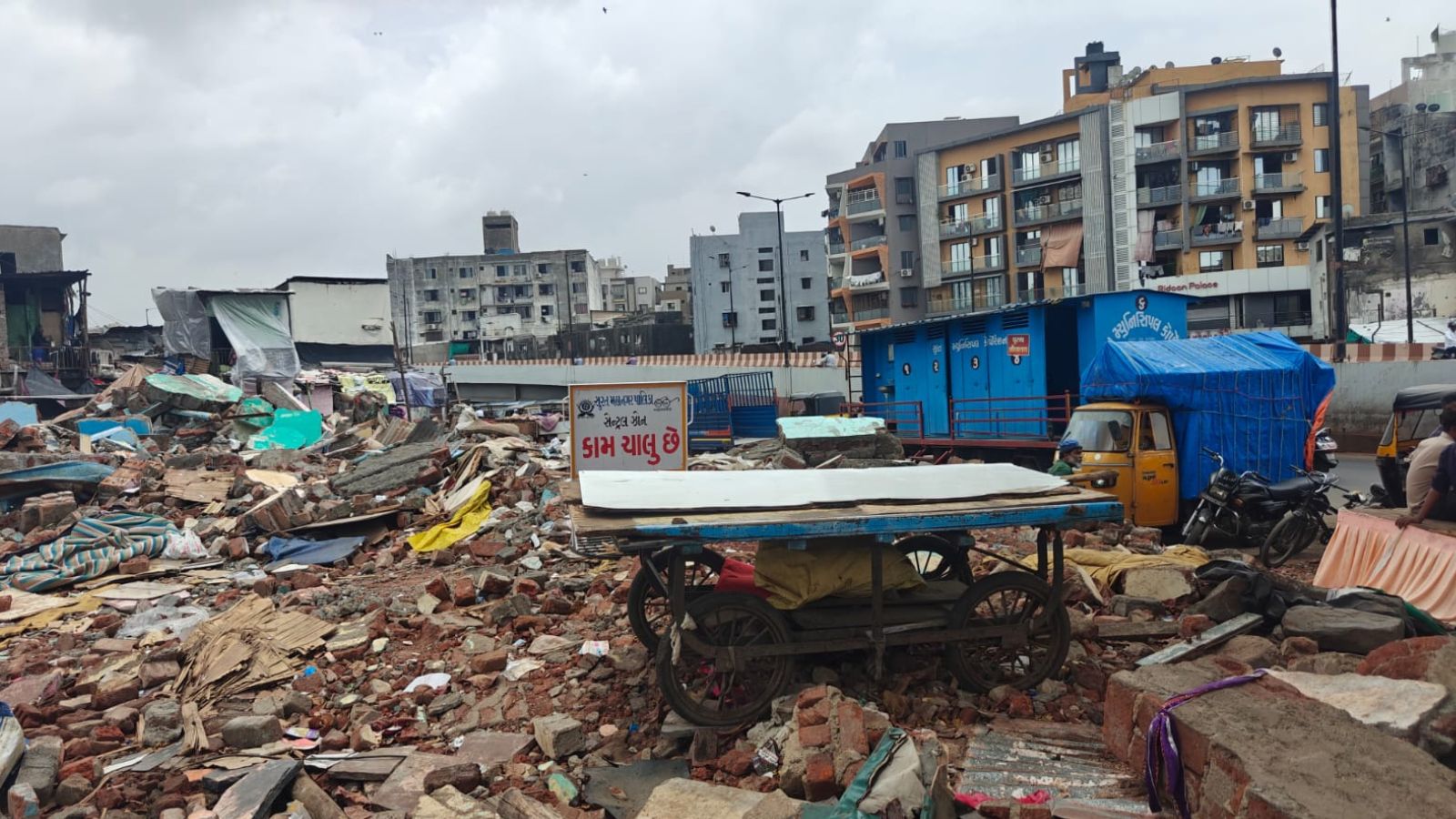
In an unprecedented move following the controversial May 30 demolition drive at Surat s Nasir Nagar, the Gujarat government Tuesday proposed providing government housing at its own expense to 29 families whose homes were completely razed, and restoring 35 part In an unprecedented move following the controversial May 30 demolition drive at Surat s Nasir Nagar, the Gujarat government Tuesday proposed providing government housing at its own expense to 29...
In an unprecedented move following the controversial May 30 demolition drive at Surat’s Nasir Nagar, the Gujarat government Tuesday proposed providing government housing at its own expense to 29 families whose homes were completely razed, and restoring 35 partially damaged structures at the site.
Advocate General Kamal Trivedi presented the proposal to the Gujarat High Court, based on a recent survey conducted by the state authorities. The submission came during the first hearing following the transfer of Surat Municipal Commissioner M Nagarajan and a sharp rebuke from the High Court over the state’s earlier rehabilitation plan, which would have forced victims to pay Rs 5.5 lakh each for government housing.
Appearing before the bench of Justice Nikhil Kariel, the Advocate General stated that a survey assessing the site’s condition revealed that 29 structures were entirely cleared, while 35 were “partially affected” but remained “habitable” and “could be repaired”,
“My instructions are that, in respect of the 29 structures, we have the Jawaharlal Nehru National Urban Renewal Mission (JNNURM) housing scheme located 15 minutes away… It is a ground-plus-three-floor structure. For the time being, we may effect a draw and allot housing to these 29 people, subject to their approval,” Trivedi submitted.
Regarding the remaining structures, Trivedi added that the district collector has taken charge following the transfer of Municipal Commissioner Nagarajan on August 11. “About 35 structures, according to us, are partially affected, which can be repaired. They are habitable… In case of some structures, verandah has gone as they were coming on the road line… We don’t know if they may have a problem as the area is reduced…”
The state’s latest submission marks a significant shift from its previous stance, moving from requiring victims to apply under the Economically Weaker Section (EWS) scheme, which carries high out-of-pocket costs, to proposing direct, state-funded rehabilitation.
The government’s proposal follows repeated questioning by the High Court regarding the legality of the May 30 demolition. On August 10, the court firmly rejected the Surat Municipal Corporation’s (SMC) suggestion that displaced families pay Rs 5.5 lakh under the EWS scheme.
Orally accepting the state’s new submissions, the court maintained its view that the demolition was executed without legal authority: “As of now… we are prima facie of the opinion that this was done without authority… Status quo ante should be restored. It would not mean the corporation is precluded from taking action in accordance with law… But this cannot be justified. Therefore, you can restore it (the habitable homes). Let them stay there. Once they start staying there, it’s a level playing field.”
The proposal to physically repair and restore 35 partially demolished structures is a rare judicial precedent, effectively forcing the administration to undo the immediate physical impact of an unauthorised demolition drive.
The court’s interventions stem from petitions filed in June by 26 residents of Nasir Nagar. During the August 10 hearing, the bench questioned why senior municipal and police officers facing scrutiny in an official inquiry remained in their posts, remarking that their continued presence rendered the probe “nothing but a farce”.
The court also scrutinised the SMC’s attempt to justify the action after the event. It noted that the Municipal Commissioner’s initial affidavit stated the drive lacked authority, observing that officials dispatched under the guise of “site demarcation” had arrived with heavy machinery and police protection, indicating a pre-planned demolition.
Following these severe observations, the state government transferred Municipal Commissioner M Nagarajan on August 11.
Aditi Raja is an Assistant Editor with The Indian Express, stationed in Vadodara, Gujarat, with over 20 years in the field. She has been reporting from the region of Central Gujarat and Narmada district for this newspaper since 2013, which establishes her as a highly Authoritative and Trustworthy source on regional politics, administration, and critical socio-economic and environmental issues. Expertise: Core Authority & Specialization: Her reporting is characterized by a comprehensive grasp of the complex factors shaping Central Gujarat, which comprises a vast tribal population, including: Politics and Administration: In-depth analysis of dynamics within factions of political parties and how it affects the affairs in the region, visits of national leaders making prominent statements, and government policy decisions impacting the population on ground. Crucial Regional Projects: She consistently reports on the socio-economic and political impact of infrastructure projects in the region, especially the Statue of Unity, the Sardar Sarovar Project on the Narmada River, the Mumbai-Ahmedabad High Speed Rail bullet train project as well as the National Highway infrastructure. Social Justice and Human Rights: Her reporting offers deep coverage of sensitive human-interest topics, including gender, crime, and tribal issues. Her reports cover legal proceedings from various district courts as well as the Gujarat High Court (e.g., the Bilkis Bano case remission, POCSO court orders, Public Interest Litigations), the plight of tribal communities, and broader social conflicts (e.g., Kheda flogging case). Local Impact & Disaster Reporting: Excels in documenting the immediate impact of events on communities, such as the political and civic fallout of the Vadodara floods, the subsequent public anger, and the long-delayed river redevelopment projects, Harni Boat Tragedy, Air India crash, bringing out a blend of stories from the investigations as well as human emotions. Special Interest Beat: She tracks incidents concerning Non-Resident Gujaratis (NRIs) including crime and legal battles abroad, issues of illegal immigration and deportations, as well as social events connecting the local Gujarati experience to the global diaspora. ... Read More