Pakistan Driverless Car Crashes Police Van Islamabad D Chowk Viral Video
I
Indian ExpressVerified Publisher
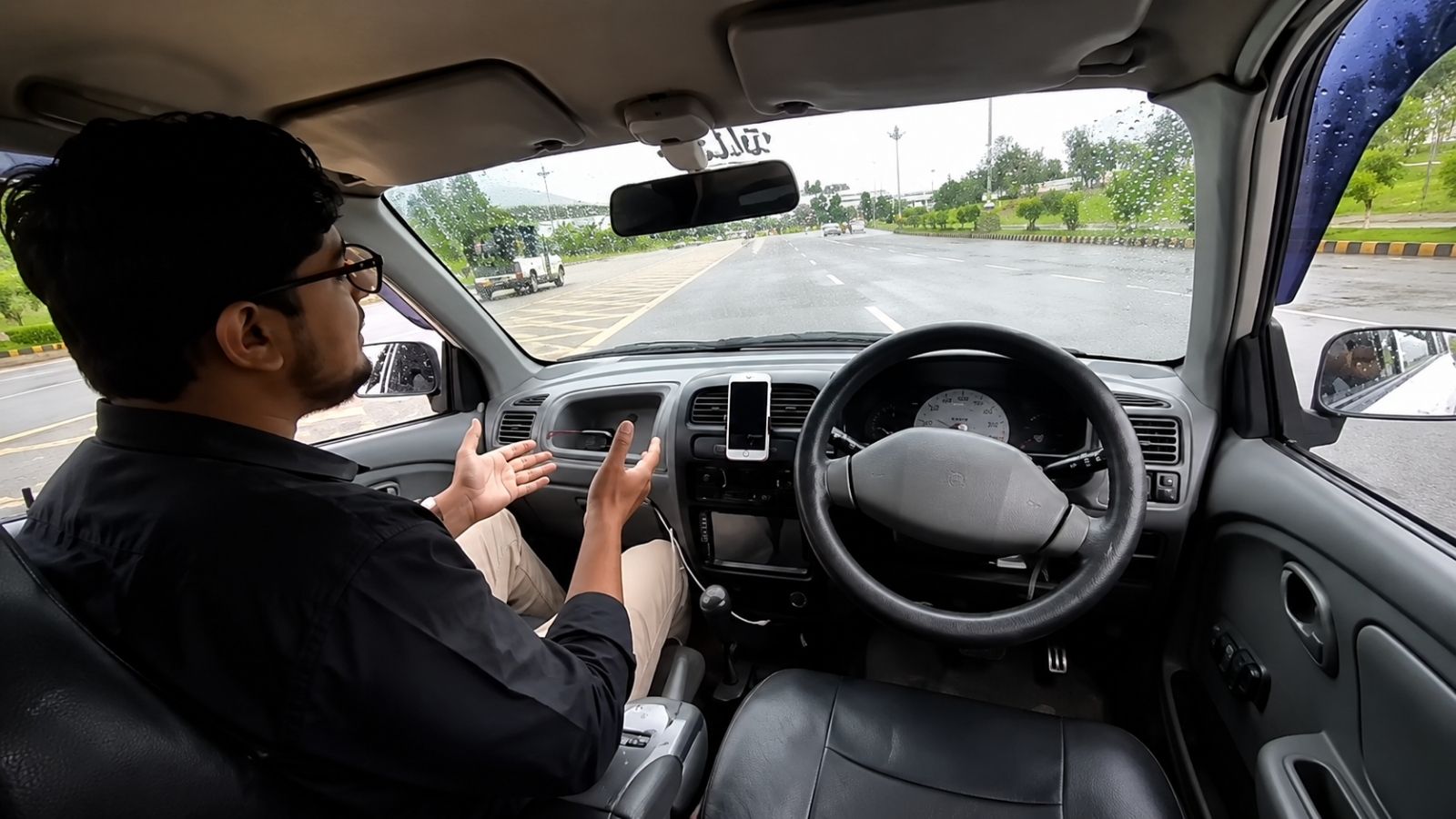
A remotely controlled car, a journalist in the passenger seat and one wrong turn a demonstration of a Pakistani student s experimental driverless vehicle ended with the car crashing into a parked police van in Islamabad. A Pakistani journalist Muhammad Aalijah A remotely controlled car, a journalist in the passenger seat and one wrong turn a demonstration of a Pakistani student s experimental driverless vehicle ended with the car crashing into a parked...
A remotely controlled car, a journalist in the passenger seat and one wrong turn — a demonstration of a Pakistani student’s experimental driverless vehicle ended with the car crashing into a parked police van in Islamabad.
A Pakistani journalist Muhammad Aalijah uploaded a video of the demonstration on Sunday, showing him sitting in the front passenger seat as the remotely controlled vehicle moved through Islamabad’s D-Chowk. The car suddenly turned towards a parked police vehicle, prompting Aalijah to pull the handbrake, but he could not stop the collision.
Aalijah was seated in the front passenger seat of the vehicle while demonstrating its automated driving technology. The car appeared to be controlled remotely as it moved forward, but its steering suddenly went out of control, and the vehicle collided with a police van parked nearby.
Aalijah was seen attempting to stop the car by pulling the handbrake, but was unable to prevent the collision.
The timing made the video even more striking. As Aalijah declared that “there is no shortage of talent in Pakistan”, the car veered towards the police van. He then desperately pulled the handbrake, but the vehicle crashed into it.
The initial explanation given by journalist Muhammad Aalijah was that an internet disruption had caused the remotely operated vehicle to lose control. However, the student behind the project later gave a different account, saying the wrong control key was pressed during the demonstration, causing the car to turn left instead of right and into the path of the police vehicle.
“Everything was fine until a technical fault occurred due to an internet disruption, causing the car to go out of control and crash into a police vehicle,” he said.
The vehicle was not fully autonomous: the inventor said it was remotely controlled through an internet-connected application, with a camera allowing the operator to see the surroundings.
Aalijah later said the video was intended as a warning about the risks of testing experimental technology before it is fully proven safe. He said he did not intend to discredit the young inventor and described the footage as an effort to encourage caution.
“The sole purpose was to raise awareness and urge people to remain cautious until any new experiment or technology has been thoroughly tested, proven safe and established as a complete success,” he said.
“This was a message of caution, not an attempt to discredit anyone.”
Aalijah said the vehicle’s system was not yet “completely safe and reliable”.
“The vehicle was being operated through satellite and internet connections, but during external control, it went out of control as soon as the internet connection was disconnected and collided with a police vehicle,” he wrote.
Aalijah noted that the incident occurred in a high-security area where traffic was limited, but warned that a similar malfunction elsewhere could have much more serious consequences.
“If the same situation had occurred on a busy road, the consequences could have been extremely dangerous, even fatal,” he said.
“This video is not criticism; it is a responsible effort to raise awareness and issue a warning — by all means, experiment, but ensure safety first,” he added.
Explaining what went wrong, Zafar said he was preparing to demonstrate the vehicle near the police car when the wrong control key was pressed. The command caused the vehicle to turn left rather than right, sending it into the path of the parked police vehicle.
The footage quickly spread across social media, drawing both appreciation for the technological experiment and a stream of humorous reactions.
“Certainly, there is no shortage of talent in Pakistan,” one user wrote, quoting Aalijah in a jibe.
Another user joked that even AI panics in Pakistan when it sees the police.
Some users, however, encouraged the technology enthusiast behind the project not to abandon the effort.
“Funny for some, maybe, but I see a great effort. It failed today; yes, hiccups happen, but I know this young Pakistani will one day have a perfect solution.”
Despite the crash, Zafar said he planned to continue working on the project. “I am going to try to keep working in this field and continuing practical work, and help make Pakistan’s name in the entire world,” he said.
The Express Global Desk at indianexpress.com which delivers authoritative, verified, and context-driven coverage of key international developments shaping global politics, policy, and migration trends. The desk focuses on stories with direct relevance for Indian and global audiences, combining breaking news with in-depth explainers and analysis. A major focus area of the desk is US immigration and visa policy, including developments related to student visas, work permits, permanent residency pathways, executive actions, and court rulings. The Global Desk also closely tracks Canada’s immigration, visa, and study policies, covering changes to study permits, post-study work options, permanent residence programmes, and regulatory updates affecting migrants and international students. All reporting from the Global Desk adheres to The Indian Express’ editorial standards, relying on official data, government notifications, court documents, and on-record sources. The desk prioritises clarity, accuracy, and accountability, ensuring readers can navigate complex global systems with confidence. Core Team The Express Global Desk is led by a team of experienced journalists and editors with deep expertise in international affairs and migration policy: Aniruddha Dhar – Senior Assistant Editor with extensive experience in global affairs, international politics, and editorial leadership. Nischai Vats – Deputy Copy Editor specialising in US politics, US visa and immigration policy, and policy-driven international coverage. Mashkoora Khan – Sub-editor focusing on global developments, with a strong emphasis on Canada visa, immigration, and study-related policy coverage. ... Read More