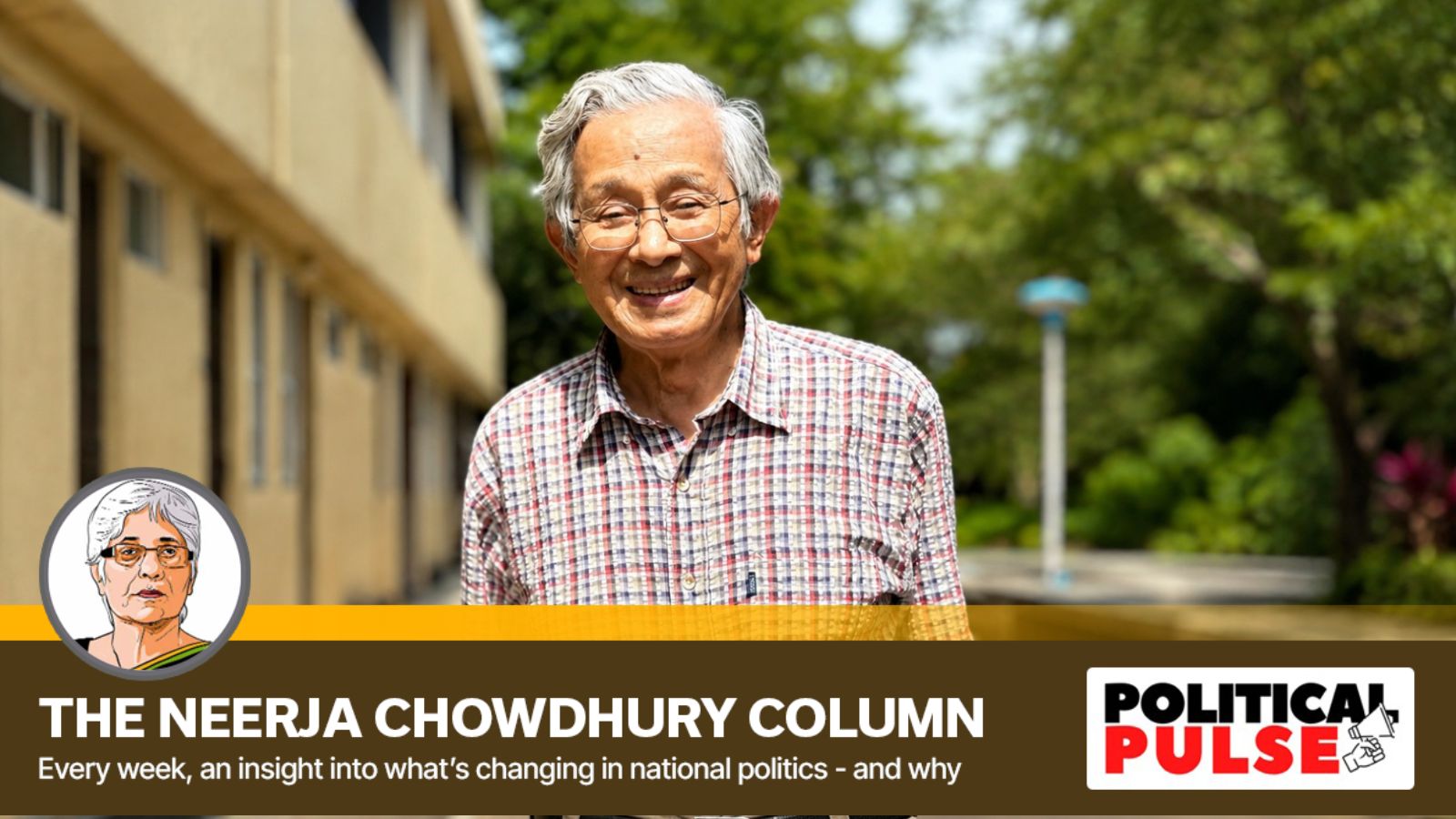
We work with people professionally all our lives, but it is only a few who really touch us in a meaningful way. Niketu Iralu from Nagaland, who died in a hospital in Delhi on August 18 at the age of 91, was such a figure who touched the lives of countless peop We work with people professionally all our lives, but it is only a few who really touch us in a meaningful way. Niketu Iralu from Nagaland, who died in a hospital in Delhi on August 18 at the age of...
We work with people professionally all our lives, but it is only a few who really touch us in a meaningful way.
Niketu Iralu from Nagaland, who died in a hospital in Delhi on August 18 at the age of 91, was such a figure who touched the lives of countless people he met.
Niketu belonged to a prominent Nagaland family – his father Sevilie Iralu was among the first Naga doctors and his maternal uncle Angami Zapu Phizo led the Naga National Council (NNC) which declared Nagaland’s independence on August 14, 1947. He however chose another path – and came to be known as a peace activist dedicated to the pursuit of solutions through non-violence, dialogue and reconciliation.
I met Niketu Iralu in Delhi first in the mid-1960s. He became my introduction to the Northeast. In 1968, he took me and Kalpana Sharma, both aspiring journalists then, to Chedema perched on a hilltop surrounded by lush green vegetation, not far from Kohima. A peace camp had been set up there which had negotiated a ceasefire in 1964 between the rebel Naga Federal Government and the Government of India, kindling hopes of a resolution after years of insurgency by those demanding a sovereign Naga state.
For the first time I got a glimpse into the history of the Naga struggle and their aspirations, and the challenges facing the Indian government — a conflict which has not yet found a solution though a new ministerial panel was formed by the Centre last week to take forward the stalled talks.
Our Chedema visit was a discovery of the colourful tapestry of tribes and communities that make up the Northeast region – a confluence of diverse races, a gateway to Southeast Asia connected to the rest of India by a narrow “chicken’s neck”.
In many ways, Niketu came to be a bridge between the Naga people and the rest of India. When Phizo died in April 1990 in London, Niketu was asked by the NNC leaders to help them get his body back to India. Phizo had been in exile since 1960 when he left for the UK to mobilise world opinion for the Naga cause.
The V P Singh government was then at the helm in Delhi. Rajmohan Gandhi, grandson of Mahatma Gandhi, was a Janata Dal Rajya Sabha MP, and Niketu’s friendship with him went three decades back as they had worked together in an organisation, Initiatives of Change, to bring about social transformation through “personal change”.
One of the enduring images I have of Niketu is of him getting out of a Maharashtra state transport bus in which our group were travelling, and rushing to a wash room at a village stop – cleaning it with water and bare hands, for all of us to use. The gesture reflected his care, and respect, for other people.
Humour and music were his language, and it endeared him to the young and old alike. He used to describe his first encounter with mainland India when he left for Madras Christian College in the 1950s for studies: “When I reached Kolkata… the number of people trying to board the train made me say to myself we have no chance to survive in this – India, which has so many people!”
Even on his hospital bed a day before he passed away, he joked about the balding head of one of his old friends who had rushed from Pune to see him, and then clung onto his hand. While deeply committed to his people, he had befriended many across India.
A Naga elder associated with many prominent organisations in the Northeast, who was recipient of several prestigious awards including the Bhupen Hazarika Integration Award, Niketu’s work deepened the idea of peace and reconciliation today in the midst of spiralling global conflicts. This was summed up in a tribute in Ukhrul Times by a young writer Markson V Luikham, who never met him but was in touch with him on the phone and through emails. “He was a deeply human man who spent decades asking Nagas to… confront their failures, resist hatred and recover the courage to listen.” Niketu did not see reconciliation as weakness, he wrote, adding that to him moral courage also involved “telling one’s own side what it does not want to hear”.
And now he lies in rest, forever under those Nagaland stars, as he wanted to, in the garden of his house in Sechu Zubza.
(Neerja Chowdhury, Contributing Editor, The Indian Express, has covered the last 11 Lok Sabha elections. She is the author of ‘How Prime Ministers Decide’.)