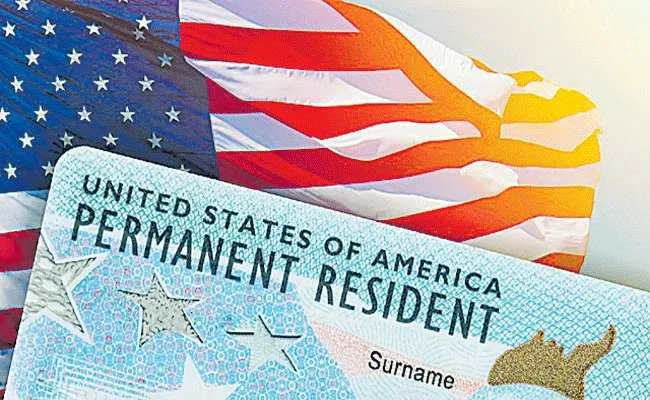
Immigrants applying for green cards or permanent residency in the United States could face fresh hurdles after the Trump administration expanded the definition of public charge , allowing immigration officers to consider a wider range of government benefits wh Immigrants applying for green cards or permanent residency in the United States could face fresh hurdles after the Trump administration expanded the definition of public charge , allowing...
Immigrants applying for green cards or permanent residency in the United States could face fresh hurdles after the Trump administration expanded the definition of “public charge”, allowing immigration officers to consider a wider range of government benefits while deciding applications.
The new rule, finalised by the US Citizenship and Immigration Services (USCIS), will come into effect from September 18 and could also affect Indian applicants seeking green cards.
Under the earlier rule, only two types of public benefits were mainly considered while determining whether an applicant could become a public charge: cash assistance for income maintenance and long-term institutional care paid for by the government.
Under the expanded guidelines, USCIS officers will be able to consider several additional factors while assessing whether an applicant is likely to become dependent on government assistance.
These may include the applicant’s use of means-tested public benefits such as cash assistance, housing support, food stamps, financial aid for college and similar benefits.
The new guidance follows the Department of Homeland Security’s decision to withdraw the 2022 Biden-era public charge regulations.
The final rule was announced on July 16 and published in the Federal Register on July 20.
It will apply to Form I-485 applications for permanent residency or adjustment of status that are postmarked or electronically submitted on or after September 18.
The new rule gives USCIS officers wider discretion to consider factors such as an applicant’s age, health, family status, financial condition and educational background.
In some cases, officers may also consider the use of public benefits by an applicant’s dependents while assessing the green card application.
If an applicant is found inadmissible only because of concerns that he or she may become a public charge, USCIS may allow the applicant to submit a public charge bond.
Immigration attorneys Cyrus Mehta and Damira Zhanatova have said the rule could give immigration officers greater discretion while deciding adjustment-of-status applications.
According to the Kaiser Family Foundation, about 13.5 million Medicaid or CHIP enrollees live in households with at least one non-citizen, including around 5.6 million US citizen children.
The organisation estimates that between 1.4 million and 4.1 million Medicaid and CHIP enrollees living with a non-citizen could leave the programmes because of concerns linked to the new public charge rule.
A large number of immigrants are exempt from the public charge rule.
These include refugees and asylees, certain Afghan and Iraqi nationals who worked with the US government, certain Cuban and Haitian entrants, special immigrant juveniles, victims of human trafficking, victims of qualifying crimes, certain Violence Against Women Act self-petitioners and applicants for Temporary Protected Status, among others.
Indian nationals form a significant share of US green card recipients.
Of nearly 1.2 million people who received green cards in 2023, around 78,100, or about 7 per cent, were from India.
Around 60 per cent of Indian green card recipients that year obtained permanent residency either as immediate relatives of US citizens or green card holders, or through other family-based categories.
The expanded public charge rules could therefore become an important issue for some Indian families applying for permanent residency in the United States, especially those who have used certain forms of government assistance.
For Indian students in the United States, the American dream has traditionally followed a familiar path. Students arrive to study at universities, complete their degrees,…
Parents applying for U.S. visas for their children must ensure that the child is physically present for the consular interview, even if the applicant is…
A long-time Indian-origin US resident and Green Card holder has been detained by Immigration and Customs Enforcement (ICE), triggering concern among her family and supporters.…